Apple is going to be mad...
Audio Summary
AI Summary
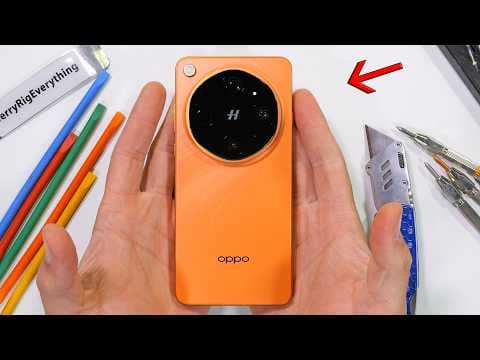
The Oppo Find X9 Ultra is presented as the "most ultra" smartphone, featuring a striking creamsicle orange back panel and a camera island reminiscent of Pangaea. Oppo claims its main camera has the largest sensor ever in a smartphone. The box includes a 100-watt fast charging brick, a USB-C cable, a SIM tool, and a free case.
The phone's front features an interactive background. Its Gorilla Glass Victus 2 screen scratches at level six and seven on the Mohs scale, protecting the 50-megapixel selfie camera. The golden anodized aluminum sides, officially "Canyon Orange," house the upper loudspeaker, microphone, and a programmable button. The bottom features a SIM card tray with a red rubber ring for IP66/68/69 water and dust resistance, a 100-watt USB-C port, and a bottom loudspeaker.
Interestingly, the phone's back is plastic, which is touted for increasing durability and repairability, a departure from typical "Ultra" or "Pro" devices. The dual diffused LED flash is also plastic-covered. The entire back is designed to look like a giant camera, housing a 50-megapixel 10x telephoto camera with sensor shift technology, a 200-megapixel main camera with the largest sensor, another 200-megapixel 3x telephoto, a 50-megapixel wide-angle camera, and a fifth hidden camera for consistent colors and tones.
The screen boasts 1 billion colors, 2K resolution, 1,800 nits, and a 144 Hz refresh rate, outperforming Apple and Samsung high-end phones. It withstands a lighter's heat for 25 seconds without permanent damage. The X9 Ultra is incredibly rigid, surviving bending attempts, reinforcing the benefit of its plastic back.
Disassembly reveals seven silver screws and fifteen black screws holding down the top plastics. The main camera units dominate the internal space. The phone supports 50-watt wireless charging, twice as fast as Apple and Samsung. The 750 mAh silicon-carbon battery has nearly double the capacity of an iPhone 17 Pro. The lower loudspeaker plastics contain internal components, including two gold microphones and a red rubber ring around the 100-watt USB-C 3.2 port, with mesh and watertight films ensuring waterproofing. The haptic vibrator is behind the under-screen ultrasonic fingerprint scanner.
The main board houses the 50-megapixel wide-angle camera (without OIS), a massive 200-megapixel 3x telephoto camera with internal OIS and its own cooling system on the vapor chamber, and another 200-megapixel main camera with internal OIS. The "Kinguple Prism Reflection" 10x periscope telephoto camera features internal sensor shift stabilization, a technology also seen in iPhones. This allows for 5,000 micro-adjustments per second by shifting the sensor, making it five times faster and more efficient than normal OIS. Oppo's sensor floats and shifts on a magnetic field.
The motherboard is uniquely square, designed as a bezel for the centrally located cameras and housing the Snapdragon 8 Elite Gen 5 chip. Unfortunately, this top-of-the-line smartphone is not available in the USA. Reassembling the phone without its telephoto camera resulted in a complete loss of camera functionality, suggesting an "all or nothing" camera system.