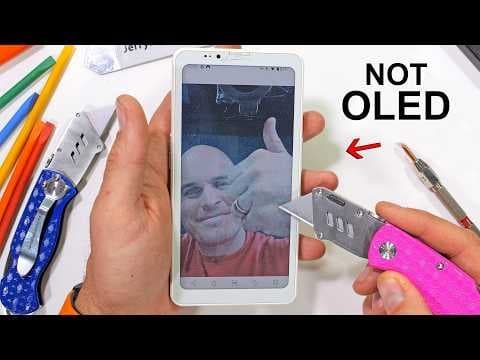
Worlds FIRST Color E Ink Smartphone - Durability Test!
Audio Summary
AI Summary
This video showcases the BigMe Hyreak Pro, touted as the world's first color e-ink smartphone, and explores its unique features and durability. Unlike traditional smartphones with vibrant LCD or OLED screens, the Hyreak Pro utilizes e-ink technology, which offers a different viewing experience with lower pixel density (150 pixels per inch for color, compared to an iPhone's 460). The primary advantage of e-ink is its power efficiency; the pixels require no power to maintain their position, similar to an Etch A Sketch. This means the screen can remain on indefinitely without draining the battery, and the last displayed image will persist even if the phone powers off or the battery dies.
The phone runs a full Android operating system and can load standard apps. However, the e-ink display's refresh rate is significantly slower, around 21 Hz, with noticeable ghosting. When viewed under a microscope, the colored pixels are revealed to be pigment pouches. The white background demonstrates the presence of red, green, and blue portions within each pixel. Swiping on the screen shows the pixel transition, which occurs relatively quickly with minimal ghosting, considering the technology. The video highlights the e-ink's function by displaying a YouTube video, albeit without the flashiness of conventional displays, which the presenter suggests might be beneficial for reducing smartphone addiction.
The durability of the Hyreak Pro is put to the test. The pre-installed plastic screen protector is removed, revealing a plastic laminate layer underneath that scratches at a level two, with deeper grooves at level three, consistent with plastic screen behavior. The presenter notes that this is acceptable, as long as users keep keys and smartphones separate. The phone's construction appears to be primarily plastic, including the large bezels and earpiece. The 5-megapixel front-facing camera, protected by a glass lens, is surprisingly good. However, the 20-megapixel rear camera's performance is described as significantly worse, akin to being "slathered in Vaseline," though this is attributed to the out-of-the-box software.
The phone's body is made of polished plastic, with metal buttons, including a distinctive red fingerprint-scanning power button. An IR blaster is also present. The left side features the volume rocker, and the bottom houses a loudspeaker, a USB-C port for 18W fast charging, and a metal SIM card tray without water ingress protection. Interestingly, the back of the phone is made of real glass, which adds weight and feels normal, but its presence alongside so much plastic is deemed unusual, especially given glass's propensity to break.
The video also touches upon app compatibility with e-ink displays. Not all apps render equally well, particularly those with fine lines or detailed graphics. The sponsor, NordVPN, is used as an example. While the app functions, the map representation is less clear on the e-ink screen compared to a Samsung phone. The presenter explains NordVPN's functionality in securing internet traffic and allowing users to appear virtually anywhere in the world.
A key technical detail revealed is that while the color resolution is 150 pixels per inch, for black and white images or text, the resolution doubles to 300 pixels per inch, approaching that of regular smartphones. This is because the colored pigment pouches occupy more space than monochrome ones.
The durability test culminates in a bend test. The phone emits a loud crack when bent from the front, and while no visual damage is immediately apparent, it renders the phone inoperable, indicating internal failure. The Hyreak Pro is officially declared "highly broken."
Following the breakage, the video offers an inside look. Removing the back glass is challenging due to a foaming permanent adhesive, making repairs messy. After unscrewing numerous screws, the back plastic separates from the screen and motherboard. The 4,500 mAh battery is disconnected, yet the display stubbornly retains its last image. Even after removing the motherboard and processor, the display remains active, confirming the e-ink's non-volatile nature. The rear camera lacks optical image stabilization, and the speaker is basic. The charging board has a rubber ring, but no overall water resistance is present.
The video reveals that the plastic layer melted during the scratch test is a permanent laminate over a glass slab. Remarkably, even after removing this glass layer, the e-ink pixels remain intact. Further disassembly uncovers the colored pigment pouches within a flexible rubber membrane, situated above the black and white e-ink layers. These become vulnerable once exposed. The video concludes by questioning whether viewers would adopt an e-ink smartphone and encouraging subscriptions.