Closed
Audio Summary
AI Summary
The speaker emphasizes the transformative power of automated trading and coding, asserting that it's a great equalizer allowing anyone to become a fully automated trader, even without prior coding experience. He provides a framework for building bots and offers four specific bot tutorials. The core message is to move away from emotional, manual trading, which often leads to losses, towards a quantitative, automated approach.
The speaker shares his personal journey, beginning as a basketball player who initially avoided coding by hiring developers. He built a successful app business but realized the limitations of manual trading, especially with high leverage in crypto. This led him to learn coding himself, inspired by an algorithmic trader managing a billion dollars daily. He dedicated four hours a day for a year to learn to code and then adapted to using AI for development, becoming an early adopter of tools like Cloud Code.
His framework for automated trading consists of three main steps:
1. **Research Trading Strategies**: Find great ideas from various sources like books (e.g., Market Wizards), Google Scholar, podcasts (e.g., Chat with Traders), and YouTube. The key is to constantly generate and explore new ideas.
2. **Backtest Ideas**: Test these ideas against historical data to see if they would have worked in the past. While Polymarket can be challenging for extensive backtesting due to its novelty, other markets like stocks, futures, and crypto offer abundant data. The speaker highlights his Moondev app, which allows users to backtest strategies with a click of a button, demonstrating examples of both profitable and losing strategies.
3. **Incubate with Small Size**: If a strategy shows promise in backtesting, deploy it with a very small amount of capital (e.g., $5) to test it in a live market without significant risk. This incubation phase is crucial for Polymarket bots where backtesting might be limited.
The speaker introduces several bots he has built, emphasizing their application on Polymarket, a platform he finds exciting due to its diverse and often unconventional markets. He notes that Polymarket offers opportunities that even legendary algorithmic traders like Jim Simons didn't have, such as trading on various sports or even political outcomes.
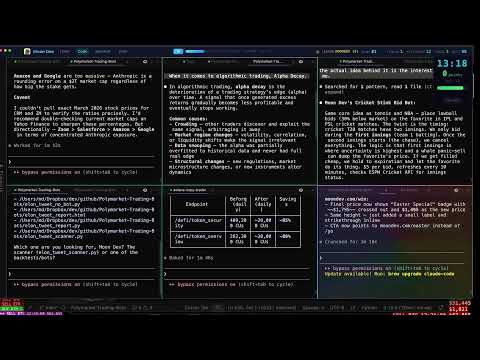
One specific bot highlighted is the **WTA Tennis Stink Bid Bot**. The idea behind this bot is to place "stink bids" – low-ball bids (e.g., 30% below market price) on the favored player in women's tennis matches. The bot aims to scoop up shares cheaply if a "whale" (large trader) panic-sells during a match, dumping the price. Since the favorite usually wins, the bot holds these shares to expiration, collecting a full dollar for shares bought at a discount. The bot refreshes every 15 minutes and focuses on WTA matches (best out of three games) due to their higher volatility, which the speaker believes creates more opportunities for upsets and discounted entries. A critical risk control mentioned is to cancel all existing orders before placing new ones to prevent over-ordering and account drainage.
Another bot discussed is the **Cricket Stink Bid Bot**. Similar to the tennis bot, it places low-ball bids (30% below market) on the favored team in IPL and PSL cricket matches. The unique timing twist is that bids are only placed during the first inning (team one batting) when uncertainty is highest. All bids are canceled once the second inning (the "chase") begins. The logic is that the first inning presents the best opportunity for a panic sell from a whale, allowing the bot to acquire shares at a discount.
The speaker also introduces the **Kalshi Whale Scanner**. This tool is designed to identify "whale" trades (over $1,000) on the Kalshi platform by scanning its API. The purpose of this scanner is to observe what liquid markets and assets large traders are investing in, providing ideas for new bot strategies. By following these whales, the speaker generates ideas for bots like his tennis bot, Elon bot, weather bot, and eSports bot. The scanner also automatically saves market data to a CSV for long-term research. He stresses that this scanner is a crucial first step for anyone looking to build bots for Kalshi.
A key philosophy shared by the speaker, inspired by Jim Simons, is to "do what others are not doing." In an industry where most traders are secretive about their strategies, he chooses to be transparent, sharing his code and ideas with his community. He believes this community-based approach, where members learn from each other and compete, leads to collective improvement and better results. He acknowledges the concept of "alpha decay," where a trading strategy's edge diminishes as more people exploit it, but he emphasizes providing the tools and framework for individuals to develop their *own* ideas, rather than simply plug-and-play solutions.
The speaker encourages listeners to embrace the identity of a "quant" (quantitative trader), moving beyond emotional, manual trading, which he views as a "waste of energy for ambitious people." He highlights that successful trading in modern markets is dominated by automated systems, not individual discretion. He offers access to his Discord community and resources on his website (moondav.com/easter) for those eager to learn and implement these automated trading strategies, emphasizing a money-back guarantee for his educational content.