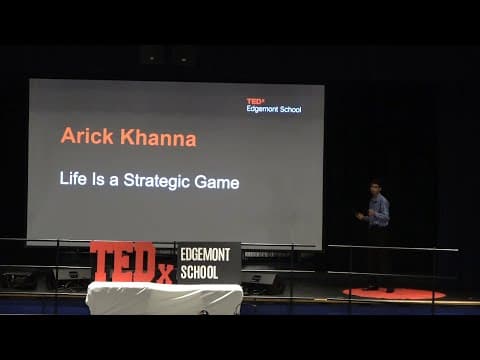
Life Is a Strategic Game | Arick Khanna | TEDxEdgemont School
Audio Summary
AI Summary
Life often presents significant challenges, leading to widespread stress, anger, depression, and anxiety, particularly among high school teens, according to the American Psychological Association. Yet, some individuals push through problems, remaining steady under pressure, while others struggle or crumble. This difference in reaction to similar difficult situations, such as an upcoming test, a conflict with a friend, or rejection from a sports team, highlights a crucial distinction in approach. One student might react emotionally, viewing challenges as unfair, personal, or permanently defining, while another experiences a more positive day despite the same obstacles. This distinction can be understood by treating life itself as a complex game involving strategy, reasoning, effort, and luck.
In this game of life, every move has a cost in time, energy, and attention, necessitating wise responses to situations. Obstacles are an inevitable part of the game, coming from the system and other players, and often feeling unfair or nonsensical. Just as one wouldn't expect a clear path in a strategy game, challenges are to be anticipated in life. However, people often expect everything to go smoothly, and when things go wrong, they complain as if the "game has broken." The most effective players don't resist these obstacles but rather pause, step back, analyze the situation, and ask what the best next move is to achieve their goals.
Crucially, these players recognize they are not pawns but the players controlling them. They don't identify themselves with every emotional setback, avoiding the equivalent of going bankrupt in a game of Monopoly. Instead, they take charge of themselves, using emotions as feedback rather than being controlled by them. This skill, known as self-distancing, involves observing situations from an objective, outside perspective. Studies show that self-distancing lowers stress levels and improves emotional regulation in tense situations, enabling individuals to realize that not every conflict is worth engaging in.
In real life, people often waste vast amounts of energy reacting to minor issues that don't truly matter. Such reactions consume limited resources like time, attention, and emotional energy. Skilled players understand which battles will advance them toward their goals and ignore those that are merely distracting. Like a poker master, they know when to engage and when to withdraw, even in conflicts with loved ones or in competitive situations. They avoid taking things personally, instead listening and perceiving before acting, understanding that others are also navigating the same complicated game. This approach, relying on communication and trusted guidance, is key to mitigating conflict and fostering mutual understanding.
A powerful shift also occurs when failure is viewed differently. In games, losing is a normal part of learning, providing immediate information for future strategies. In life, however, failure often feels heavier, leading individuals to define themselves by it or conclude they are incapable. Instead, failure should be treated as information about the strategies employed. Rather than asking "What's wrong with me?", the more productive question is "What does this result tell me about the strategy I used?" This perspective keeps the game moving forward, allowing players to adapt and create new, more successful strategies, rather than suffering or spiraling. Research confirms that learning from setbacks is vital for long-term success and resilience. A West Point study even found that grit—responding to setbacks and persisting toward goals—was a major predictor of student success.
The detachment inherent in a gameplay mindset means that effective players focus on what they *can* control, rather than external factors like other players, circumstances, or luck. They concentrate on making moves that will help them win and achieve long-term goals. When life is approached as a game, individuals stop waiting for things to get easier and instead learn to play better. The student who initially felt overwhelmed by a midterm paused, assessed the situation, and made the best move. When ignored by a friend, he understood the cause and resolved it. After being cut from the soccer team, he accepted what he couldn't control and adjusted his strategy for the next season. Players who pause before reacting, choose their battles wisely, and maintain mental space for strategic thinking gain not just success, but control over their minds—a powerful advantage in a world full of distractions, difficulties, conflicts, and unpredictable events.