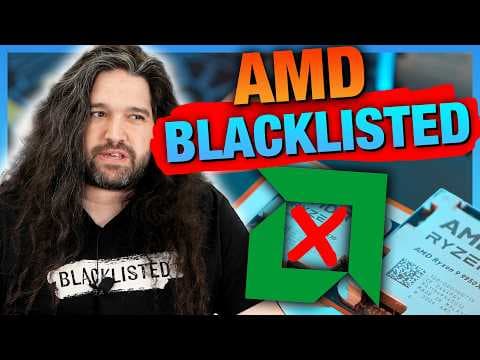
BLACKLISTED by AMD | AMD's Dirty Tactics
Audio Summary
AI Summary
The video discusses AMD's decision to blacklist the content creators from receiving samples and early information about their new 9950X3D2 CPU. This action is seen as a direct consequence of the creators' critical reporting on AMD's alleged involvement in political corruption and anti-consumer practices.
The creators explain that being blacklisted is not a new occurrence for them, having faced similar situations with Nvidia in the past due to their refusal to comply with implicit threats regarding favorable coverage of DLSS. This time, the exclusion from AMD seems to stem from their reporting on AMD's participation in what they term the "Council of Corruption," which involves questionable political contributions and associations.
Specifically, the reporting highlights AMD's donation of $1 million to the MAGA Inc. super PAC, a move that appears to violate AMD's own corporate policies against political activity outside of its employee-funded pack. The creators also point to AMD CEO Lisa Su's attendance at a Melania Trump movie premiere, which reportedly generated significant profits for the Trump family, and her presence on the "Council of Corruption" alongside figures like Jeffrey Epstein associate Howard Lutnik and Nvidia CEO Jensen Huang. Furthermore, AMD's alleged support for policies that reduce clean air and water regulations related to data center construction, and their engagement with lobbying firms that represent surveillance companies like Flock Safety and Palantir, are scrutinized.
The creators detail how they have attempted to get answers from AMD for months regarding these issues, including inquiries about driver support for the Z1 SOC found in the Asus ROG Ally, but have been met with silence. This lack of response, even to seemingly innocuous questions, has led AMD to shift them to a third-party PR agency, which the creators interpret as a personal affront for hurting their feelings.
Despite the sampling ban, the creators state they are not entitled to samples and can procure hardware themselves, albeit with a slight delay in their review. They emphasize that they will not compromise their journalistic integrity to obtain samples or publish reviews. The timing of AMD's actions, coinciding with the creators' questions about sensitive political and corporate matters, is deemed highly suspicious and indicative of them being "over the target."
The video also promotes the creators' online store, store.gamerex.net, as a means of support, especially as companies increasingly shun them. Various merchandise, including PC building mats, retro-themed coasters, t-shirts, and dice, are featured.
A significant portion of the video delves into AMD's lobbying efforts. They have employed Ballard Partners, a firm with ties to the Trump administration, whose clients include surveillance companies Flock Safety and Palantir. Palantir's CEO's controversial statements about using drones to spray fentanyl-laced urine on analysts are highlighted, as is Ballard Partners' past employment of Pam Bondi, who has a history of lobbying for wealthy special interests. Flock Safety's expansion of a surveillance network using AI to report suspicious movement patterns is also discussed, drawing parallels to "Minority Report" and pre-crime arrests.
The creators note that AMD has significantly increased its lobbying spending, particularly since discussions around AI became more prevalent. In 2025, AMD spent nearly $5 million on lobbying, a substantial increase from previous years. This spending includes efforts related to the Chips Act, national security, and various proposed export control laws. AMD's lobbying disclosures even name the FBI and the Federal Trade Commission (FTC), the agency responsible for consumer protection and antitrust laws, raising questions about AMD's motives.
AMD's hiring of Venture Government Strategies to lobby on issues related to computing and energy development is also mentioned, with this firm representing clients like Boeing and Charter. The involvement of Michael Katzios, director of the White House Science and Technology Policy Group, in AMD's lobbying efforts is noted, linking back to AMD's advocacy for rapid data center construction and AI infrastructure.
The video also touches upon AMD's lobbying for export licenses for the MI325X chip to China, questioning the apparent contradiction of China being simultaneously viewed as an adversary too dangerous for access to powerful GPUs and as a customer.
The creators reiterate their frustration with AMD's strategy of ignoring uncomfortable questions, even simple ones about driver support. They provide a timeline of their inquiries, starting from January 7th, asking about AMD's claims of using AI to design a renewable energy source, to inquiries about Lisa Su's attendance at the Melania movie premiere, and their violation of political engagement policies. The creators also mention that AMD eventually sent replacement parts to two users whose computers were destroyed in house fires, after initially committing to do so and then failing to follow through until after critical coverage was published.
They conclude that AMD, like other companies, would prefer reviewers to focus solely on product performance and purchasing decisions, ignoring the broader implications of their corporate actions. However, the creators argue that it's impossible to ignore "the man behind the curtain" and that understanding these actions is crucial to grasping the industry's progression, the hobby's development, and the monopolistic and antitrust concerns arising from the interconnectedness of silicon companies. They suggest that lobbying the FTC might be a way for companies to circumvent these concerns.
Despite the sampling issues, the review of the 9950X3D2 will proceed, with the creators already anticipating that the $900 price tag will make it a "ripoff," even before testing. They express their determination to continue reporting on AMD's corporate engagements and alleged corruption, regardless of the company's sampling decisions.