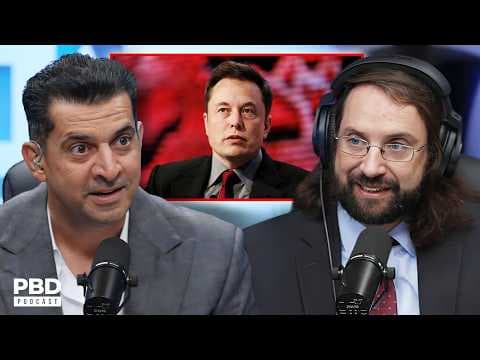
"The Bankruptcy Of The United States" - Musk WARNS Only AI & Robots Can Save America
Audio Summary
AI Summary
The discussion begins with Elon Musk's assertion that America is 1,000% destined for bankruptcy due to national debt, with AI and robotics being the only potential saviors. He argues that without these technologies, the country will fail. The interest payments on the national debt already exceed the military budget, surpassing a trillion dollars annually. Musk believes AI and robots will provide enough economic growth to solve this problem, provided there's sufficient time for their development before bankruptcy occurs.
Jeff, a participant in the discussion, draws a historical parallel to post-World War II America. He explains that the nation emerged from its debt by combining economic growth with fiscal sanity under presidents Truman and Eisenhower. This wasn't aggressive austerity but a prudent approach to spending, allowing the economy to expand. Jeff suggests Musk's vision of AI-driven economic growth, coupled with fiscal sanity, could replicate this success. However, he emphasizes that political will for fiscal sanity is the harder part. While acknowledging AI as a potential source of growth, he disputes the claim that it's the "only" solution, arguing that such statements are "wrong."
Another speaker highlights that the core problem is excessive government spending, with a trillion dollars disappearing into "rat holes" — not necessarily fraud, but legal inefficiencies like farm subsidies. Major contributors to this spending include social security and healthcare. The current tax system is described as dysfunctional, designed to raise minimal revenue at high marginal rates. The speaker advocates for tax reform, such as a 1986-style overhaul or a consumption tax, to generate revenue. He also points out the difficulty of building infrastructure in the US, citing the California high-speed train as an example, and the 15-year permit process for connecting windmills to the power grid. He suggests that fixing these "dumpster fires of growth," returning to free markets, fiscal sanity, and tax reform, are achievable with a "faintly competent government." He warns against an "AI policy" that could stifle its growth, comparing it to Europe's approach.
The conversation then shifts to the idea that current government spending habits would squander any economic boom from AI and robotics, likening it to a person with terrible spending habits winning the lottery. The consensus is that foundational economic management needs to be in place.
Musk's controversial claim that saving for retirement is irrelevant because AI will create a world of abundance is then addressed. He suggests that in a future of massive productivity and profitability, with the cost of labor and intelligence near zero, universal basic income (UBI) would be necessary to ensure people can buy products and services. He advises against saving for retirement, stating it "won't matter."
Jeff strongly disagrees with Musk's retirement advice, calling it a "reckless comment." He questions the feasibility of distributing goods and services in an economy where labor is eliminated, and whether such a scenario is achievable in 10-20 years. He believes a human-robot partnership will enhance productivity, keeping humans central to the economy.
A speaker labels Musk's economic views as "incoherent," highlighting the cognitive dissonance of simultaneously predicting governmental bankruptcy and a world of abundance requiring UBI. He refutes the idea of widespread job loss due to AI by drawing parallels to historical technological advancements like the printing press, steam engine, and tractor. For instance, in 1900, 70% of Americans worked on farms, but the invention of the tractor didn't lead to mass unemployment; instead, it increased human productivity and opened new possibilities and businesses. AI, he argues, will not eliminate workers but tasks and burdensome hours, making human contributions more valuable.
The discussion acknowledges the rapid pace of AI development, citing ChatGPT's overnight success and its potential for brain "atrophy" if people over-rely on it without engaging in critical thinking. The unknown future of AI's impact on work and daily life is emphasized, with a call for humility and adaptability, especially for business owners and executives.
Regarding young people and retirement, a speaker from Palo Alto suggests that while some young people might not save for retirement due to climate change concerns, they are adept at using AI, including for "cheating on tests" and in the workplace. He reiterates that historically, new technologies have always worked out, despite initial fears. He expresses concern about job displacement but warns against regulating AI or providing checks without encouraging new skills. He points to the education system as the real issue, where many students graduate with low reading levels.
Finally, an upcoming "Vault Conference" is promoted, an event designed for small business owners and executives to discuss money, business, family, faith, and politics without inhibition. The conference, which started small, is now expecting 12,000 attendees at the MGM Grand Arena from August 31st to September 3rd. Attendees are encouraged to bring family, peers, and clients.