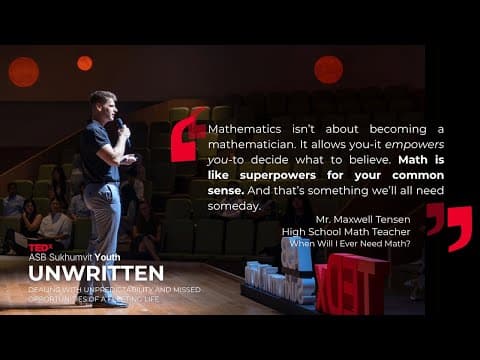
When Will I Ever Need Math? | Maxwell Tensen | TEDxASB Sukhumvit Youth
Audio Summary
AI Summary
The speaker, a high school math teacher, addresses the common student question: "When am I going to need this?" He acknowledges that math can feel abstract, esoteric, and hyper-specific, unlike more tangible subjects like science or English, leading many students to dislike it. He explains that while professions like doctors, architects, and engineers clearly use math, it's harder to see its relevance for fields like writing.
To answer the core question of why math is important for everyone, the speaker proposes to prove its relevance using the axiomatic method, similar to a geometry class. He defines mathematics as the "systematic use of logic, abstraction, and pattern recognition to reason about problems," essentially the ability to use numbers and logic to solve things. He contrasts this with common sense, defined as the "natural human ability to reason about situations and problems," which everyone possesses.
The speaker then establishes two axioms:
1. **The Problem Axiom:** All people encounter essential problems that require reasoning to make decisions, understand situations, or determine truth. In simpler terms, everyone faces problems they need to solve.
2. **The Common Sense Axiom:** Humans possess common sense, but common sense alone can be incomplete, inconsistent, difficult to explain, or easily misled.
Using these definitions and axioms, he constructs a proof. The argument proceeds as follows:
1. Everyone faces decisions (Problem Axiom).
2. We initially rely on common sense to make these decisions (Common Sense Axiom).
3. However, common sense can be flawed and inconsistent (Common Sense Axiom).
4. Mathematics sharpens reasoning, forces clarity, and demands consistency (Definition of Mathematics).
5. Therefore, since mathematics improves our thinking, and we require thinking to navigate the world and make decisions, mathematics is useful for everyone.
The speaker concludes that the practical application of math isn't about performing complex calculations like indefinite integrals. Instead, math empowers individuals to decide what to believe, make tough decisions using logic, and discern whether something truly makes sense or just sounds plausible. He likens mathematics to "superpowers for your common sense," something universally needed.