Building a World of Plenty: A Bold Vision for Global Prosperity by 2100
AI Summary
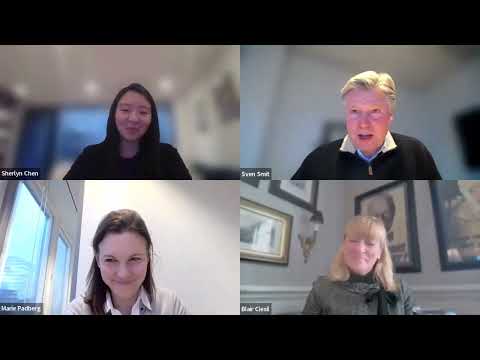
Marie and Blair welcome listeners to the February session of "McKenzie Unpacked," a series launched to demystify McKinsey, its culture, and its people. This session marks their 17th, and they express excitement about their topic and guests. The format includes an opening segment on what's on their minds, a deep dive into the main topic, and a concluding "snack" of practical advice.
Blair shares that the Olympics are currently on her mind. She finds it humbling to witness athletes at the peak of their sport, noting that McKinsey hires Olympians and Paralympians, valuing their grit, resilience, self-discipline, selflessness, and pursuit of excellence – qualities that translate well to their work. Marie echoes this sentiment, highlighting the positivity and aspiration embodied by the Olympics, particularly the stories of dreaming big and not giving up. Her children are avid viewers, especially enjoying figure skating.
The main topic is a deep dive into the new book, "A Century of Plenty," authored by the McKinsey Global Institute (MGI). Blair introduces Sven Smith and Cherylyn Chen, two of the book's lead authors, as "McKenzie celebrities." The book explores unprecedented advances of the past century and paints an optimistic vision for the future, questioning if every country could achieve the prosperity of Switzerland by 2100, which would require significant global economic growth.
Sven, a former senior partner and former chair of MGI, has been with McKinsey for 35 years. He recounts his initial attraction to the firm, which was relatively unknown in Europe at the time. He was drawn by the "mystique," the unusual interview questions, and a poster that suggested they hired "Renaissance people." He found a place where he could help shape the future, not just work in the past. He also highlights the unique partnership model, which he likens to democracy, stating he has never had a boss and has always served the partnership. Cherylyn, an engagement manager based in London, started her career in Singapore. She joined McKinsey for its rigorous, fact-based approach to problem-solving, the opportunity to work with bright people on challenging issues, and its global footprint. She also emphasizes the strong spirit of collaboration within the firm, evident even in the book's creation.
Sven explains that the McKinsey Global Institute (MGI) is an independent research arm funded by the partnership. It focuses on economics research, often taking a micro-to-macro approach by leveraging the firm's vast network of experts across various industries. MGI aims to provide baseline knowledge that supports progress, citing their work on climate change and the frequently quoted $9.3 trillion annual cost of inaction. He notes that even AI models now reference their "Century of Plenty" work. Cherylyn shares her personal journey into MGI, seeking a broader, macro perspective after client work. She applied for a rotation at MGI and ended up staying, now being a full-time member.
The central thesis of "A Century of Plenty" is the "progress machine" that has driven advancements over the last century. Sven illustrates this with personal family stories, contrasting the hardships of his great-grandparents during the Great Depression with his own experiences and his daughter's current life. He identifies eight "cylinders" of this machine: more workers (including increased female participation), invention, knowledge economies, capital investment, increased energy use, market economy growth, and knowledge economy growth. He poses the question of whether this progress can be replicated, envisioning a future where all countries reach Switzerland's level of prosperity by 2100. He emphasizes that GDP growth is a proxy for broader progress, correlating with reduced mortality, improved health, and increased safety.
Cherylyn clarifies that while inequality has a weaker correlation with GDP growth compared to other metrics, global inequality has actually decreased due to the convergence of emerging economies. She also points out that the world already produces 1.5 times the food needed to feed everyone, suggesting distribution, not sufficiency, is the issue.
Addressing how to accelerate towards this vision of plenty, Sven highlights that the future is still being made, with AI and biotech as key drivers. He stresses the importance of reframing goals, contrasting the IPCC's prediction of a three-times economic increase with MGI's projection of 8.5 times for global prosperity. This reframing, he argues, changes how we design and build for the future, making cleaner energy and resource utilization more feasible. He believes that achieving this higher growth rate, even with a slight increase in global temperature, is a worthwhile trade-off to lift billions out of poverty, rather than denying them prosperity.
When discussing hindrances to progress, Sven points to the collective decisions on governance and economic systems, citing communism as an example of humanity going off track for decades. He advocates for capitalism's role in driving productivity but stresses the need for sound rules and regulations that allow for investment and profitability. Cherylyn adds that institutions are often the slowest to adapt. Sven argues for smart, strong, but not overly detailed regulation, seeing individuals as the primary actors creating prosperity within the "glue" of institutions. He uses the analogy of a smooth glue allowing actors to move freely, contrasting it with overly restrictive regulation.
Regarding human capital and "builders," Cherylyn emphasizes the importance of continuous learning and upskilling, especially with the advent of AI, as the half-life of skills is shortening. Sven adds that building extends to the physical world and reframes the AI job displacement narrative. He suggests that in an 8.5 times economy with high automation, there might even be a shortage of people, unlike the transition from agriculture to industry. He believes that while specific tasks may be replaced, human-centered skills like integrity, judgment, and instinct will remain crucial. He likens McKinsey's role to interpreting the "tide" of trends through the eyes of thousands of companies and helping them "catch the tide" through transformation, a process he believes AI cannot fully replicate. He uses a personal anecdote about establishing a cruise ship soda market to illustrate how McKinsey adapted and grew through changing tasks. Cherylyn adds that the existence of jobs like dog groomers 100 years ago shows a failure of imagination to dismiss the possibility of future jobs.
For aspiring leaders, Cherylyn offers three pieces of advice: embrace hard problems in critical areas like clean energy and AI, prioritize continuous learning and upskilling, and remain optimistic, believing in progress. She notes that writing the book reinforced her optimism by highlighting humanity's resilience despite current turmoil. Sven echoes the importance of optimism, quoting David S. Landis: "In this world, the optimists have it. Not because they're always right, but with their optimism, they are trying." His second piece of advice is to build "systems" of skills and networks rather than focusing on intermediate goals. His third is to harness serendipity by observing the world and talking to people, which helps discover personal "meaning" rather than a shallow "purpose." He shares his own experience as an early part-timer at McKinsey as an example of building a system that led to unexpected growth and learning.
The session concludes with Marie and Blair thanking Sven and Cherylyn for their insightful discussion, emphasizing the book's optimistic outlook and the importance of human potential in achieving a future of plenty. They encourage listeners to buy and read the book.