How to use Jev to automate your business (Step-by-step w/ Treg)
AI Summary
The new model, Jeff, addresses limitations of current large language models (LLMs) in business workflows, despite their prowess in complex tasks like coding. Current LLMs often exhibit overconfidence, making incorrect judgments without calibrated confidence scores, which is problematic for business processes requiring near 100% accuracy. Additionally, their cost and speed are often prohibitive for high-volume business workflows. These issues stem from their training process, which relies on reinforced learning from human feedback, primarily for creative and assistive chat functions.
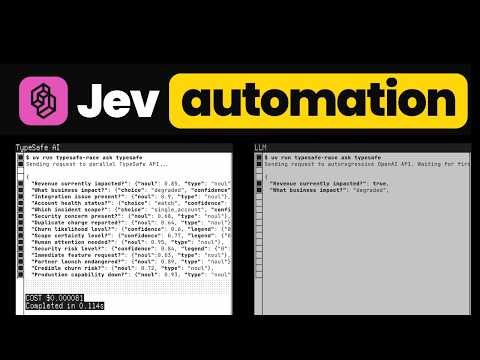
Jeff, however, employs "reinforced learning for calibrated decisions," making it a model designed for reliable, high-quality decision-making rather than creativity or text generation. It excels at choosing from a given set of options but cannot generate options, output text, write code, or reason step-by-step. Unlike LLMs that output token by token, Jeff predicts probabilities for a list of given answers, making it exceptionally fast and efficient. This design makes Jeff significantly faster and cheaper than even the most affordable LLMs, demonstrated by being 5-7 times faster and 5 times cheaper than models like GPT 5.6 Luna. A current limitation is its 32K context window, requiring workarounds for larger responses.
A key feature of Jeff is its output of probability distributions for answers, providing a confidence score. This allows businesses to build robust logic and trust models for fully autonomous operations, opening up previously impossible use cases. For instance, Jeff can play games autonomously due to its speed and limited input/option sets. It can also provide real-time classification for call center monitoring, identifying fraud or customer frustrations.
Jeff significantly improves browser and computer automation. The challenge for agents using browsers is accurately identifying UI elements within messy DOM structures. Jeff integrates into browser stacks, receiving tasks, interaction history, and DOM elements, then predicts the next action (e.g., click or type) and the specific UI element, along with a probability score. This rapid identification, combined with a small LLM for text generation, streamlines browser interactions.
Jeff is ideal for business automation requiring high accuracy or processing massive data volumes, where traditional LLMs are uneconomical. An example is internal link mapping for SEO. While LLMs might take hours to map links across hundreds of pages, Jeff can scan over 500 pages and map them in under 50 seconds. It can also be used for real-time content customization based on visitor personas.
Interacting with Jeff involves passing a "state" (prompt) and a set of questions, along with instructions and options. Jeff responds with probability scores for each option. It supports multi-choice, true/false, and scoring questions. For true/false, it can prevent prompt injection by classifying user requests as "jailbreak" or not, with a confidence score. For scoring, it can assess, for example, the authenticity of a social media post based on criteria, providing a final score and probability for each range.
The confidence score is a powerful feature, enabling sophisticated business logic. For example, in prompt injection detection, a decision tree can be built: if the "hazard score" is above 70%, block the message; if between 35% and 70%, flag for human review; otherwise, send normally. Tips for more accurate responses include providing detailed descriptions for questions and including examples within criteria options, similar to few-shot prompting. For instance, in customer support, specifying the focus (e.g., "route to whoever must fix the root cause") can direct Jeff to the technical team instead of billing for a double-charge issue.
Real-world applications of Jeff in production include fraud detection and website signup analysis. For platforms like Superdesign and Track, which face frequent bot attacks, Jeff classifies new signups as fraudulent based on product usage data, enabling automatic bans. This evolved into a full website signup analysis, where Track verifies emails and enriches user profiles, and Jeff classifies users as fraud, upsell opportunities, or affiliate partners. This process, scanning hundreds of signups for about $1 per day, was previously uneconomical.
Another use case is identifying high-quality leads. Track fetches popular LinkedIn posts relevant to a vertical, identifies users who interact with them, and then Jeff qualifies and scores these leads, classifying them into personas to identify good fits. Analyzing 20 posts and nearly 400 leads costs almost nothing. This demonstrates Jeff's utility in buyer signal automation and lead qualification.
Finally, Jeff is used for viral expose screening, identifying paid versus organic product launch posts on Twitter. A pipeline grabs trending posts, and Jeff classifies them as organic, paid/boosted, or noise, providing a daily feed of relevant insights. A free tool is available where users can paste a Twitter post to get an analysis of whether it's organic or paid, with full reasoning.
Combining Jeff with data services like Track fundamentally changes the economics of many automation processes, opening up numerous previously unfeasible opportunities.