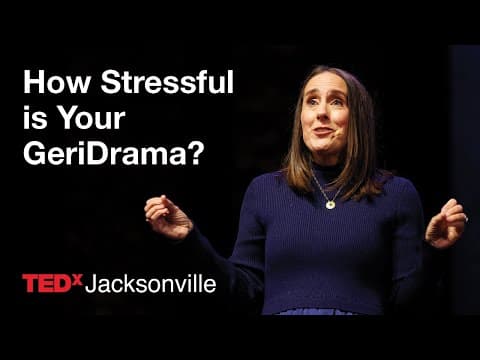
Aging Isn’t a Crisis. It’s a Design Challenge We’re Ignoring. | Susanna Barton | TEDxJacksonville
Audio Summary
AI Summary
The speaker shares a personal story about becoming the power of attorney and caregiver for a deceased friend's parents, highlighting the immense unpreparedness and "Jerry drama" that ensued due to a lack of prior conversations about their wishes, finances, and care needs. This experience led the speaker to realize that most people are ill-equipped to handle the realities of aging, often only learning the necessary systems when already deep in crisis.
The speaker argues that aging shouldn't be viewed as a disaster but as a design challenge that can be addressed proactively. This realization prompted a career change, leading to writing a book, obtaining a gerontology degree, and dedicating their mission to normalizing conversations about aging, reducing "Jerry drama," and helping people find peace through preparation.
The urgency of this preparation is underscored by global demographic shifts. The 65-plus population is rapidly increasing, with projections showing older adults outnumbering children in the US by 2035. The number of centenarians is expected to quadruple, signifying longer lives that also bring increased care, costs, and complexity. A significant portion of older adults fear running out of money more than death, yet many have no retirement savings, compounded by confusion over long-term care, a shrinking caregiver pool, limited housing accessibility, and a low will-writing rate.
To address this impending "storm," the speaker proposes "mindful aging," a proactive approach to aging as a design challenge. Ten essential "design" elements are outlined:
1. **Financial Preparedness:** Consult a certified financial planner to discuss long-term care costs and payment strategies.
2. **Legal Preparedness:** Engage an elder law attorney to draft a will, appoint a power of attorney and healthcare proxy, create a living will, and discuss advanced directives, Medicaid planning, and trusts.
3. **Information Curation:** Create a "death binder" with essential documents for easy access by a trusted loved one.
4. **Communication:** Openly discuss plans with loved ones, show them where important information is located, and revisit these conversations regularly.
5. **Finding Help:** Learn about available resources like geriatric care managers, death doulas, hospice nurses, and daily money managers.
6. **Home and Neighborhood Planning:** Assess home accessibility and neighborhood connectivity.
7. **Decluttering:** Proactively declutter to ease the burden on others later.
8. **Transportation and Mobility:** Plan for the eventual transition away from driving.
9. **Contingency Planning:** Engage in "what if" scenarios (e.g., what if I fall tomorrow?) to prepare for potential challenges.
10. **Legacy Focus:** Live with intention, practicing what you want to be remembered for.
These steps are presented not as grim necessities but as gifts of calm and clarity for those who will provide future care. The speaker emphasizes that good planning begins with curiosity, honesty, and ongoing conversation, and that planning for aging is about taking control, not losing it. By practicing mindful aging and designing intentionally, individuals can build a beautiful and well-prepared future.