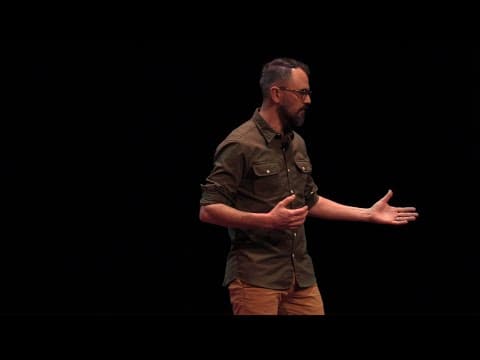
Take a stand by sitting down… to pee | Jay Hill | TEDxAsheville
Audio Summary
AI Summary
The speaker, Jay Hill, confesses to a personal habit: sitting down to pee. He acknowledges this is often seen as taboo, especially for men, and feels like a secret. While he doesn't sit every time, he advocates for it in private, clean spaces like a home bathroom or a single-stall office, contrasting this with situations where standing is necessary or preferable.
Hill explains that his upbringing, where his father taught him to stand and his mother involved them in cleaning, led him to question the inconsistency of leaving a mess in the bathroom when he wouldn't in the kitchen. He highlights that standing and splashing urine isn't just an individual act; it creates extra labor, often falling disproportionately on women, who are frequently tasked with cleaning.
He delves into the physics of splashing, citing research from Brigham Young University's Splash Lab. The science shows that urine travels significantly farther when standing, breaking into droplets that can mist and spread several feet, meaning even the person standing is within the splash zone. He points out that toilets and even urinals aren't ideally designed for standing, and the hinged seat is merely a cover for the mess.
Hill shares his personal realization that after moving out on his own and being solely responsible for cleaning, he understood the need for a change. He discovered that "everyone is already sitting down when they pee sometimes," and questioned why it's difficult to apply this to all situations. He admits that for years, he kept this habit private, only sharing it with a very small circle.
The speaker reflects on the societal silence and unspoken rules surrounding this behavior, particularly the connection between masculinity and standing to pee. He believes these are cultural constructs, not innate traits, and that defensiveness arises when these behaviors are challenged, often perceived as a threat to identity and masculinity. He argues that true masculine strength involves adapting and considering others, not just making selective sacrifices.
Ultimately, Hill frames sitting to pee as a practical act of care for others and a way to reduce the "social gravity" of these unspoken expectations. He encourages the audience to consider sitting as a simple way to begin caring for one another, suggesting that sometimes "taking a stand means taking a seat."