The emotional side of economics | Aarya Sharma | TEDxUniversiteitVanAmsterdam
Audio Summary
AI Summary
The speaker begins by highlighting the profound impact of Jerome Powell's words, even his tone and pauses, on financial markets. This illustrates how emotions and interpretations, rather than just raw data, can significantly influence economic outcomes. The core argument is that emotions are not mere noise in the economic system but an integral part of it.
The speaker uses personal anecdotes to demonstrate this, contrasting the stress of a €15 gift card providing relief with the perceived lesser value of a costly university degree. This highlights how seemingly small emotional gains can feel more meaningful than significant, calculative decisions. This human tendency to attach outsized meaning to small things, the speaker argues, extends to market movements.
Historical examples are provided to support this. The tulip mania of the 17th century, where a single tulip bulb was sold for an exorbitant price, and the 2008 subprime mortgage crisis, fueled by the belief in perpetually rising house prices, are cited as instances where collective emotions and perceptions, amplified by structural issues, led to dramatic economic events. The dot-com bubble is also mentioned, noting that while driven by irrational frenzy, the resulting investments financed crucial internet infrastructure. The speaker emphasizes that emotions can both destroy and build.
Compassion is presented as a constructive emotion through the story of Muhammad Yunus and the Grameen Bank. Yunus observed poverty in Bangladesh, recognizing it wasn't due to laziness but systemic distrust that prevented women from accessing loans. His empathetic approach of micro-financing empowered millions, demonstrating how compassion can create robust economic systems. Trust is another crucial emotion, exemplified by the Silk Road traders who operated on mutual trust, and early European trading houses that relied on handshakes as agreements.
This concept of trust is brought into the modern context as "confidence." Confidence in institutions, governments, and currencies like the dollar, euro, and rupee, even when not backed by gold, derives value from the shared belief and trust that governments will uphold their worth. Banks lend and individuals work based on this underlying trust and the expectation of future value.
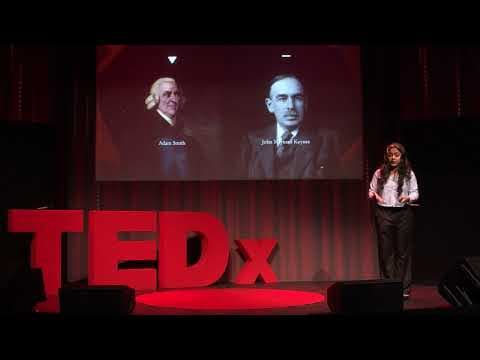
The speaker then delves into economic theory, referencing Adam Smith, who acknowledged that human behavior is motivated by more than just self-interest, including benevolence and moral reasoning. John Maynard Keynes's concept of "animal spirits" is discussed, highlighting how consumer and producer confidence actively shape the economy, acting as self-fulfilling prophecies. Fear and pessimism, conversely, can trigger recessions by discouraging spending.
Modern research is cited to show that emotions are not fringe ideas but are deeply embedded in economic systems. Behavioral economics challenges the traditional view of purely rational decision-makers. Researchers like Loewenstein and Rick distinguish between "expected emotions" (anticipating future feelings) and "immediate emotions" (feelings in the moment of decision), both of which influence market behavior. The interplay between cognition and emotion is central to understanding economic actions.
To illustrate this further, the speaker introduces the "ultimatum game." In this experiment, participants are given money to split, with the condition that if the offer is rejected, neither party receives anything. Traditional economic theory predicts a rational division, but in practice, people often offer fairer splits and reject unfair offers, demonstrating a preference for fairness and dignity over pure financial gain. This raises the question of whether economics is driven by emotions or rationality, concluding that it is driven by people who are a complex mix of both.
The speaker then reflects on their own duality, starting a community foundation driven by a desire to help, yet also striving for a "perfect career" path. This personal experience mirrors the contradictions seen in society and globally. India is presented as an example of a nation with deep-rooted traditions, scientific advancements, and spiritual wisdom, yet also grappling with prejudice, superstition, poverty, and discrimination. This duality, the speaker argues, is not unique to India but is a human characteristic.
The talk emphasizes that humanity is capable of both catastrophic and marvelous actions, holding the power to shape systems. The intention is not to preach morality but to acknowledge our "humanness" and the intriguing paradox of building systems that often contradict our feelings and behaviors. Emotions, far from being isolated, permeate systems, crash markets, build societies, and determine who thrives or suffers.
The concluding message is that individuals are not mere data points on a graph; their actions have real-world consequences. The speaker ends by stating that while economics may influence behavior and feelings, emotions also drive the economy, underscoring the inseparable link between the two.