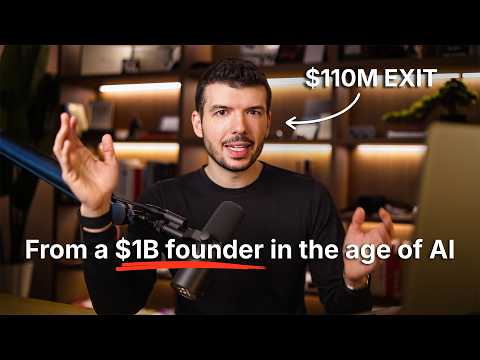
What I learned from living with a $1B unicorn founder
AI Summary
The speaker spent seven days with a founder who built a billion-dollar company before 30 and is now building a new startup that recently raised from Sequoia Capital. A key takeaway is that AI has fundamentally changed how startups are built, and those adhering to old playbooks risk being overwhelmed.
The traditional startup model involved pairing a business founder with a technical founder, raising angel money, hiring engineers, and aiming for $10,000 a month in revenue within 12-18 months to secure seed funding. This "ramen profitable" approach, once a standard for decades, is now obsolete due to advancements in AI and product development. Tiny teams are now achieving millions of dollars in revenue in just a few months, outcompeting larger, slower companies that haven't adapted.
The core of this transformation lies in how AI-native founders ship products. Unlike the old method of spending hours in meetings, wireframes, user interviews, writing product specifications, and mocking up designs, AI-native founders directly steer product development in real-time using AI coding tools. This isn't "vibe coding" where engineers are replaced; rather, the founder works alongside a team of engineers. The founder drives the product vision, shaping features with AI tools, while engineers act as "guard rails," reviewing pull requests, cleaning code, and ensuring stability. This collaborative approach, where the CEO, AI, and engineers operate as a single unit, allows companies to move ten times faster, reaching millions in revenue quickly.
However, this speed also makes it easier to derail without a robust system. The second key lesson is the singular metric that truly matters in this new era: shipping to production. Early-stage startups often get bogged down in micro-decisions like company names, domain names, logo colors, or initial customer segments. While seemingly productive, these decisions can lead to paralysis, resulting in no customers, no product, and no cash. The founder's mantra is that "the only thing that counts as real work is shipping to production." For sales, it's signed contracts; for new features, it's whether the feature is live and done, not just commits or code. This relentless focus on outcomes drives intense velocity, with daily progress and celebration of releases.
The rapid pace of AI development, particularly with agentic coding agents, has made building apps incredibly easy. People can now create entire working applications from idea to live product in a few hours. While this sounds positive, it presents a significant challenge: the number of apps being released is increasing at an exponential rate. This creates an "arms race" where a "do or die" mindset is essential. For instance, the founder went from an idea to a Sequoia check, five employees, a fully working product, industry partnerships, and daily massive upgrades in just one month. The pressure is immense: if they don't launch now, someone else will.
To navigate this arms race, founders need to build what is termed a "momentum machine." Many founders claim to be "all in," working long hours, but their efforts are often scattered. When a person enters a flow state, their brain builds momentum on the task. However, context switching—attending dinners, grabbing coffee, or going to concerts—breaks this momentum, preventing the sustained focus needed to go from "good to great." In contrast, the founder's entire life is a continuous loop of momentum. He works from the moment he wakes up, eats meals at his desk while working, and even works out with his laptop. His breaks often involve scanning Twitter for AI and product breakthroughs to apply immediately. This constant focus on the same problem creates an extraordinary level of intensity and momentum. While this lifestyle isn't for everyone, it exemplifies the mindset required for building at the highest level.
This high-standard approach extends to his team. The founder ensures that everyone on his team is held to equally high standards. He engages in uncomfortable but critical conversations with employees who aren't meeting expectations. These conversations begin by acknowledging the employee's talent and potential for greatness within the company. He then clearly articulates the expected level of achievement based on their experience and time with the company, giving specific metrics like shipping a certain number of features or reviewing pull requests within the same day. Crucially, he then asks if the employee has everything they need to meet these standards. This allows the employee to voice any roadblocks, which the CEO then makes it his job to remove, ensuring they can perform their best work. The ultimate goal is to gain buy-in from the team member, empowering them to commit to achieving these standards. The founder genuinely believes he is building the next multi-billion dollar company, offering a career-defining opportunity, which justifies holding team members to such high standards.
To build as an AI-native founder and avoid creating an "AI mess," specific tools and workflows are necessary.