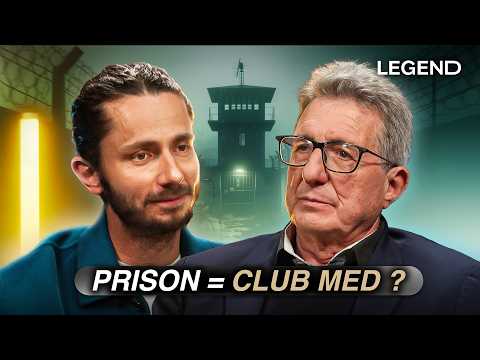
DIRECTEUR DE PRISON : 30 ANS FACE AUX DÉTENUS LES PLUS DANGEREUX : IL RACONTE TOUT (BOMBES, MAFIAS…)
AI Summary
Pierre Rafin, a retired prison director, shares his 45 years of experience in the French penitentiary system. He began his career in 1977 at Fleury-Mérogis, one of France's largest prison complexes, as a deputy director, a new position at the time requiring a competitive exam similar to those for police commissioners or magistrates. Fleury-Mérogis, a massive complex housing up to 7,000 inmates across various facilities, provided his initial exposure to the realities of prison life.
Rafin clarifies the role of a prison director, dispelling the common misconception of being an arbiter between guards and inmates. Instead, directors are part of the staff, working to harmonize the operations and manage the fragile balance within the prison. This involves navigating between necessary authority and essential benevolence, as a prison is not a place where everyone is armed or blindly follows orders.
He explains the different types of prisons in France: *maisons d'arrêt* (detention centers) for those awaiting trial or serving short sentences, *centres de détention* (detention centers) for medium-term sentences, and *maisons centrales* (central prisons) for long-term sentences. He started his career at 24, initially surprised by the relaxed atmosphere he encountered during a visit to a Toulouse prison, which contrasted with his preconceived notions of a rigid and austere environment.
Prison directors are armed, though not constantly carrying a weapon. Prisons also have armed guards in watchtowers, authorized to use lethal force as a last resort to prevent escapes, a unique aspect of the job. Rafin identifies suicide as a major concern, viewing it as a failure of the prison's mission to keep inmates healthy. Escapes are also a significant challenge, with 120-130 occurring annually across France. He has experienced numerous collective movements (riots), which were particularly dangerous before the establishment of specialized intervention teams.
Reflecting on relationships with inmates, Rafin states that while strict adherence to rules is necessary, fairness and explanation are key. He claims to have never had genuinely bad relationships with inmates, even recalling an instance where a former inmate paid for his coffee as a thank you for fair treatment during his time in prison. This highlights the complex and sometimes surprising human interactions within the prison system.
Rafin discusses the motivation behind his career choice. Fascinated by criminology and penal science during his law studies, he sought a profession that would immerse him in criminal phenomena. His father, working in fiscal administration, suggested the newly created director of prison competitive exam. Despite not knowing what the job entailed, he took it and found the environment deeply engaging, a passion essential for enduring such a challenging profession.
He describes the "schizophrenic" nature of a prison guard's role, shifting from intimate interactions with inmates—inquiring about their well-being, accompanying them to activities, and even meeting their families—to being tasked with potentially lethal force in a watchtower. This stark contrast, unique to prison work, demands an extraordinary emotional and ethical balance.
Rafin recounts an unusual incident at Fleury-Mérogis where he was accidentally locked in a cell with four inmates for two hours. The cell doors, electronically controlled, automatically locked if the safety mechanism wasn't engaged. Despite the initial surprise, the inmates were courteous, offering him coffee, and they discussed their cases. This experience, though brief, gave him a firsthand understanding of what it felt like to be incarcerated.
He acknowledges that human relationships complicate the ideal of treating all inmates equally. He had privileged contacts with some, including notorious figures like Guy Georges, the "East Parisian killer," who confided in him more than he did the police. Rafin found Georges to be a seductive and articulate individual, and their discussions offered insights into his criminal past, though listening to such accounts was difficult.
Rafin believes some psychopaths, like Michel Fourniret or Tommy Recco, should never be released due to the high risk of recidivism, despite his opposition to the death penalty. He recalls a painful experience where a unanimous decision to grant a release permit to a seemingly well-behaved inmate resulted in him sexually assaulting a 10-year-old girl, making Rafin much more restrictive on such decisions afterward, especially for sex offenders.
Inmates typically addressed him as "Monsieur le directeur," and tutoiement (using "tu" instead of "vous") was forbidden in the penitentiary administration to maintain a necessary distance. He notes that in his early career, guards would even address each other formally to prevent inmates from learning their names or personal details, a protective measure less common today.
Rafin observed a hierarchy among inmates, with "truands" (gangsters, mafiosi) at the top, and child molesters at the very bottom, subject to violence from other inmates. He describes how old-school criminals, like those in the film *Un Prophète*, held significant influence and commanded respect within the prison.
He served during the period when the death penalty was still in effect in France (abolished in 1981). He knew three inmates condemned to death, including Philippe Maurice and Montetit. He recounts a striking moment when Montetit, a habitually difficult inmate, displayed a "glimmer of humanity" in his eyes upon returning from his death sentence verdict. Rafin was relieved when the death penalty was abolished, finding it emotionally taxing for staff who might have to participate in executions. He firmly opposes it due to the irreversible nature of judicial errors, citing cases like Christian Ranucci and Patrick Dils.
Rafin experienced the first helicopter escape in France in 1981 at Fleury-Mérogis. An unexpected white helicopter attempted to land on the sports field, then moved to the promenade yard. Inmates used automatic weapons to deter others from climbing aboard. The escapees were recaptured six months later. This event led to the development of anti-helicopter devices in prisons, which did not exist at the time.
He notes a significant shift in prison culture over his career. While there used to be strong solidarity among inmates, leading to collective movements, today there are fewer large-scale riots but more unpredictable, individual acts of violence. The "code of honor" among criminals has largely disappeared, mirroring changes in society at large.
Rafin's career took him to Réunion and Mayotte in 1988, where he observed different prison cultures. Unlike metropolitan France, where inmates live primarily in cells, in Réunion, they lived on the promenade yard and only returned to cells to sleep. He learned the importance of adapting prison regimes to local cultures. He also noted that inmates often preferred older, less modern facilities due to better human relationships, sometimes leading to suicides when transferred to new, more impersonal prisons.
From 1993 to 1997, he served in Corsica, closing the old Bastia prison and opening the new Borgo facility. He was impressed by the professionalism of Corsican guards, who, contrary to stereotypes, diligently applied rules despite difficult inmates. He recounts a memorable incident where a Corsican "truand," whose 5-year-old daughter was dying of cancer, was granted a special release to see her. The inmate, having given his word, returned to prison as promised. Four years later, this same inmate warned Rafin of an impending escape at his new prison in Draguignan, saying, "I have paid my debt."
Rafin experienced several car bombings in Corsica and Aix-en-Provence, targeting his position as a symbol of the state. While the Corsican bombings were typically designed to cause property damage without injury, a bombing in Aix-en-Provence involved defensive grenades with delayed fuses near his home, where his children were playing, highlighting the extreme danger of his profession. Despite these threats, he never had personal bodyguards, relying on his own vigilance. He recounts a terrifying incident in Borgo where he almost fired his service weapon at two masked, armed individuals near his official residence, only to discover they were 15-year-old boys playing paintball. This deeply affected him and reinforced his belief in the importance of restraint.
He believes it's natural for inmates to want to escape, provided it's done without violence. He mentions Michel Vaujour, a "king of escape" who consistently tried to break out. Years later, as director of Saint-Maur, Rafin helped Vaujour get his security period reduced, leading to his conditional release. Vaujour, who went on to become a screenwriter, expressed gratitude to the prison administration for giving him a second chance, a success story for Rafin.
At La Santé prison in Paris, Rafin was director of the "VIP" section (or isolation ward), housing high-profile inmates or those whose safety would be compromised in general population. He encountered Maurice Papon, the former Vichy official, who was uncommunicative. He also had interactions with Bernard Tapie during his incarceration in Aix-en-Provence following the OM-Valenciennes scandal. Rafin was tasked with ensuring Tapie's well-being and preventing suicide. He even helped Tapie discreetly leave prison for a release permit, driving him out in his personal car under a blanket to avoid journalists. Tapie remained grateful, sending him greetings for years.
Rafin was the last director to live inside La Santé prison, experiencing prison life 24/7. His children grew up seeing inmates arrive in shackles. While friends were hesitant to visit, he recalls a surreal moment when, during a night disturbance, he and an inmate in a facing cell simultaneously looked out their windows, sharing a silent moment of shared curiosity like ordinary neighbors.
He discusses controversial prison activities like karting or inflatable pools, deeming them inappropriate. He advocates for constructive activities like education, vocational training, sports, and arts, which help inmates develop skills and a new outlook on life. He shares an anecdote of a former inmate who, after a harsh six-year sentence in the 1970s, turned his life around, believing the severity of his experience motivated him to change.
Portable phones, though forbidden, are prevalent in prisons today, entering through various means including families, corrupt staff, or drones. Rafin stresses that prison peace is never bought through tolerance of contraband like drugs, which only destabilize the environment and lead to violence. He notes the increasing influence of organized crime, with threats against directors by mafias, a phenomenon not seen years ago.
Rafin, who retired early in 2022 due to a rare heart infection, reflects on the human aspect of his profession as its most rewarding part. He expresses immense admiration for penitentiary staff, especially guards, who perform an incredibly difficult job. His least favorite aspect was administrative red tape, often finding it necessary to "ask for forgiveness rather than permission" to implement positive changes, such as displaying a guillotine during a public exhibition at the Baumettes prison to highlight the reality of the death penalty. He would do it all again, believing in the importance of his work.