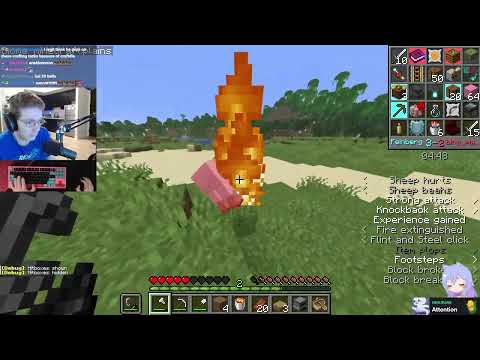
DRAFTOUT. WILL I EVER LOSE AGAIN? OF COURSE. WILL IT BE TODAY? NOT SURE.
Audio Summary
AI Summary
The speaker begins by discussing their recent win streak in a game, achieving 36 consecutive wins at rank one, though noting that three or four of these wins weren't technically at rank one. They then shift to discussing strategies and in-game situations, often expressing frustration with their mouse sensitivity or perceived bad luck with item spawns. They mention needing specific items like redstone, a geode, or a golem for various in-game goals.
The speaker frequently compares their progress to an opponent, wondering if the opponent has achieved certain advancements or found specific items faster. They consider different routes and strategies, such as going for an anvil, spyglass, or moss, while also lamenting missing opportunities for soul lanterns or zombie pig spawns. There's a particular focus on finding geodes, room portals, and villages with golems.
A significant portion of the discussion revolves around the competitive aspect of the game, with the speaker expressing concern about their opponent's potential advantages. They analyze their opponent's possible moves, like going for absorption or gold armor, and strategize how to counter or keep pace. The speaker often uses exclamations of frustration and surprise, especially when encountering unexpected game elements like an igloo with weakness potions or an ancient city in snowy slopes.
They delve into the mechanics of trial chambers, explaining the layout of hallways, fountains, and starter rooms, and the potential loot like honeycomb, amethyst, or cake. The speaker recounts missing a geode that was on their screen due to being overly focused on other tasks. They ponder how an opponent could reach a fort so quickly in the Nether, suggesting they might have forced their way through.
The conversation shifts to a broader critique of a competitive game's qualification system, possibly "Gridlock" or "Draft Out." The speaker expresses significant frustration with several aspects:
1. **Low Participation:** Only about 200 duos played in the first weekend of qualifiers, rendering the top 256 advancement useless.
2. **Team Queueing Issues:** Teams could queue against the same opponent twice back-to-back, leading to unfair results.
3. **Dodging Opponents:** The 8-hour queue period for only 3.5 hours of gameplay allows good teams to dodge strong opponents by watching streams.
4. **Non-Cumulative Scoring:** Scores from different weekends are not cumulative, making the first two weeks potentially irrelevant if the final week is a fresh start. This also creates an imbalance where teams playing "coughing babies" could gain an unfair advantage.
5. **Server Infrastructure:** An admin reportedly stated they lacked the server infrastructure for cumulative scoring over three weeks, which the speaker finds unacceptable and even offers to pay for.
The speaker believes the qualification system is flawed and that the organizers are too rigid with their schedule, compromising competitive integrity. They mention that they and others are not playing due to these issues.
Returning to in-game mechanics, the speaker discusses the usefulness of various items and strategies, such as using redstone for comparators, vines for advancements, or leveraging different village types. They debate the efficiency of mining for iron versus pursuing other goals. There's an ongoing internal monologue about tactical decisions, like whether to prioritize activator rails over crafters to force the opponent to waste iron.
The speaker reflects on their own performance, acknowledging that they are strong in Nether-centric and mid-to-late-game goals but struggle with overworld-focused objectives. They find it difficult to predict the long-term consequences of giving up early-game structures or speed for Nether tempo. Despite this, they maintain a strong win streak, although they attribute some of it to luck against specific opponents.
The discussion then transitions to a different game, "Valorant." The speaker is playing with a team and provides live commentary on their gameplay. They make tactical calls, react to enemy movements, and express both frustration and excitement during rounds. They discuss agent abilities (like stun, flash, smoke, ultimate) and strategies for attacking and defending bomb sites.
Throughout the Valorant gameplay, there are moments of self-criticism ("I'm so ass," "I'm stupid") mixed with confidence ("I'm the [__] god right now," "I'm kind of the best draft out player"). They analyze individual plays, lament missed shots or poor utility usage, and celebrate successful team coordination. The speaker also engages in lighthearted banter with teammates, discussing game curses (like the "2-10 curse" where a team up 10-2 always loses) and character difficulties (Fade versus Sova).
They touch upon personal gaming habits, such as not buying skins in Valorant, and past gaming experiences, like playing Hearthstone and Magic the Gathering. The conversation also briefly covers a real-life "straight line" walking challenge inspired by "Geo Wizard."
As the Valorant match progresses, the team faces a tough opponent. The speaker and their teammates continue to strategize, adapt, and make calls. They discuss specific map locations (cat, mid, heaven, main, door, garage) and enemy agent positions. Despite some setbacks and individual mistakes, the team eventually secures a victory.
After the win, the speaker receives a significant amount of "RR" (Rank Rating) and reflects on their performance in Valorant, acknowledging areas for improvement, particularly in aim hygiene. They mention having played 8 hours of Valorant that day and that their Discord crashes when they alt-tab from the game.
The stream concludes with the speaker deciding not to play more of the competitive game today, citing a need for food and a lack of focus. They plan to be live again tomorrow, emphasizing the importance of focus for gaining ELO.