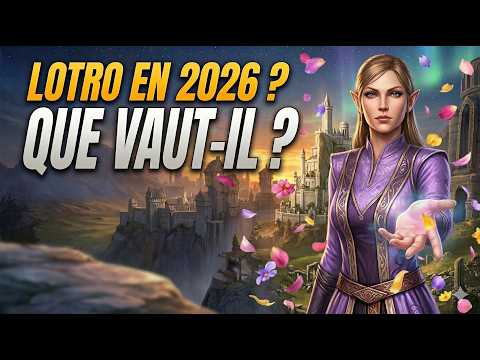
LOTRO en 2026 : Est-il toujours un bon MMORPG ?
Audio Summary
AI Summary
This video explores the enduring appeal of The Lord of the Rings Online (LOTRO), a game that, for many, holds a special place, much like a comforting novel or a familiar home. The central question addressed is whether LOTRO, in 2026, still holds up, or if it has become an outdated, buggy experience.
Before delving into LOTRO, the speaker announces a new project: "Cita Chronicles," a YouTube channel dedicated to storytelling and lore within virtual worlds and imaginative universes. This channel will explore the archives of The Lord of the Rings, as well as other franchises like Dune, Cyberpunk, and Harry Potter, analyzing the deep narratives offered by video games. The first video on Cita Chronicles is a detailed reconstruction of Gollum's pursuit, based on Tolkien's archives and inspired by an upcoming 2027 film. Viewers are encouraged to subscribe to Cita Chronicles.
Returning to LOTRO, the speaker provides a historical overview. Launched in 2007, the game has existed for an "eternity" by current gaming standards. While many MMOs have risen and fallen, LOTRO has not only survived but grown, which is surprising given the highly competitive MMORPG market where players often seek modern graphics, rapid progression, and high performance. Despite being an "old school" game, often perceived as slow or archaic, LOTRO persists. Originally developed by Turbine, it is now maintained by Standing Stone Games, a smaller, almost indie-like team. Importantly, LOTRO is not merely a museum piece for veterans; it regularly receives updates, new content, chapters, stories, regions, technical corrections, and improvements. The developers are actively invested in the game, with weekly community manager streams demonstrating their commitment. A significant recent change was the migration to 64-bit servers and the partial relocation of infrastructure for European players, leading to reduced lag and improved stability.
The initial impression of LOTRO for new players can be mixed. Searching online might reveal comments about a dated interface, noticeable lag, graphics from another era, rigid gameplay, and a potentially intrusive cash shop (though the speaker personally disagrees with the latter). While these negative comments exist and some are valid, there's also a strong community of passionate players who defend the game, highlighting its qualities over its shortcomings. Many have played for 10-15 years with no intention of stopping. The speaker suggests that the truth lies somewhere in the middle, and the only way to form an honest opinion is to experience it firsthand.
The adventure in LOTRO begins with character creation. Players choose from classic Tolkien races: Elves, Dwarves, Hobbits, Men, and Beornings. All races have access to all 12 classes, each with unique specializations for damage, healing, or support. Each race also has its own starting zone, adding replayability. A special mention goes to the High Elf race, which begins in the Second Age, offering a radically different introduction to Tolkien's universe, particularly appealing to those passionate about deep lore. The 12 classes offer unique mechanics and depth, encouraging experimentation. Players can also choose between two tutorial versions, an older and a more recent one, showing the game's effort to accommodate both new and returning veterans.
The early stages of LOTRO can feel slow, especially for players accustomed to modern MMOs that constantly guide them. The rhythm is classic, with a prologue that gradually familiarizes players with combat, interface, and quest functions. While pedagogical, it’s not always thrilling. A noticeable weak point is navigation; quest markers can be unclear, and important NPCs are not always easy to locate, leading to some aimless wandering. However, the game also offers pleasant surprises, such as combat mechanics where attacking while moving reduces precision, encouraging strategic positioning. The loot system is also convenient, with items appearing in a separate interface where players can easily take what they want.
The narrative structure is a strong point of LOTRO. From the beginning, the game establishes that players live the story *within* the community, not as the main heroes. You are not Frodo, but you aid him and his companions, sometimes closely, sometimes from afar. The initial tutorial involves fighting Black Riders, spiders, and brigands, leading to Aragorn's intervention. The story then moves to the village of Archet, where players help defend against brigands. After liberating Archet, the Hobbits return to the Shire, and the vast world of Tolkien opens up.
LOTRO's world is immense and coherent, allowing players to traverse landscapes on foot, feeling the scale of the world. Iconic locations like Bilbo and Frodo's house are meticulously recreated. The game excels at portraying the Hobbits as simple people in their simple world, rather than epic heroes. The atmosphere shifts dramatically upon reaching Bree and the Prancing Pony, where the main storyline truly begins around level 13-14. Beyond the starting zones, the world expands to include Lothlórien, the Mines of Moria, Mordor, and even regions from Tolkien's annex books like the Silmarillion, never explored in the films. The game features diverse environments, from contemplative to dark, icy to almost tropical, with contrasting ambiances that highlight its rich artistic direction and visual identity, which still hold up despite older graphics.
A key distinguishing feature is that the player character never wears the One Ring; that task belongs to Frodo and the Fellowship. Their journey is ever-present, acting as the "red thread" of the player's adventure. Players follow their traces, cross the same places, encounter the same threats and characters, and sometimes intervene to protect them without ever overshadowing their roles. The player's role is that of the unsung heroes: messengers, spies, soldiers, healers.
LOTRO's fidelity to Tolkien's texts is central. Details omitted by cinematic adaptations, such as Tom Bombadil, Glorfindel, and Radagast, play significant roles. Quests are remarkably rich, often long, multi-chapter narratives with well-crafted dialogues and concrete stakes, reflecting the rhythm and tone of Tolkien's writing. While the main story gains momentum in Bree, it is not tied to specific expansions.
In terms of pure gameplay, LOTRO is an "old school" MMO. Combat is target-based, similar to World of Warcraft but slower and more tactical, emphasizing positioning, skill timing, and arsenal control. It rewards prudence and planning over quick reflexes, appealing to players who enjoy strategic PvE. A "trait" system offers additional progression, allowing players to unlock statistical improvements by defeating certain numbers of enemies or performing specific actions, and racial traits add further customization.
LOTRO has experimented with features uncommon in other MMOs, such as mounted combat (a distinct system deserving its own discussion) and the deliberate absence of flying mounts. This choice reinforces the sense of travel and discovery, encouraging players to traverse the world, explore routes, and appreciate the journey rather than teleporting everywhere. This contemplative rhythm is intentional.
Beyond combat, LOTRO offers a deep crafting system. Players choose a "vocation" (a combination of three professions) and can specialize in gathering resources, transforming them, creating useful equipment, and selling items. Each vocation groups collecting, production, and complementary jobs. For instance, an explorer can collect and refine minerals to craft armor. This crafting process is time-consuming but coherent with the world. Housing is also available, allowing players to purchase and customize homes in various residential areas, each with its unique ambiance and architecture, becoming a personal project. Other activities include seasonal events, fishing, playable music, reputation titles, and cosmetic customization. LOTRO rewards players who take their time, connect with their characters, and appreciate details. Whether focusing on dungeons or crafting, both approaches are valid.
Years of expansions have accumulated a vast amount of PvE content, including dungeons for different levels, raids of various sizes, and instanced scenarios tied to the lore. An adjustable difficulty system allows revisiting old instances, ensuring they remain challenging and relevant. Progression is designed for a long journey, encouraging slow exploration, following the main quest, wandering regions, and engaging in side activities. The game never implies that the "real game" only begins at max level or in the endgame, which can be an advantage for some players but too slow for those accustomed to fast-paced MMOs.
PvP in LOTRO is unique, featuring a "Players vs. Monster Players" (PvMP) system. Players can choose to control creatures of the dark forces (Wargs, Goblins, Uruks), each with their own progression, roles, and abilities. This asymmetric team-based combat requires understanding both sides. While original and thematically coherent, it's not a traditional PvP experience and not LOTRO's main strength.
LOTRO's economic model is hybrid and unique by today's standards. A significant portion of the base game, up to level 95, is free, offering hundreds of hours of gameplay. The premium currency, LOTRO Points, can be earned through in-game achievements, allowing players to unlock quest packs and even expansions without real money, though it requires time and patience. The VIP subscription acts as a comfort pack, accelerating progression, offering experience bonuses, and removing restrictions, similar to The Elder Scrolls Online. It makes the experience smoother but isn't strictly necessary.
The most evident sign of LOTRO's age is its interface. It can feel cluttered with information, especially on 2K or 4K screens, where text and buttons become very small. Fortunately, the interface is highly customizable, allowing players to rearrange panels and supporting plugins and modifications, making the experience more comfortable and familiar for those from other MMOs. Scaling tools are also available for high resolutions. While the initial interface might be off-putting, a small investment in personalization greatly improves the experience.
In conclusion, if judged solely as a modern MMORPG, LOTRO might seem slow, laborious, with heavy combat and an outdated interface. However, by embracing its age and unique rules, its enduring popularity becomes clear. It's not a game for quick two-hour sessions but for a long, fantastic journey where players progressively live a character's story, exploring a vast world, engaging in quests, or simply admiring landscapes. Whether LOTRO is worth playing in 2026 depends on player expectations. If dynamic combat, minimal time commitment, and cutting-edge graphics are priorities, it might not be the right choice. But for those seeking an immersive adventure, solo, in small groups, or with a large guild, LOTRO offers a rich and continually updated experience.