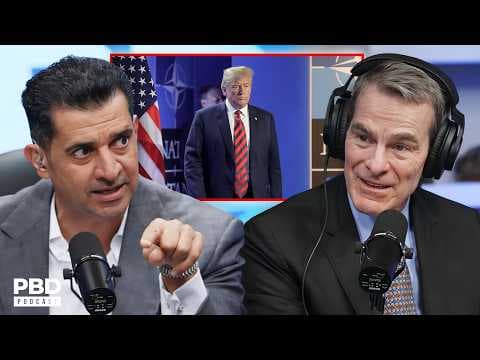
"Trump Has Been GRIDLOCKED" - The SECRET NATO Provision Handcuffing Trump EXPOSED
Audio Summary
AI Summary
The discussion centers on NATO, particularly the issue of member countries paying their minimum 2% GDP contribution. A key chart is presented, illustrating that from 2011 to 2016, under previous administrations, only two or three NATO members consistently met this 2% threshold. However, once Trump took office in 2017, the number of paying members steadily increased, reaching five in 2017, seven in 2018, nine in 2019, and eleven by 2020. This trend then saw a dip when Biden entered office, but by 2023, the number rebounded to eleven, with a projected increase to over thirty in the near future. This suggests a direct correlation between Trump's presidency and an increase in NATO members meeting their financial commitments.
A significant development in 2023, during the Biden administration, was the passing of a law requiring a two-thirds Senate vote for the US to withdraw from NATO. This is seen by some as a strategic move to prevent a future president, potentially Trump, from unilaterally leaving the alliance, given his past threats to do so. The question is raised whether NATO or the US administration anticipated Trump's potential return and enacted this measure for protection.
The conversation then delves into the implications of this gridlock. If the US president cannot unilaterally withdraw, it forces a reevaluation of strategy. One suggestion is to create parallel structures or alliances, effectively diminishing NATO's importance if it's perceived as ineffective or undesirable. This concept of realignment is exemplified by other geopolitical shifts, like those in the Middle East.
The specific law mentioned is Section 1258 of the National Defense Authorization Act for Fiscal Year 2024, designed to prevent a president from unilaterally withdrawing from NATO. Interestingly, senators Tim Kaine and Marco Rubio are noted as having signed on to this, despite their differing political stances. The law stipulates that withdrawal requires either a two-thirds Senate approval or a separate congressional law authorizing withdrawal.
One participant argues that NATO remains crucial and that the US should not abandon its allies. They contend that Vladimir Putin's actions in Ukraine have spurred European nations to increase their defense spending, which is a positive development. This perspective emphasizes NATO's role in collective defense and its importance as an alliance of democracies.
However, a contrasting view suggests that NATO may no longer be as important, particularly given the shifting global focus towards the Pacific region and the rise of China. It's argued that NATO's historical purpose, rooted in the Cold War era, might be outdated, and that its expansion has even antagonized Russia, potentially contributing to current conflicts.
A historical anecdote is brought up regarding a supposed offer from Putin to join NATO during Bill Clinton's presidency, which was allegedly rejected after Clinton made some phone calls. This is presented as a missed opportunity to integrate Russia into a "civilized" alliance, though others counter that Russia's trajectory under Putin made such integration unrealistic and that Putin's intent might have been to undermine NATO from within.
The discussion also touches on the expansion of NATO eastward, despite assurances made by James Baker that NATO would not expand "a foot past the Berlin Wall." This expansion, particularly towards Ukraine, is seen by some as a red line that provoked Russia's aggression.
The argument is made that the US, as the primary funder and protector of NATO, should have the leverage to threaten withdrawal, especially if other members are not contributing their fair share. The fact that only the US, France, and the UK possess nuclear weapons within NATO further emphasizes the US's disproportionate burden.
The conversation concludes with a strong endorsement for a business conference called "The Vault Conference," presented as a comprehensive event covering money, business, family, faith, and politics, with an expected attendance of 12,000 people.