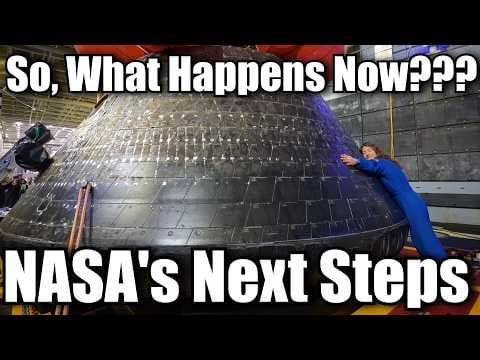
What Happens Next For Artemis? Can NASA Launch Artemis III Next Year?
Audio Summary
AI Summary
It's been less than a week since the crew of Artemis 2 returned from their voyage around the moon, proving the Orion spacecraft could sustain humans in deep space and paving the way for future Artemis program flights. While changes and an ambitious vision have been laid out, the biggest question is what happens next. The logical answer for the Artemis program is Artemis 3, expected next year. However, before then, up to four uncrewed missions are expected to land on the lunar surface, carrying payloads as part of NASA's commercial lunar payload services program.
The immediate focus is on getting SLS flying again and whether NASA and its partners can stick to the timeline for Artemis 3 next year. The plan is for Artemis 3 to fly into Earth orbit and rendezvous with human landing system (HLS) prototypes to verify control capabilities and life support. A major uncertainty is whether either HLS prototype will achieve orbit with the necessary capabilities. The current "space race" is between HLS providers, SpaceX and Blue Origin, and Artemis 3. Ideally, by this time next year, one or more landers will be in low Earth orbit, ready for rendezvous, and in the same orbital plane for potential visits from Artemis 3.
Currently, only renders and mock-ups of hardware have been seen. There's no visible progress at Starbase for a lunar Starship, and Blue Origin has yet to test the Mark 1 version of their Blue Moon lander, let alone the larger Mark 2 planned for humans. The Mark 1 has completed testing and is expected to be part of a Commercial Lunar Payload Services (CLPS) mission, but its success is unknown. The 2027 goal seems tough, but a silver lining is that neither spacecraft needs to go beyond Earth orbit, eliminating the need for numerous refueling flights. Both companies have publicly pledged to work harder. There are suggestions that Blue Origin might use their Mark 1 lander for human lunar landings, avoiding the need to test an entirely new lander design.
Axiom is also involved in the Artemis 3 race, providing lunar spacesuits. They hope to test these suits next year, primarily on the International Space Station (ISS) during an EVA. Having them ready for Artemis 3 would allow testing inside the lunar landing spacecraft.
The discussion then shifted to a competitive brain game called Matx, described as a "mind sport" where players solve number puzzles against others or the clock. It exercises mental arithmetic skills through various rounds, such as "math jewels" for speed and "ability jewels" for challenges like factorization. The game matches opponents at similar skill levels, allows invitations to friends, and tracks progress on leaderboards and online profiles. Matx offers multiple play styles, including "math blitz" challenges, "mind snap" for memorization, and puzzles like "crossmath" or "ken ken." Daily challenges allow players to compete for leaderboard rankings by solving puzzles quickly.
Returning to Artemis flights, historically, the SLS and Orion hardware have taken the longest. The question is whether NASA can launch Artemis 3 almost a year ahead of its original schedule. Examining the SLS launch system components:
- **Launch Platform:** Damage occurred, but upgrades were made after the previous flight to enhance robustness. It's expected to be ready when hardware arrives.
- **Booster Segments:** Solid boosters are being moved to Kennedy Space Center via train and will be among the first items stacked.
- **Booster Core:** Scheduled for rollout in April, but this is only 80% of the rocket. The aft section with engines is already at Kennedy.
- **Engines:** Still being tested at Stennis, expected to ship to Kennedy by July. Integration onto the core will follow. For Artemis 2, the booster core entered the Vehicle Assembly Building in December 2024 and wasn't flight-ready until a year later. This timeline will need to be compressed for an early 2027 launch.
- **Launch Vehicle Stage Adapter, Interim Cryogenic Propulsion Stage (ICPS), and Orion Stage Adapter:** These parts are already built. However, the change from a lunar mission to an Earth orbit mission for Artemis 3 might mean the ICPS (upper stage) is not needed. The SLS core booster is capable of putting the ICPS and Orion into orbit without the upper stage's propulsion. This could allow NASA to save the ICPS, providing an additional Block 1 SLS if needed, a prudent decision given uncertainties about adapting Vulcan's upper stage for SLS. However, this configuration was only planned for three flights, so hardware for a fourth flight would be needed. The launch vehicle adapter and Orion stage adapter are made at Marshall Space Flight Center, and production hardware has been idle. The ICPS is a Delta 4 upper stage, and the last one was finished in 2023, with production shut down. A replacement, possibly a structural test article from 2016, would need to be found and prepared.
- **Orion Spacecraft:** Already at Kennedy Space Center, it needs to be prepared for an earlier launch than its original January 2028 target, which is not expected to be a major problem.
- **European Service Module:** Already at the Cape and ready for integration.
- **Launch Escape System/Launch Abort System:** No anticipated problems.
For Artemis 2, stacking began in November 2024 and finished by October 2025 (11 months). This timeline will need to be expedited. It's presumed that platform repairs will take a couple of months, with booster and core stacking expected by summer. By then, more clarity on Artemis 3 plans will be needed, especially regarding crew selection. Four astronauts will need to be chosen: an Orion/SLS operations expert, a Starship pilot, a Blue Moon pilot/expert, and someone to test the spacesuits if that's part of the mission. The two crew members working with HLS partners will likely need to be assigned soon to embed with SpaceX or Blue Origin for training.
In the meantime, parts for Artemis 4 and 5 need to be built to maintain a production line. NASA aims for two lunar landing flights in 2028, but even one would be a success. HLS providers must complete their lunar landing demos, potentially reusing landers or flying new ones through the refueling cycle, which is a significant undertaking for a 2028 landing.
Several unmanned payloads are expected to land on the moon. The next CLPS mission is expected to be Blue Moon Mark 1, though the exact timing and payloads are unclear. NASA has provided a retroreflector and a "scalps" payload (cameras to observe exhaust plume interaction with the lunar surface). This mission will primarily validate Blue Origin's lander technology. Later in 2027, Blue Origin will use the Blue Moon lander to deploy the Viper rover, which was previously canceled but now has a chance to fly. Intuitive Machines' third flight is expected in 2026, and Astrobotic's Griffin spacecraft will carry the Astrolab Flip Rover. Firefly's Blue Ghost 2 aims for a far-side moon landing in December 2026.
NASA is also expected to assign new CLPS payloads to build out a lunar base, and it will be interesting to see what Gateway components are repurposed for the lunar surface. Beyond Artemis 5, NASA needs to consider future plans. SLS support in Congress is likely to continue, and if the Centaur 5 upper stage can be integrated with SLS, it could become a faster, more cost-effective operational program. Many changes are anticipated, but the hope remains for humans to walk on the moon in 2028.