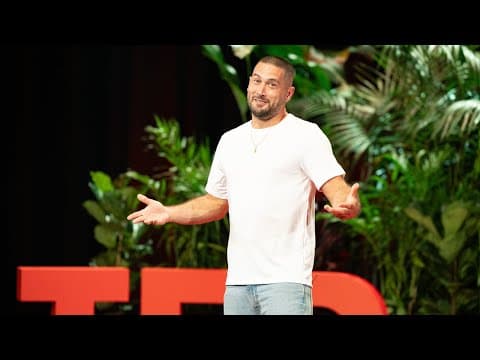
How To Gamify Your Life | Daniel Delby | TEDxSutherland
Audio Summary
AI Summary
The speaker describes feeling pressured by societal expectations to follow a linear life path with predetermined milestones. This pressure led to feelings of failure if he wasn't meeting these unspoken social KPIs. To combat this, he decided to "gamify" his life, treating himself as the main character in a video game. This involved exploring the map, seeking out challenges, and collecting tools, much like in a game where defeating bosses brings achievement and fun.
He contrasts his expected life at 39 – married with kids, a 9-to-5 job – with his reality: single, no children, but a married celebrant who loves love but can't seem to find it for himself. He's a co-host of the "Hard Yarns" podcast, a corporate MC, a writer and host of comedy quiz nights, and a full-time freestyle rapping comedian, all while being a teacher for children with learning difficulties in math and science. He attributes this multifaceted life to ADHD, which he was diagnosed with 20 years ago. He humorously notes that his diagnosis involved failing a test because he didn't finish it, leading the psychologist to declare him a "winner."
For the speaker, ADHD isn't a limitation but rather the "ability to do heaps of different stuff," which he playfully redefines as his acronym. He explains that with ADHD, he doesn't complete one "side quest" before starting another; instead, he tackles hundreds simultaneously, making his life fun and opening unexpected opportunities.
He uses the analogy of video game levels to describe his life. Level one was school, which he enjoyed and which laid the foundation for his academics and friendships. A pivotal moment in school was his first "boss battle" in Year 8: a freestyle rap battle against a Year 9 student. Initially confused, he learned it involved rhyming insults. Despite his inexperience, he accepted the challenge, performing in front of 300 kids. This experience, inspired by the movie "8 Mile," unlocked a hidden skill set and taught him the value of facing challenges head-on, even when unprepared. He emphasizes that in games, you don't avoid bosses; you seek them out, learn their weaknesses through failure, and level up your own skills. This "tool" of freestyle rap, though initially unconventional, became a valuable part of his "inventory."
Level two, university, proved more challenging. He restarted the level four times because the course syllabi sounded unappealing. He initially tried business law and biomed science, but eventually followed his intuition, choosing drama and physics. This decision went against societal stigma, but he embraced it, determined to excel. A mistake was choosing physics as a minor and drama as a major. His first attempt at teaching drama revealed his unpreparedness, leading him to restart the level a fourth time. He switched his major to physics and minor to drama, which, despite adding time and cost, allowed him to thrive and achieve high marks. However, upon starting his teaching career, he realized his passion was being ignored by teenagers and devalued by society.
The real boss presented itself as Level three, which paused his life. As a physics teacher, physical ability was crucial. In his final six months of his physics degree, a javelin throw resulted in a herniated disc, severely impacting his health and mobility. This injury prevented him from teaching physics and playing sports, a significant part of his identity. Instead of quitting, he viewed it as another side quest, a chance to "change games." He became a relief teacher, experiencing numerous classrooms and "gaming lobbies" filled with "32 mini smashers" (students) who employed "swarm tactics" to drain his health bar. He surprisingly enjoyed this, facing up to 150 different "characters" daily. He found that his sense of humor became his biggest defense weapon, breaking down student defenses and engaging them in learning. This allowed him to handle the most challenging classes, often those teachers were on stress leave for, which he found to be the funniest.
He shares an anecdote from his first day as a relief teacher, where a student's crude comment about "dragging balls" caught him off guard, highlighting the unexpected challenges of teaching. His friends, tired of being his sole audience, signed him up for an open mic comedy night. He viewed this as another side quest, a manageable five-minute challenge. While he initially believed he "killed it," he admits he "sucked, but not too bad." This experience helped him overcome the fear of public judgment and failure.
He realized his back injury, which he initially saw as the worst thing to happen, had actually opened a "hidden level" of opportunity. This led to a mix of terrible and award-winning comedy shows and solo performances. More importantly, it spawned "new players," leading to collaborations like "Thriving Together" and "Thriving Solo." He created a show called "Teacher Comedy Night," which sold out and allowed him to bring others along, something he couldn't have planned as a teenager. He emphasizes that there's no university course for mastering side quests or gamifying life, but he's mastered his "ADHD degree" to spread joy.
His core lesson is that starting is more important than being good. He never imagined his javelin injury would lead him to meet amazing people, travel, make people laugh, and embrace challenges. He encourages the audience to treat themselves as the main character, seek side quests, embrace challenges, press play, restart as needed, and gamify their lives for maximum fun.
He then introduces a bonus level: his freestyle rap skills, learned in high school, led him to a comedy show where he met another freestyle rapper, Max Shane. Together, they formed "Who's Ry," initially performing for two people but eventually playing to crowds of up to 14,000 at festivals. They then engage the audience in a freestyle rap game, asking them to hold up items from their pockets, purses, or handbags for them to rap about. They demonstrate by rapping about various items like Vaseline, an espresso shot, a water bottle, a lanyard, a watch, a nine of spades, wet wipes, keys, a Google Chrome device, medication, a puffer, a shoe, coffee, and a dental floss pick, often incorporating themes of ADHD and their experiences.