Class 6 Radioactivity & Energy & Pressure Ol Camb حملة الانقاذ
AI Summary
An atom consists of three subatomic particles: protons, neutrons, and electrons. Protons and neutrons reside in the nucleus, while electrons orbit in outer shells. Protons have a charge of positive 1e (1.6 x 10^-19 Coulombs), neutrons have no charge, and electrons have a charge of negative 1e (-1.6 x 10^-19 Coulombs). Alpha particles, which are helium nuclei, consist of two protons and two neutrons, giving them a charge of positive 2e (3.2 x 10^-19 Coulombs).
Regarding mass, protons and neutrons each have a mass of approximately 1 atomic mass unit (U), while an electron's mass is significantly smaller, about 1/2000 U.
Elements are represented in the periodic table by their atomic representation or nuclide notation. This notation includes the element symbol, mass number (nucleon number) above, and proton number (atomic number) below. For a neutral atom, the proton number equals the electron number. The number of neutrons is calculated by subtracting the proton number from the mass number.
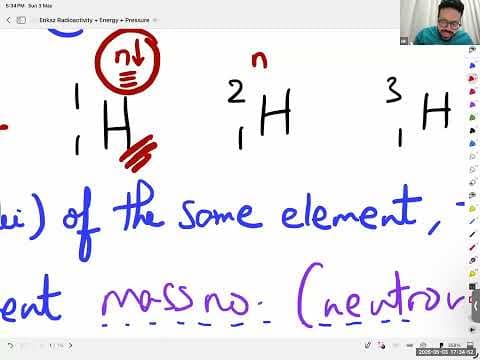
Isotopes are atoms of the same element with the same atomic number (same protons and electrons for a neutral atom, hence same chemical properties) but different mass numbers (different number of nucleons or neutrons, thus different physical properties like density, melting point, and boiling point). For example, hydrogen has isotopes like protium (hydrogen-1), deuterium (hydrogen-2), and tritium (hydrogen-3).
Beta particles are fast-moving electrons, represented as 0/-1 e. Alpha particles are helium nuclei, represented as 4/2 He. Gamma rays are electromagnetic waves with no mass or charge, represented as 0/0 γ.
The abundance of an isotope in nature is related to its stability. Generally, isotopes with a stable ratio of neutrons to protons are more stable. An increase in the number of neutrons can lead to instability, making the element radioactive.
Radioactivity is the process where unstable nuclei emit alpha, beta, or gamma radiation to become more stable daughter nuclei. The original unstable nucleus is called the parent. Daughter nuclei are more stable than parent nuclei.
Comparing alpha, beta, and gamma radiation:
- **Nature:** Alpha is a helium nucleus (2 protons + 2 neutrons). Beta is a fast-moving electron. Gamma is an electromagnetic wave of high frequency and energy.
- **Mass:** Alpha has a mass of 4 U. Beta has a mass of 1/2000 U. Gamma has zero mass.
- **Charge:** Alpha has a charge of +2e. Beta has a charge of -1e. Gamma has zero charge.
- **Ionization Power:** Alpha is the strongest ionizer, followed by beta (moderate), and gamma (weakest). This is because alpha particles have the largest mass and charge, leading to more frequent collisions with atoms. This makes alpha radiation the most damaging.
- **Range in Air:** Alpha travels a few centimeters (up to 10 cm). Beta travels a few meters. Gamma travels several kilometers.
- **Stopping Material:** Alpha is stopped by a sheet of paper. Beta is stopped by 3-4 millimeters of aluminum. Gamma requires a thick wall of lead (e.g., 3 cm) or concrete (e.g., 50 cm).
- **Behavior in Electric Field:** Alpha, being positive, deflects towards the negative plate. Beta, being negative, deflects towards the positive plate. Beta experiences a larger deflection than alpha due to its lighter mass. Gamma, being neutral, passes straight through without deflection.
- **Behavior in Magnetic Field:** Using Fleming's Left-Hand Rule, alpha (positive charge flow) and beta (negative charge flow, so current in opposite direction) will deflect. Gamma, having no charge, passes straight through.
Radioactivity is measured using a Geiger-Mueller (GM) detector. The unit of activity is counts per second or Becquerel (Bq). When measuring radioactivity, it's crucial to account for background radiation.
Background radiation is the natural radioactivity or radiation present in the environment even without a specific radioactive sample. Sources include rocks in building materials, radon gas in the air, cosmic rays from outer space, and even food and drink. To obtain an accurate "corrected reading," the background radiation count must be subtracted from the total reading. Background radiation is assumed to be constant.
Radioactive decay is characterized by its half-life, which is the time taken for the radioactivity of a sample to decrease to half its initial value. Radioactive substances never fully decay to zero. This necessitates proper disposal of radioactive waste.
To identify unknown radiation (alpha, beta, or gamma):
1. Place a sheet of paper in front of the source. If the reading drops to zero, it's alpha.
2. If paper has no effect, place a 3mm sheet of aluminum. If the reading drops to zero, it's beta.
3. If aluminum has no effect, the radiation is gamma.
In nuclear reactions (decay equations):
- **Alpha decay:** The mass number decreases by 4, and the atomic number decreases by 2. For example, X(A/Z) -> Y(A-4/Z-2) + α(4/2).
- **Beta decay:** The mass number remains the same, and the atomic number increases by 1. This occurs when a neutron in the nucleus converts into a proton and an electron (beta particle). For example, X(A/Z) -> Z(A/Z+1) + β(0/-1).
- **Gamma decay:** Neither the mass number nor the atomic number changes, as gamma radiation has no mass or charge. It is usually emitted after alpha or beta decay to release excess energy.
When mass changes during a nuclear reaction (e.g., X -> α + Y), the total mass of the products (α + Y) might be slightly less than the initial mass of X. This "missing mass" is converted into the kinetic energy of the products.
Hazards of ionizing radiation:
Ionizing radiation can cause skin burns, mutations, and cancer. Precautions include using lead shields, long handling tools, keeping sources in lead boxes, avoiding overexposure, and increasing distance from the source.
Applications of radioactivity:
- **Determining atomic structure:** Rutherford's gold foil experiment used alpha particles to deduce that the atom has a small, dense, positively charged nucleus and mostly empty space.
- **Detecting leaks in pipes:** A gamma source is used because gamma radiation can penetrate soil and be detected externally. The isotope used should have a short half-life to prevent long-term contamination.
- **Tracking thickness of sheets:** Beta radiation is used because it is partially stopped by the sheet's thickness, allowing for monitoring and adjustment. Alpha would be completely stopped, and gamma would pass through largely unaffected.
- **Smoke sensors:** Alpha sources are used. Smoke particles block the alpha radiation, reducing the current in the detector and triggering the alarm. Americium-241 is commonly used.
- **Sterilizing food:** Radiation kills bacteria.
- **Medical tracers:** Gamma sources with short half-lives are injected into the body to track blood flow or detect cancer. Gamma is used because it can exit the body to be detected. A short half-life minimizes damage to the patient.
- **Radiation therapy for cancer:** Specific radioactive isotopes are injected to target and destroy cancer cells.
Nuclear reactions:
- **Nuclear Fission:** A fast-moving neutron is absorbed by a large, unstable nucleus, causing it to split into smaller nuclei, releasing a large amount of energy. This is used in nuclear power stations.
- **Nuclear Fusion:** Two small nuclei join together to form a larger nucleus, releasing a vast amount of energy. This process requires extremely high temperatures and pressures (millions of Kelvin) to overcome the electrostatic repulsion between the positively charged nuclei. It occurs in the sun and stars.
Energy:
Energy is a scalar quantity, measured in Joules (J). It can be converted from one form to another but cannot be created or destroyed (Law of Conservation of Energy).
- **Gravitational Potential Energy (GPE):** Energy stored due to height and gravity. GPE = mgh, where m is mass (kg), g is gravitational field strength (N/kg), and h is vertical height (m).
- **Kinetic Energy (KE):** Energy due to motion. KE = 1/2 mv^2, where m is mass (kg) and v is velocity (m/s).
- **Chemical Energy:** Energy stored in chemical bonds (e.g., food, fuel, batteries).
- **Thermal Energy:** Related to friction, rubbing, or contact.
- **Strain/Elastic Potential Energy:** Energy stored when an object's shape is changed (extension, compression, bending, twisting).
- **Light, Sound, Electrical Energy.**
- **Internal Energy:** The sum of kinetic and potential energies of particles within a substance. Kinetic energy of particles relates to temperature (heat), and potential energy relates to chemical bonds.
In scenarios where energy is converted from GPE to KE (e.g., an object falling), assuming no energy loss to air resistance or friction, mgh = 1/2 mv^2. The mass 'm' cancels out, showing that the final velocity is independent of mass. In reality, air resistance causes energy loss, making the actual speed less than the calculated value.
Work Done:
Work done is force times parallel distance (W = Fd). It is a scalar quantity, measured in Joules. Energy can be transferred mechanically (work done), electrically, by heating, or by electromagnetic waves. Work done against friction results in energy loss, typically as heat.
Power:
Power is the rate of work done or energy transfer over time (P = W/t or P = E/t). It is measured in Watts (W) or Joules per second. Power and time are inversely proportional.
Efficiency:
Efficiency is the ratio of useful output energy (or power) to total input energy (or power), multiplied by 100%. Efficiency = (Useful Output / Total Input) x 100%. Output and input must be in the same units (Joules or Watts). Efficiency is always less than or equal to 100%, with 100% being ideal and rarely achieved in practice.
Pressure:
Pressure is force exerted per unit area (P = F/A). Force is in Newtons (N), area in square meters (m^2) or square centimeters (cm^2). The unit of pressure is Pascal (Pa) or N/m^2.
- **Pressure in fluids:** P = ρgh, where ρ is density (kg/m^3), g is gravitational field strength (N/kg), and h is depth (m). This formula calculates the pressure due to the weight of the fluid.
- **Total pressure:** To find the total pressure at a certain depth in a fluid exposed to the atmosphere, atmospheric pressure must be added to the fluid pressure.
- **Force exerted by fluid:** Force = Pressure x Area.
- In a container with taps at different depths, the tap at the lowest depth will have the highest pressure and thus the largest rate of water flow due to the greater weight of the fluid above it.