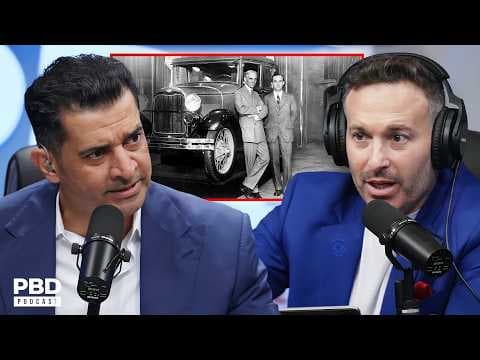
"The GUILT Of Being Wealthy" - How Foundations MANIPULATE Billionaire Donors
Audio Summary
AI Summary
In 1935, Henry Ford II, the second richest man in the world after Rockefeller, faced a significant challenge due to tax reforms introduced by the Roosevelt administration. These reforms demanded 70% of large inheritances, which meant that upon his father's death, the Ford family would be forced to liquidate their stock and lose control of the company. Despite his philanthropic reputation, having donated an estimated $37.6 million to charity during his lifetime and establishing institutions like a world-class hospital in Detroit and the Henry Ford Museum, Ford did not believe in simply giving away money. He emphasized providing opportunities for people to make things for themselves.
To address the inheritance tax issue, Henry Ford II established the Ford Foundation. Initially, he was the primary donor, and the foundation's board consisted of only two other trustees, both employees of the Ford Motor Company. This structure ensured that the foundation's operations aligned with Ford's original vision and priorities, which were largely focused on Michigan.
However, over time, a shift occurred. Henry Ford II was persuaded to democratize control of the foundation, believing it was a moral responsibility and a best practice for charitable organizations. As the number of trustees increased, their influence grew, and they began to challenge Ford's opinions despite him being the sole source of funding. The foundation's priorities expanded beyond Michigan to a global scope. In 1950, a report outlined five new areas of action: economic improvement, education, freedom and democracy, human behavior, and world peace. By 1953, the foundation moved its operations from Detroit to New York City, and by the 1970s, Henry Ford's Detroit was left to crumble.
The loss of control became almost total. Henry Ford II's requests for donations to the Henry Ford Hospital, which he had founded, were flatly denied by the foundation's president, McGorge Bundy, who prioritized "more important things" related to global matters. Author Heather McDonald noted that the foundation's focus became the entire world.
A more radical shift occurred in the 1970s when the Ford Foundation became involved in eugenics and population control, driven by fears of global starvation. For instance, foundation official Douglas Enminger created a large-scale sterilization program in India, offering vasectomies to millions. This program's infrastructure was later co-opted and made mandatory by then-Indian Prime Minister Indira Gandhi, leading to the forced sterilization of over 6 million men in 1976 alone.
In December 1976, Henry Ford II, having lost all control, resigned from the foundation. In a public letter, he expressed his regret, stating that he had made a mistake by not retaining control. He noted that the foundation's diverse ventures had diluted its mission and societal purpose.
Today, the Ford Foundation continues to operate, but its activities are completely divorced from the original Ford family's values. Recent donations include millions to the Southern Vision Alliance, a group identified as a creation of the revolutionary Marxist-Leninist World Workers Party. The foundation has also given $300,000 to build "grassroots Muslim power" and $600,000 to a Chinese state think tank to promote an internationally accepted ESG system with Chinese characteristics. In 2020, their blog announced support for grantees at the forefront of change, including those advocating for dismantling the Minneapolis police department.
This situation with the Ford Foundation highlights a broader concern regarding charities. Other examples of charitable endeavors that have faced issues include the American Red Cross, which raised half a billion dollars after the 2010 earthquake but built only six permanent structures for shelter; the Gates Foundation's ineffective multi-billion dollar efforts to reform the US school system; Madonna's $15 million Malawi Academy for Girls Project, which was destroyed before breaking ground after millions were wasted on salaries, cars, and golf memberships; and LeBron James' I Promise school, where no eighth-grade student passed the math test in three years.
The speaker emphasizes that unless the person running a charity is actively involved and trusted, it is better to leave 100% of one's money to family and children. He argues against the "die with zero" concept, calling it the "dumbest idea in the world" after observing what happened to the Ford Foundation. The speaker advocates for giving to charity today if the administrators are trustworthy, but not leaving inheritance to charities where control and values might change.
The speaker also discusses the pressure on billionaires to donate to charity and cites Warren Buffett's recent withdrawal from the Bill Gates Foundation as an example of changing perspectives. He advises controlling charitable giving to ensure it aligns with one's values and principles, even writing these stipulations into a will or trust. The ultimate wealth created, he argues, is for oneself and one's family, to provide children with a head start in life. He cites 2 Corinthians 12:14, which states that children should not save up for their parents, but parents for their children, reinforcing the idea of parental responsibility to provide for their offspring.
The speaker attributes the initial decision to give away wealth and relinquish control to a "guilt of being wealthy" or "survivor's guilt," suggesting that Henry Ford II felt a need to give away money because he was too rich. This guilt, he believes, leads founders to extend control to others, who then steer the organization in directions contrary to the founder's original intent.
The speaker concludes by urging the audience, particularly those who are wealthy, to take estate planning and living trusts seriously to prevent their money from being misspent by organizations whose causes do not align with their own. He also shares a personal anecdote about the increasing demand for "size 14" shoes for his new shoe line, which he describes as comfortable, functional, and luxurious, handmade in Italy with super foam technology.