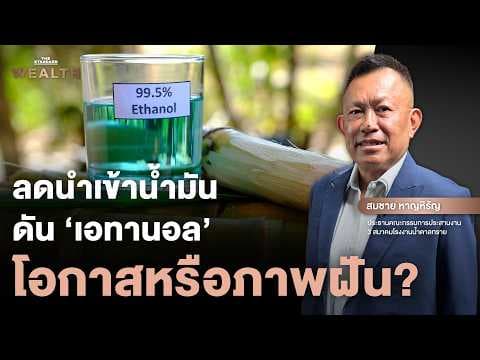
ราคาน้ำมันผันผวนไม่หยุด ‘เอทานอล’ คือคำตอบ หรือแค่ภาพฝันทางนโยบาย | Exclusive Interview EP.75
Audio Summary
AI Summary
The video discusses the impact of oil prices on electricity consumption and the role of ethanol as an alternative fuel, particularly in Thailand. A 1% rise in oil prices leads to a mere 1% reduction in electricity consumption, indicating low price elasticity. This is attributed to the low cost of oil, often due to tax reductions, subsidies, and reduced marketing expenses, which are presented as short-term solutions.
The ethanol industry, it's argued, cannot thrive naturally and requires government management and support, especially during periods of low oil prices. Volatility in oil prices significantly impacts the entire economy. While oil is a commodity with high price flexibility, meaning usage is affected by price changes, the speaker notes that even a 1% increase in oil prices results in a very small decrease in usage, around 0.1% to 1%.
Increasing ethanol use, such as transitioning from E10 to E20, can reduce dependence on foreign oil imports, potentially saving billions annually. A crisis is defined by unavailability, unaffordability, or widespread impact. In Thailand, oil price increases, even with subsidies, are substantial, averaging around 50% and impacting GDP. This leads to inflation and increased costs across various sectors, prompting consumers to become more frugal. Job losses and economic vulnerability are also consequences.
Current ethanol blends like E10 and E20 are underutilized. The proposal to increase ethanol use to E20 could boost ethanol production significantly, but its impact on reducing oil imports is limited to a few percentage points. Ethanol helps reduce dependence on foreign oil, contributing to energy security and reducing volatility.
The feasibility of increasing ethanol production depends on agricultural output, such as sugarcane. Brazil's long-standing ethanol program, initiated in the 1970s, serves as a model. This program involves revenue sharing between farmers and ethanol plants and requires a complex, long-term political commitment. Key to Brazil's success is government regulation of vehicle engines to accommodate high ethanol blends and public awareness campaigns. For ethanol to be competitive, its price should be significantly lower than gasoline.
Thailand needs to prepare its supply side for increased ethanol use, ensuring raw material availability. Transitioning to E20 is seen as feasible in the short to medium term, but higher blends require substantial agricultural expansion. A major challenge for Thailand is the dominance of imported car models, making it difficult to mandate flexible-fuel engines. Furthermore, the country is shifting towards electric vehicles, which could sideline investments in internal combustion engine technology.
Effective policy implementation requires inter-ministerial collaboration, including energy, agriculture, industry, and commerce. Quotas and import controls on ethanol are necessary to support domestic production and prevent over-reliance on imports. The government's role is crucial in managing subsidies and mandating fuel blends to ensure the ethanol industry's survival and profitability.
Ultimately, addressing structural issues in the energy sector requires a comprehensive approach, from agricultural production to energy consumption, with strong political will and long-term planning. The current low oil prices are a result of short-term measures like tax reductions and subsidies, which do not solve the underlying structural problems.