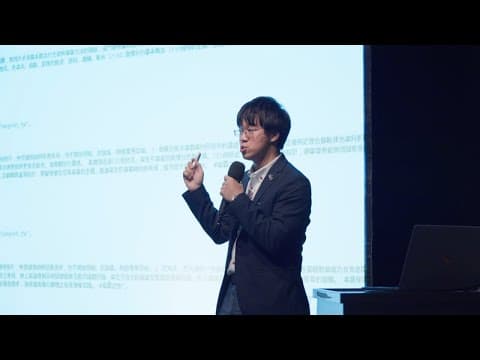
重新思考「跳脫框架」 | 顥天 呂 | TEDxNTHU
Audio Summary
AI Summary
The speaker begins by discussing the learning process, emphasizing that it's not always about innate talent but rather the conditions and environment that foster learning. They share a personal anecdote about a project they worked on in university, initially a small mapping tool, which evolved into a larger project that surprised them with its success. This experience highlighted the power of unexpected outcomes and the excitement of pushing boundaries.
The narrative then shifts to the importance of community and diverse perspectives in learning and innovation. The speaker mentions attending various events and engaging with different teams and research groups, underscoring the value of collaboration and the exchange of ideas. They express a desire to understand how others approach problem-solving and learning, particularly in finding common ground and effective methods.
A significant portion of the transcript delves into the concept of learning and knowledge acquisition, using the analogy of learning to "fish" versus being given a "fish." The speaker argues that true learning involves understanding the underlying principles and processes, enabling individuals to become self-sufficient. They illustrate this with a simple example: learning to use a cane requires understanding its purpose and how to wield it effectively, rather than simply being handed one. This personal agency in learning and creation is presented as a key differentiator.
The speaker then introduces a project involving a "Citrix API" and a search platform, detailing its development journey. They recount a situation where a friend, facing a challenge, was able to find a solution by leveraging available information and tools, highlighting the practical application of learned skills. This leads to a discussion about the creation of an "effective effect" and the subsequent development of more advanced tools and APIs.
A core theme emerging is the distinction between theoretical knowledge and practical application. The speaker emphasizes that while theory is important, it's the ability to translate that theory into tangible actions and solutions that truly matters. They differentiate between learning for personal growth and learning for a specific purpose, suggesting that the latter requires a more focused and problem-oriented approach.
The concept of a "framework" is explored in the context of education. The speaker questions whether an educational framework should be rigid or adaptable, and what the ultimate goal of learning within such a framework should be. They propose that a framework should facilitate learning what is necessary and desirable, without being overly restrictive. The structure of learning, they suggest, is about understanding and applying rules, both personal and societal.
The speaker then reflects on their own research journey, mentioning their studies at Western American universities and the importance of questioning existing curricula. They express a strong passion for research, driven by a desire to explore and prove their capabilities. This personal drive to push beyond comfort zones and challenge existing paradigms is presented as a crucial element of their work.
The idea of "breaking out of the structure" is revisited, not as an act of rebellion, but as a natural progression towards growth and achieving new goals. The speaker suggests that individuals often feel a pull to move beyond their current circumstances, even if they are comfortable. This desire for advancement and exploration is framed as a fundamental human drive.
The transcript also touches upon the idea of navigating complex environments and the importance of planning and persistence. The speaker acknowledges that moving into unfamiliar territory can be disorienting, but emphasizes that it's a necessary step for progress. The "circle" is used metaphorically to represent a continuous process of learning and adaptation, rather than a fixed boundary.
Finally, the speaker reiterates their commitment to research, driven by a "strong focus of their human knowledge." They express a clear vision and a determination to challenge themselves. The concluding remarks touch upon the idea of reviewing social constructs and the importance of scientific rhetoric in achieving goals. The overarching message is one of continuous learning, personal growth, and the pursuit of ambitious objectives through a combination of theoretical understanding and practical application.