When Reality Becomes Editable, Who Stays in the Picture? | Ziyao Zhuang | TEDxWLSA Shanghai Academy
Audio Summary
AI Summary
The speaker begins by sharing a childhood story about a machine that transports people to the moon by scanning, destroying the original, and rebuilding them. The main character, Jay, travels to the moon, only to find assassins after him, appointed by his wife and, shockingly, another version of himself on Earth. The Earth-bound Jay, upon attempting to use the machine, is told to return home, but then discovers a copy of himself already on the moon. This raises the question: which Jay is real, and why were assassins only after Moon-Jay?
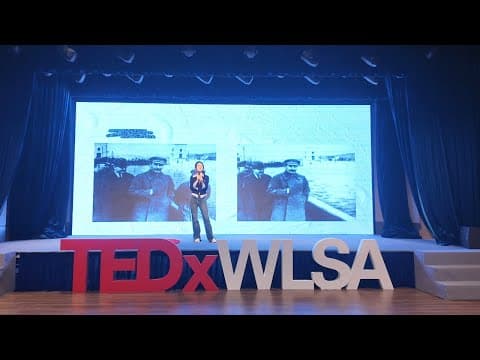
This seemingly fantastical story now feels relevant in an era where reality is editable—digitally, socially, and potentially physically. Photo editing, a common technology, has been used for nearly a century to manipulate reality. An example is the removal of Nikolai Yezhov from a photograph with Stalin, effectively erasing his existence from public memory. This manipulation challenges our understanding of reality and whether body continuity defines identity.
Drawing on philosophy, the speaker questions what makes us "us" when our bodies constantly change. Psychologist Elizabeth Loftus's research on memory, comparing it to an editable Wikipedia page, further complicates this. Our memories are not perfect archives; they can be revised by others or ourselves, meaning our sense of identity isn't based on an unalterable past. Split-brain research, particularly concerning the left-brain interpreter, reveals that when memories are incomplete, our brains invent explanations to maintain a continuous sense of self, bridging gaps in our personal history.
Revisiting the Jay story, the speaker asks what makes either version the "same person" or even "real." The answer, they suggest, lies in power. George Orwell's quote, "Who controls the past controls the future, and who controls the present controls the past," highlights this. In the story, Earth-Jay had more power—a wife, bank accounts, a passport, and an official timeline—making him the "legitimate" version and giving him control to send assassins.
This concept extends to edited history, where individuals are erased due to a lack of witnesses or records. Minorities often face this, with their names misspelled, languages dismissed, and stories told without their true representation. Power, then, is defined as the control over another person's story and the ability to create a definitive narrative.
The speaker concludes by reiterating the central question: when reality, time, appearance, and even oneself become editable, who has the ability and control to stay in the picture?