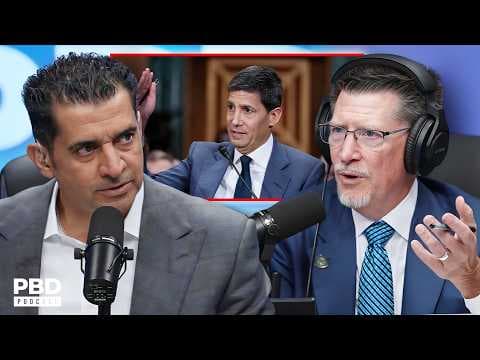
“Trump’s Sock Puppet” - Kevin Warsh CLASHES With Warren At HEATED Fed Hearing
Audio Summary
AI Summary
The discussion begins with the confirmation hearing of a new Fed chair, focusing on an exchange with Senator Elizabeth Warren. Warren pressed the nominee, identified as Mr. Worsh, to verify the 2020 election results. Worsh responded by stating that the body had certified the election years ago, emphasizing the need to keep politics out of the Federal Reserve if confirmed. Warren persisted, questioning his independence and courage. The conversation then shifted to a later exchange where Warren accused the nominee of being a "sock puppet" for Donald Trump, suggesting that his installation as chair would aid an "illegal takeover of the Fed" and lead to "corruption and economic catastrophe."
An unexpected observation during these clips was the presence of Larry Fitzgerald, the former NFL wide receiver, sitting behind Kevin Worsh. This led to questions about his attendance, which remained unanswered but was noted as an interesting detail.
The conversation then delved into the political nature of the Fed chair's appointment and the role itself. Tom remarked that Elizabeth Warren would find an angle to criticize anyone, regardless of their qualifications, due to her staunch anti-Trump stance. He described Worsh as intelligent and having a moderated view of the Fed's tools, suggesting he would offer gentle, forward-looking adjustments rather than radical shifts. Tom expressed support for Worsh, recalling that he was a favored candidate and that his feisty, measured responses to Democratic pressure were positive.
David added that the entire process is "great political theater," emphasizing that the choice of Fed chairperson is always political. He cited examples like Janet Yellen, appointed by Obama and working in the White House, and Alan Greenspan, who wrote speeches for President Ford. However, David stressed that the Fed chairperson is largely a figurehead with only one vote on the Federal Open Market Committee (FOMC). He clarified that decisions on interest rates and policy require a majority or consensus from the entire FOMC, which includes governors, the president of the New York Fed, and rotating bank presidents. David argued that the power of the chair is often "overplayed," noting that even Donald Trump's pressure on Powell was directed at an individual with only one vote, rather than the entire committee. He drew a football analogy, comparing the chair to a quarterback leading a team, not solely responsible for all decisions.
Brandon echoed the sentiment about overplaying the chair's power, wishing Trump had attacked the "concept of the Fed" rather than just its head. He observed a lack of diversity in opinion among Fed members, often falling into "dove" or "hawk" categories, and suggested they tend to "overcorrect." Brandon noted Worsh's past inconsistent positions on interest rates, appearing dovish or hawkish depending on the political climate. While not "super excited," he viewed Worsh as a "slight better than Powell," whom he believed was "consistently wrong," having "loosened too much in 2020" and "tightened too quickly—too late." Brandon concluded by stating that a "serious economy" would not exist until the Federal Reserve's control over the "price of money goes away or changes."
The discussion highlighted the fact that Jerome Powell, despite criticism, was appointed by Trump, underscoring the complexities of political influence and the Fed's independence. The point was made that Powell "did his job," despite controversies related to spending. It was also noted that Worsh could potentially serve under multiple presidents, given the six-year term.
A "dot plot" chart was presented, illustrating the collective projections of Fed voters on interest rates. While the chair has one vote, their influence on these projections and the lobbying efforts within the group are significant in "keeping the peace" and guiding policy. The majority of dots showed only a quarter-point reduction for year-end 2026 and another for the following year, indicating a measured approach unless economic data drastically changes. The "summary of economic projections," published periodically, also informs these outlooks.
The conversation concluded with a promotional segment for the Vault Conference, scheduled for 2026 in Las Vegas at the MGM Grand Arena. The conference is expected to host over 12,000 attendees, including entrepreneurs, CEOs, and business leaders. It was emphasized that over 6,000 attendees are decision-makers running companies with revenues from $25 million to over $500 million, and more than 2,000 CEOs lead teams of 75+ employees. The conference boasts high engagement with sponsors, with 85% interacting on-site and over 71% actively opting to connect directly through the event app. Sponsorship opportunities range from premium custom booths to brand visibility on the Las Vegas Strip, with potential for on-stage moments and ads on screens. Past sponsors included industry leaders like PayPal and Tony Robbins. The pitch encouraged businesses to secure sponsorship spots, highlighting the potential for scaling businesses through direct connections and qualified leads.