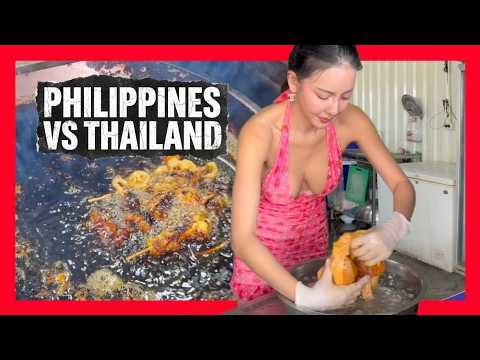
Why Is FILIPINO STREET FOOD Ranked Among the WORST in the World?
Audio Summary
AI Summary
Filipino food is often ranked poorly despite the Philippines being geographically located among countries celebrated for their cuisine, such as Thailand, Vietnam, Japan, and Indonesia. This discrepancy, it is argued, is not primarily a food story but a health story, with alarming statistics about the health of Filipinos.
Filipinos face a 25% chance of dying from heart disease, cancer, diabetes, or lung disease between the ages of 30 and 70, significantly higher than the Western Pacific regional average of 15%. Unlike most of the region where these numbers are declining, in the Philippines, this rate increased between 2000 and 2019, indicating a worsening health trend. This is puzzling given the Philippines' extensive coastlines, suggesting an abundance of fresh fish, and a climate suitable for growing diverse produce.
The key to understanding this contradiction lies in the street food, which forms the backbone of daily eating for millions of Filipinos. A common observation at Filipino street stalls is the prevalence of deep-fried, uniform items. This contrasts sharply with Thai street stalls, which, despite similar tropical heat and economic pressures, offer freshly prepared dishes like shredded papaya, cut lemongrass, and made-to-order curries and noodles. The difference is attributed to "turnover."
In high-volume Thai street stalls, cooking oil is changed regularly due to the rapid movement of food, making fresh oil a necessary part of daily operations. In slower Filipino stalls with fewer customers and thinner margins, cooking oil is reused and reheated repeatedly. Reheating oil past its smoke point causes it to break down chemically, producing acrylamides, compounds linked to cancer risk. This means the crispy texture in some Filipino street food might come from oil heated and cooled dozens of times, failing basic quality checks in Western countries. This situation is not blamed on vendors, who are simply trying to survive, but on a systemic problem.
Lifestyle diseases now account for 70% of all deaths in the Philippines, with over 600,000 Filipinos dying annually from heart disease, cancer, and diabetes. In Thailand, these numbers are lower and declining, while in the Philippines, they are climbing.
A particularly alarming trend is the impact on young Filipino women, with obesity rates significantly higher in women (around 20%) compared to men (around 3%). This large gap is crucial as belly fat is a major risk factor for heart disease, diabetes, and stroke. The base culture of eating in the Philippines is built on "survival ingredients" that strip out nutrition. The average Filipino diet scores a low 19 out of 100 on the global healthy eating index, compared to Thailand's score of more than double that. The typical Filipino adult diet primarily consists of refined rice, pork, fats, oils, and bread, with critically low intake of vegetables, fruits, and dairy. This dietary pattern, sustained over a lifetime, accumulates and manifests in the mortality data.
While it might seem like a poverty issue, Thailand, which faced similar post-war poverty and rapid urbanization, has resolved this contradiction. Three in ten Filipino households still experience moderate to severe food insecurity, yet obesity rates are simultaneously climbing—a "triple burden of malnutrition" encompassing underweight, overweight, and micronutrient deficiency. Life expectancy in the Philippines is 71 years, almost six years less than Thailand's 77 years, a loss attributed quietly, daily, one meal at a time.
Beyond the reused oil and processed ingredients, some Filipino street foods contain substances that would not pass regulatory review in Europe, Canada, or Japan. Processed meats, like hot dogs on sticks, use chemicals to maintain color and shelf life, increasing cancer risk with frequent consumption. Artificial colorings, such as yellow five and yellow six, found in cheap snacks and drinks, require warning labels in the European Union but not in the Philippines. Potassium bromate, a chemical used in cheap commercial bread, is banned in many countries but not in the Philippines.
Thailand, despite having its own processed food industry, has a stricter regulatory framework, a nutritionally denser baseline diet, and its street food generally does not rely on these harmful additives to be palatable. The destructive diet in the Philippines persists, not due to a lack of care, but because the surrounding system perpetuates it.