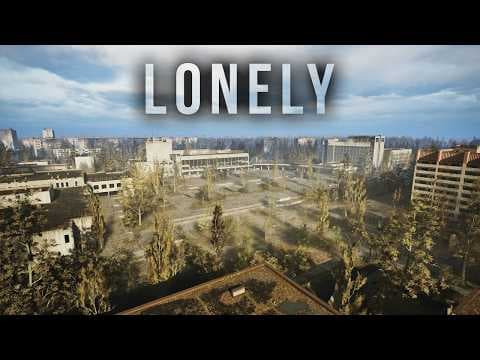
20 Open World Games That MAKE YOU FEEL LONELY
Audio Summary
AI Summary
This summary explores 20 open-world games that evoke a profound sense of loneliness, often intentionally, through their design, atmosphere, and gameplay mechanics.
Starting with **Stalker 2, Heart of Chernobyl**, the game offers a meticulously detailed, oppressive, and grim recreation of the Chernobyl exclusion zone. Despite the presence of human NPCs, vast stretches are barren, populated only by mutant monsters. Limited fast travel options force players to trudge slowly through the world, accompanied by only ambient sounds. The unforgiving nature of the game, with its premium on carrying capacity, quick-killing bandits, and invisible anomalies, amplifies the feeling of isolation. Even in seemingly dangerous abandoned facilities, nothing alive might be present, yet signs of former life are everywhere. Unlike many bombastic post-apocalyptic games, Stalker’s huge world and forced traversal ensure players can spend hours without encountering anyone.
**Legend of Zelda: Breath of the Wild** achieves loneliness through its presentation. Quiet, distant music and atmospheric sound effects emphasize the world's vastness and the significant empty spaces between major points of interest. This design, a departure from previous Zelda titles, intentionally fosters wanderlust and a sense of loneliness and loss, showcasing the ruins of a post-apocalyptic Hyrule. Despite cheerful NPCs and towns, players often wander alone.
**Shadow of the Colossus**, a classic, shares thematic similarities with Breath of the Wild but is fundamentally a boss rush. The open world connecting these fights, devoid of minor enemies, points of interest, or complex navigation, primarily serves to build a forlorn mood. The game's tragic story is wordlessly conveyed through music, sound, and the quiet solitude of its atmosphere, with sadness permeating the bleak, abandoned world. The quiet, lonely periods between epic Colossus battles are crucial to their impact.
**No Man's Sky**, while not inherently sad, can be a solitary experience, especially when playing solo. Although current versions allow for multiplayer interaction and NPC encounters, the core gameplay revolves around exploring planets and building bases alone. With co-op turned off, it becomes a quiet, isolating, and even meditative experience.
**Subnautica** is described as a horrifying game despite not being explicitly horror. It makes players feel small and alone by stranding them on a water-based alien planet, with escape as the sole objective. The journey requires diving deeper into dark, alien-filled depths, far from resources and air. The constant threat of drowning and the rarity of dangerous creatures, appearing at the worst possible times, contribute to a stressful and isolating experience in an environment hostile to human life.
**Journey** is unique as a multiplayer game that paradoxically enhances the feeling of loneliness. Players control a nameless robed figure in a desert, heading towards a distant mountain. While other players can be encountered, active choice is needed to stay together, otherwise, drifting apart is easy. This subtle multiplayer system makes the solitude more profound, allowing players to piece together a story from the ruins of a dead civilization.
**Project Zomboid** is a zombie survival game that debunks the myth of the rugged loner. Going it alone almost guarantees death from mundane accidents or overwhelming zombie hordes. Even building a self-sustaining compound can feel lonely, with only the moans of zombies for company in a bleak world where the player's eventual death is a certainty.
**Just Cause 3** unintentionally creates a lonely open world. The main island is vast and empty, with large stretches of wilderness between objectives. The ability to move quickly through this emptiness paradoxically amplifies the solitude. Despite being an action game, the second half of the map feels quiet and lonely, suggesting a possible design oversight due to the map's size.
**Fuel**, an open-world racing game, embraces loneliness by design, setting its massive world in a Mad Max-like apocalypse. At 5600 square miles, it's one of the largest open-world games ever, but it's mostly empty, lacking characters, story, or NPCs. This quiet emptiness can be consuming despite the long hours of gameplay it offers.
**The Talos Principle 2** uses its spacious and massive environments to foster a lonely, quiet, exploratory feeling in a puzzle game. Unlike other puzzle games that feel like amusement parks, its worlds are less accommodating, more mysterious, and prioritize world-building between puzzles. Despite the presence of robot characters, the majority of the experience is a solitary endeavor, quietly solving puzzles in a visually lush environment.
**The Long Dark** masterfully evokes a feeling of cold and isolation through its visuals, sound, music, and quiet apocalyptic atmosphere. It's a brutal survival game focused on scavenging rather than crafting, where players must layer clothes and seek shelter. However, staying in one place too long can lead to "cabin fever," forcing players back into the abandoned, inhospitable wilderness.
**Sonic Frontiers** surprisingly achieves a lonely atmosphere by adopting elements from Breath of the Wild. It features large, grassy fields, somber atmospheric music instead of funky tunes, and fewer animal friends, leaving Sonic alone. This unexpected approach contributes to it being one of the better modern Sonic games.
**Mad Max** creates a lonely experience despite the presence of a mechanic character, who remains distant. The game emphasizes Max's emotional distance from others and the general unimportance of most human characters. The core gameplay involves driving through desolate, apocalyptic roads, exploring abandoned places, and clearing bandit forts, with vast stretches of nothing in between unique landmarks and biomes.
**Outer Wilds** makes space feel truly dangerous, where crashing into planets or being launched into impossible distances is easy. It's a game about exploring forgotten civilizations, with other astronauts who have mostly given up, waiting for the end of the universe. While the premise is bleak, the game finds triumph and discovery in its solitary exploration of space and abandoned planets, creating a unique blend of loneliness and hope.
**Bleak Faith Forsaken** excels at atmosphere, taking place in an impossibly huge mega-structure. The cyclopian scale makes the player feel like an ant in a maze for giants, with twisted, nonsensical forms. This Soulslike game amplifies the genre's inherent loneliness and haunting nature, making everything huge, confusing, and easy to get lost in, evoking feelings of awe, strangeness, and profound loneliness rather than traditional fear.
**Minecraft Vanilla**, despite its immense popularity, can feel incredibly lonely in a solo game with vanilla settings. The slow, nostalgic piano music in an empty, block-based world is comforting yet disquieting. The subtle discord in the relaxing tunes hints at something sinister beneath the kid-friendly surface, like an abandoned nursery.
**Everybody's Gone to the Rapture** is a walking simulator centered on a single guy exploring an abandoned English countryside town where everyone has vanished. The game focuses on sifting through old notes and clues to learn about the former inhabitants, capturing the distinct loneliness of wandering through a place recently occupied but now utterly empty.
**No More Heroes 1** presents the world of Santa Destroy as a dull, empty "teenage wasteland" with shut-down storefronts and vacant city streets. The open world serves as a "transitory location" between exciting assassination missions and bland side jobs, creating a desolate and lonely environment that feels almost like a parody of open-world concepts.
**Death Stranding** is the "ultimate lonely open-world game," a "Strand-type game" where players encounter signs of others' efforts (like discarded items) but rarely see them directly. Interactions are primarily with holograms. The game explores a fragmented society and the sad, relatable concept of trying to reconnect everyone, creating a unique blend of loneliness and indirect community.
Finally, **The Hunter: Call of the Wild** is the "ultimate quiet nature walk simulator," where hunting is an option but a significant amount of time is spent simply walking across vast, realistic maps modeled after real nature parks. The game's accurate scale and general emptiness, with few landmarks beyond nature stretching endlessly, create an incredibly lonely experience, making it an excellent quiet, lonely walk game.
A bonus mention is **Yume Nikki**, an RPG Maker exploration horror game where the player character explores a dream world where nothing makes logical sense. Its lack of information, stream-of-consciousness design, and absence of characters to talk to create an incredibly isolating and creepy atmosphere without obvious jump scares.