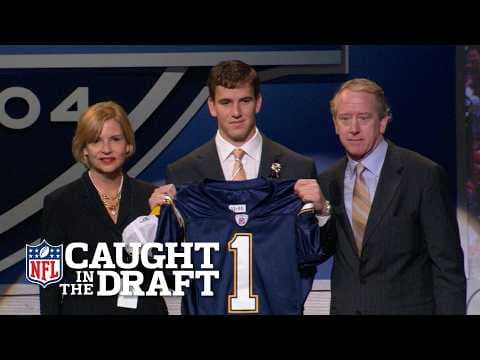
Eli Manning's 2004 draft day trade and controversy | Caught in the Draft
Audio Summary
AI Summary
The 2004 NFL draft was a significant media event, with television ratings 25% higher than the previous year. Six top picks were invited to New York, and for the first time, cameras captured their every move, with some footage never seen until now. The San Diego Chargers, holding the number one overall pick, had intended to draft Mississippi quarterback Eli Manning. However, discussions with the Manning camp took an unexpected turn just before the draft when Archie Manning, Eli's father, decided he did not want Eli to play for San Diego.
Reports circulated that Eli was prepared to sit out if the Chargers picked him. Eli himself stated that his father had already expressed everything they had discussed, and he would simply wait to see what happened. The reason for this stance remained unclear to many. The speculation was that the Mannings were attempting to orchestrate a trade to the New York Giants. Eli later clarified that it wasn't about wanting to go to New York, but rather not wanting to go to "one place," which he wouldn't name, to avoid bringing up old stories.
The day before the draft, Eli tried to maintain a low profile while other top projected picks attempted to provoke him, with one jokingly stating, "I'm gladly playing in San Diego." Ernie Accorsi, the Giants' general manager, had not known AJ Smith, San Diego's general manager, but had expressed interest in trading if the Chargers were willing, even before Eli or his agent made any public statements. The Giants were at pick number four, within striking distance for a trade, but Accorsi wasn't confident it would happen. He had a strong fallback in Ben Roethlisberger, whom the Giants rated second, so it wasn't a panic situation for them. Accorsi was determined to get a franchise quarterback, confident they would secure one regardless.
Ernie had extensively scouted Eli throughout his collegiate career, convinced that Eli's composure, personality, and achievements with fewer resources as a collegiate quarterback were precisely what the Giants needed to succeed. While Roethlisberger was also a strong candidate, and it seemed likely he would fall to the Giants, Tom Coughlin, the Giants' coach, called Accorsi the night before the draft, indicating the trade for Manning might not materialize, and Roethlisberger would be their pick.
The Giants had anticipated Manning's desire to play in New York due to marketing opportunities. This raised the question of how San Diego would react: would they still draft Manning, or would they trade out of the position? If they traded, it was expected to be for Philip Rivers, a quarterback whose stock had risen significantly after his appearance in the Senior Bowl, where he was coached by the San Diego Chargers staff. Rivers had sensed San Diego's interest due to this interaction, but he had also worked out for the New York Giants and felt the Pittsburgh Steelers, at pick 11, were the most likely destination for him.
When asked why he didn't want to play for the Chargers, Eli reiterated that he wouldn't provide details, stating it was his decision and he wasn't told to do it. He believed it was the best idea. When asked if he would wear a Chargers hat if they drafted him, he replied, "I don't know. We'll see what happens."
As expected, the San Diego Chargers selected Eli Manning as the first overall pick in the 2004 NFL draft, leading to boos and making Eli a "villain" in the eyes of many. Eli Manning's situation echoed that of John Elway 21 years prior, who also threatened not to sign after being drafted first overall by the Colts. Ernie Accorsi, who was the Colts' general manager during the Elway situation, now found himself in a similar predicament with the Giants.
Accorsi almost made a trade to move to seventh with Cleveland, assuming they wouldn't get Eli and could still secure Roethlisberger. However, a rumor that Cleveland was trying to move closer to draft Eli made Accorsi reconsider, fearing he would regret enabling Cleveland to get Manning if he had stayed put. He decided against the trade, prepared to draft Roethlisberger if the Manning trade didn't happen.
As the Giants were on the clock for the fourth pick, news emerged that if Philip Rivers was available, discussions would occur with the Chargers to draft Rivers and then swap quarterbacks. For six minutes, there was no pick, no trade, and no communication between AJ Smith of the Chargers and Ernie Accorsi of the Giants. Accorsi deliberately avoided making the first call to maintain leverage.
Almost at the seven-minute mark, AJ Smith called. He requested another player in the trade, which Accorsi was unwilling to give up if the value wasn't right. The Chargers were prepared for Eli to sit out if a trade wasn't made. In the final seconds, a deal was struck, though the players involved were unaware of the specifics.
The New York Giants then selected Philip Rivers as the fourth pick. Rivers, who hadn't received a call from the Giants, was initially excited to be a Giant, but then heard from a child that he had been traded. News quickly spread that the San Diego Chargers and New York Giants had exchanged draft picks: Eli Manning for Philip Rivers.
AJ Smith explained that the deal took so long because of "dialogue" that "didn't work out" until the Giants "surprised" them by picking Rivers, after which "little dialogue took place and it came together." Accorsi clarified that there were no real discussions until they decided to pick Rivers, which they had reasons for, hoping it would interest other clubs. He picked Rivers, trusting Smith's word that a trade would then occur, even though picking a player for another team is not permitted by the league. Accorsi stated he wouldn't have picked Rivers without the trade, and that Roethlisberger was the player they would have originally chosen.