What is the Evidence for Evolution?
AI Summary
The theory of biological evolution posits two main claims: all living things on Earth are related, having evolved from a common ancestor, and this evolution is driven by natural processes. Evidence supporting these claims comes from various fields of study. To simplify, the focus here is on the first claim, specifically examining the evolutionary history of cetaceans (whales, dolphins, and porpoises), which biologists suggest evolved from ancient four-legged land mammals.
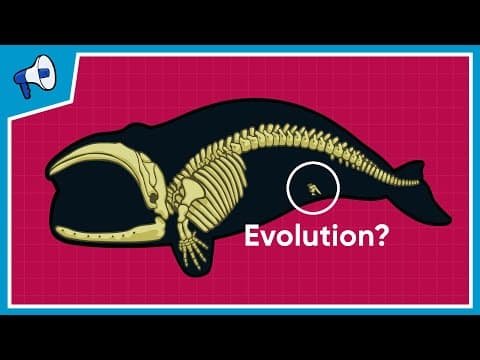
Comparative anatomy provides initial insights. Despite their fish-like appearance, whales share key characteristics with land mammals: they have placentas, give live birth, feed milk to their young, are warm-blooded, and breathe air with lungs, unlike fish that have gills. While whales breathe through blowholes on top of their heads, skull examination reveals these blowholes split into two nasal passages internally, suggesting they are highly modified mammal noses. Furthermore, many whales possess hair, like the whiskers on a baby gray whale. Intriguingly, their front flippers contain arm, wrist, hand, and finger bones, homologous to those found in bats, hippos, and humans. Modern whales also have a pair of strange bones where hind legs should be, resembling shriveled hip, thigh, and shin bones, complete with ball and socket joints. These anatomical similarities hint at a terrestrial ancestry.
Embryology offers a second line of evidence. Dolphin and human embryos, at similar developmental stages, both display arm and leg buds. In humans, leg buds develop into legs, but in whales, they grow for a short period before fading away as the embryo develops. Early dolphin embryos also show two nostril grooves on the face, similar to puppies or humans. As the dolphin grows, these nostrils migrate to the top of the head and fuse to form the blowhole. These developmental patterns further support the idea that whale ancestors were four-legged land creatures.
The fossil record provides a third witness. Extinct basilosaurid whales, living 34 to 40 million years ago, have well-preserved skeletons. Their nasal openings are located in the middle of the skull, an intermediate position between modern whales (top of head) and land mammals (end of snout), aligning with evolutionary predictions. Basilosaurids also possessed small, but fully developed hips, legs, ankles, feet, and toe bones at the back of their bodies. These legs were too small for walking on land but might have been useful for mating or scratching. Further back in time, Myocetus, an ancient whale-like mammal, had hip bones sturdy enough for walking on land. Its fossils are found among sea creatures, indicating an oceanic lifestyle, while its short legs and webbed hands and feet suggest strong swimming abilities. Myocetus's teeth and unique middle ear bone structures match those of basilosaurid and modern whales. The discovery of numerous ancient whale-like mammal fossils blurs the distinction between four-legged land mammals and fully aquatic modern whales, solidifying the idea of their evolution from land creatures.
Finally, DNA analysis provides a fourth independent line of evidence. Comparing the DNA of different creatures reveals their relatedness. Whale DNA shows the closest genetic match to the hippopotamus, suggesting whales and hippos share a common ancestor from approximately 54 million years ago. While whales are carnivores and hippos are vegetarians, they share several peculiar features, possibly inherited from this common ancestor. These include specially shaped ankle bones found only in hippos and their relatives, giving birth and nursing young underwater, multi-chambered stomachs (uncommon for carnivorous mammals), a lack of fur, and internal testicles.
In conclusion, four independent lines of evidence—comparative anatomy, embryology, the fossil record, and DNA—converge to tell the same story: whales evolved from four-legged land mammals. This principle extends to other species as well; for instance, bird wings are modified arms, and birds evolved from dinosaur-like ancestors. Bat wings evolved from five-fingered hands. Humans share a common ancestor with chimpanzees, and mammals evolved from reptile-like creatures, which in turn evolved from amphibian-like creatures, and those from fish-like creatures. Ultimately, fish share a common ancestor with segmented worms. Thousands of observable facts from diverse fields of study consistently demonstrate that all living things on Earth are related.