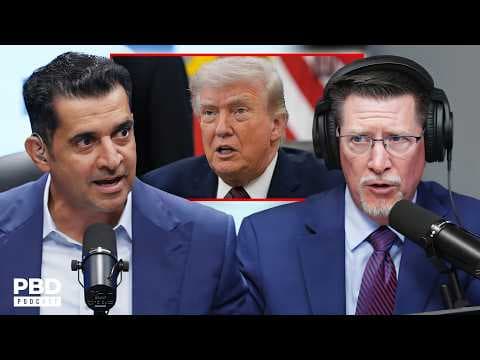
“Open The F#cking Strait” - Trump WARNS Iran Before Bridges & Power Plants Strikes
Audio Summary
AI Summary
The discussion centers on escalating tensions between the US and Iran, marked by threats, military posturing, and reports of a potential shift in Iran's nuclear stance.
The president issued a public threat to Iran, stating that "Tuesday will be power plant day, bridge day, all wrapped up in one in Iran. There will be nothing like it. Open the effing straight, you crazy bastards, or you'll be living in hell. Just watch." This message, delivered on Easter, was seen as a direct challenge.
In response, Iran released videos threatening to bomb OpenAI's $30 billion data center in Abu Dhabi, highlighting a landmark 1-gigawatt AI data center project announced for 2025, with a 200-megawatt phase opening in 2026. This project involves partnerships with major American enterprises such as Apollo, Nvidia, OpenAI, Microsoft, and Goldman Sachs. Iran's message was clear: if the US wants to play hard, Iran will target its infrastructure.
Compounding the situation, a report emerged suggesting Iran is willing to discuss its nuclear program, specifically regarding its possession of 460 kilograms of 60% enriched uranium, enough to develop 11 nuclear bombs. This admission of their nuclear capability comes amidst the escalating threats.
One participant, Vinnie, expressed skepticism about the Iranian regime's true intent, comparing them to North Korea, stating they "don't care what happens to their people" and that their ultimate goal is "pure death." He views Iran's actions, including attacking neighbors, as a strategy to pressure the US president to de-escalate. Despite this, he acknowledges a "crack in the door" for potential negotiation.
The conversation then shifted to a video allegedly showing the grandson of a prominent figure walking into a nuclear facility, interpreted as a propaganda move by Iran. This highlights the ongoing "propaganda war" between the two sides.
A critical point of discussion was the reliability of information, with one participant, Tom, stating he would "audit" any statement from the IRGC. The discussion also touched upon an interview where the president claimed the US sent guns to Iranian protesters through the Kurds, but that the Kurds allegedly kept the weapons themselves. This raised questions about the Kurds' motives and their trustworthiness as allies in this context. It was suggested that if the Kurds did indeed withhold the weapons, it was a "dumb move" that undermined trust and the goal of regime change.
The broader context of the conflict was framed by another participant, Adam, as a "religious war" or a "clash of civilizations," deeply ideological rather than purely military or economic. He emphasized that the Islamic Republic of Iran is willing to die for its cause, viewing it as a "death cult." He also highlighted Iran's theocratic nature, where every decision is rooted in religious doctrine, making it challenging to defeat such an ideology. Adam posed the question of how to defeat a regime that believes it is on the side of good, despite its neighbors and the West viewing it as evil.
The suffering of the Iranian people was a recurring theme. The leaders in Iran are seen as using the civilian population as leverage, as they themselves would be safe in bunkers while the people suffer from the destruction of infrastructure. A study from the Netherlands indicated that 81% of Iranians are "done with this regime," with the fastest-growing demographic identifying as agnostic, atheist, or Christian, and mosques closing down. This suggests a significant disconnect between the regime and its populace, with the average people bearing the brunt of the conflict.
The discussion then touched upon the role of Gulf States, particularly their leverage in the conflict. While they possess oil, the US's strategic move to secure Venezuelan oil supplies diminishes the Gulf States' economic leverage. Their primary concern is their proximity to Iran, making them vulnerable to attacks. They are seen as having no choice but to support efforts to neutralize the threat from Iran, as they have invested heavily in economic diversification and connecting with the West. Their message to the US president is consistently, "You got to finish the job here."
In a significant development, a Wall Street Journal report was mentioned, stating that Israel had killed the number two person in the IRGC, Brigadier General Majid Khadmi, in Tehran. This marks another high-ranking official taken out, raising questions about the future of negotiations. The lead negotiator for Iran, Abbas Achi, Minister of Foreign Affairs, was also mentioned as a potential target. If such a key figure were eliminated, it would signal a lack of interest in negotiation from Israel's side, suggesting a pursuit of a complete victory.
The conversation concluded by reiterating the complexity of the situation, with questions about who genuinely wants to negotiate and the potential consequences of escalating military actions. A report from Fox News indicated that Iran had conceded not to acquire a nuclear weapon, but this was met with a request for verification. The overall sentiment was that if key negotiators are targeted, it implies a clear intention to avoid negotiation and pursue a more decisive outcome.