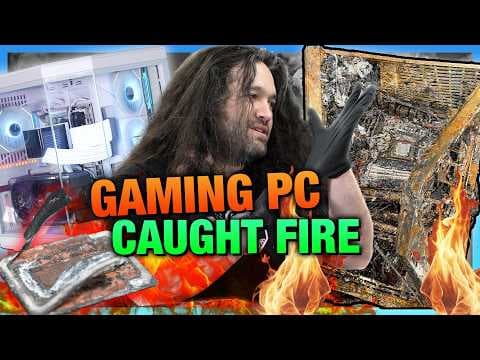
House Fires Destroyed 2 Subscriber PCs - Rebuilding & Inspecting the Remains
Audio Summary
AI Summary
This video documents the replacement of two PCs destroyed in house fires, neither of which were caused by the computers themselves. The project involved Rob Teller, the former product director for HYTE, who designed one of the cases being replaced. He was brought in to help rebuild the PCs, offering unique insights into the design and manufacturing process.
The first PC belonged to a Reddit user whose HYTE Y70 case and entire house were destroyed in an electrical fire. The second PC, from Romania, was a Ryzen 5 3600, RX 6700 XT, and 16 GB RAM build also lost in a house fire. The goal was to provide both users with systems that were better than what they lost.
The video begins with an inspection of the charred remains of the first computer. The damage was extensive, with components melted into unrecognizable forms. Rob Teller, upon seeing the wreckage, noted the preserved substrate where the silicon would attach and the melted fan hub and PCB. He remarked on the unusual state of the metal, which had turned to powder, likely mixed with plastic. The team also identified what appeared to be a melted processor and resistors.
Next, they examined the second computer, which was still largely contained within its HYTE Y70 case. Despite the severe fire damage, the case structure was somewhat intact, with external hard drive caddies and the power supply still embedded. Rob was able to orient the case, identifying the back, top, left glass side, right cable management side, and front. He noted the presence of the graphics card, which was impressively still within the case, showing bare traces. Shiny pieces within the wreckage were identified as possibly silicon.
Upon further disassembly, they found the CPU still in its socket, an AM5, and an SSD. Rob meticulously worked to remove the CPU from the melted motherboard, noting that the socket was likely unusable. The original parts list for this PC included a HYTE Y70 Snow White case, an AMD Ryzen 7 7700X CPU, a Gigabyte B850 Elite Wi-Fi 7 motherboard, and a Trikes Panorama SE 360 cooler, which was completely missing from the wreckage. Rob mentioned that the Snow White Y70 was the best-selling case he ever made, accounting for about 50% of all Y70 sales. The system also had 4 TB of storage, which had significantly increased in price since the user's original purchase.
The team then attempted to salvage the GPU from the second PC. Rob used a Dremel tool to cut away the melted material, revealing the silicon still visible on the cold plate. He observed the memory modules and the copper on the right side, noting the BGA (Ball Grid Array) on the back. This process provided a unique look at how the components had fused and the resilience of certain materials like copper and silicon under extreme heat. Microscopic examination of the salvaged silicon pieces further illustrated the internal structure of the chips and their connection to the substrate.
Moving on to the rebuilds, the team aimed for a "like-for-like" replacement for the Y70 user, while also upgrading components where possible. For the high-end build, they used a new HYTE Y70 case. The other user received a HYTE X50 case, which was also designed by Rob's former team. Rob explained that cases typically take less than a year to develop, with newer models benefiting from the development of previous ones. He also touched on the challenges of SKU complexity and color variations in the current market, noting that HYTE's past success with diverse color options is now difficult to replicate due to lower run rates.
For the new builds, both users received significant upgrades. The Y70 user's system went from a Ryzen 7 7700X to a Ryzen 9 850 X3D. The other user's build was upgraded from a Ryzen 5 3600 to a Ryzen 9 800 X3D and from an RX 6700 XT to an RTX 9070, offering much better ray tracing potential. Both systems were equipped with 64 GB of RAM, a substantial increase from the original 16 or 32 GB, and multiple NVMe drives for storage, replacing the original single 4 TB SSD for one user.
During the assembly process, Rob shared anecdotes about case design challenges, particularly the Y70's touchscreen. He emphasized his belief in the feature but acknowledged the difficulty of developing the necessary software. He also reminisced about sales volumes at NZXT, where selling over 4,000 cases a month was a "huge deal," compared to the Y-series cases, which consistently sold between 10,000 and 20,000 units monthly.
The build process involved managing extensive RGB cabling. Rob demonstrated his method of applying thermal paste, opting for a "star" pattern to ensure even coverage, a departure from the "vertical line" method used by the host. He also discussed the "toolless" design of certain case features, like the rear panel mechanism, which required significant engineering to avoid numerous screws.
Ultimately, both new PCs were successfully assembled, showcasing impressive upgrades in CPU, GPU, and memory. The Y70 build closely mirrored the original in aesthetic but with vastly improved internal components. The second build also received substantial enhancements. The project provided an opportunity to reflect on product design, manufacturing, and the evolution of the PC hardware industry, highlighting the resilience of certain materials and the ongoing challenges of component pricing.