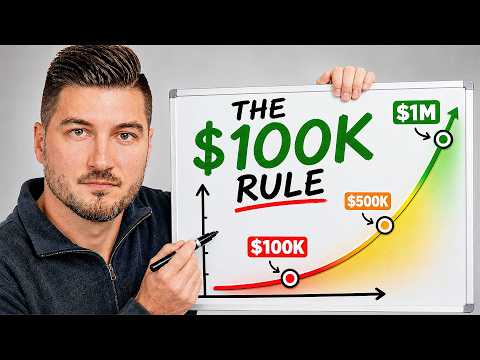
Once You Hit $100K The Math Does Most Of The Work For You
Audio Summary
AI Summary
The video explains the power of compound interest and how reaching $100,000 is a significant turning point in wealth accumulation, being a third of the way to a million dollars in terms of compounding effort, not just dollar amount. Investing $100 a week, or $5,200 annually, with an assumed 8% average annual return, illustrates this journey over 36 years.
The core concept is compound interest, where earnings generate further earnings, creating a snowball effect. While many understand it in theory, the practical reality involves a long period where savings appear to grow slowly, testing patience. The analogy of dollars as employees or soldiers highlights the need for strategic allocation and growth.
The blueprint uses specific parameters: $100 weekly investment, $5,200 yearly, and an 8% annual return. This 8% is chosen as a conservative real return after accounting for inflation, as opposed to the S&P 500's nominal 10%. Over 36 years, personal contributions total approximately $187,000, while the total account value reaches over $1 million. This means the market generated roughly $800,000 in growth, with personal contributions making up only about 18% of the final sum, underscoring the importance of starting early and staying consistent.
The journey is divided into three phases:
Phase 1: The Grind (Years 1-12). This initial 12-year period sees an investment of over $62,000 personally contributed, reaching $100,000 in the account. The market contributes about 40% of this amount. This phase is described as a "pain in the butt" and like pushing a boulder uphill or getting a large water wheel turning. Many people quit during this stage, similar to dieters who don't see immediate results. The key is patience, as this phase builds the foundation.
Phase 2: The Shift (Years 12-18). This six-year period marks a significant change. The net worth doubles from $100,000 to $200,000. In these six years, personal contributions are about $31,200, but investments generate over $68,000. For the first time, the money is outworking the individual, signifying that compound interest has crossed the contribution threshold. Reaching $200,000 means you are halfway to $1 million in terms of compounding progress and effort, not just dollar value.
Phase 3: The Snowball (Years 18-36). This final phase, from year 18 to 36, is where compound interest becomes tangible. By year 36, the account surpasses $1 million, with personal investment of $187,000 and market growth exceeding $800,000. Crucially, at $1 million invested at 8%, one adds roughly $80,000 annually in appreciation without further contributions. This phase illustrates exponential growth; by year 45, the account could exceed $2 million, generating over $160,000 annually. This is a "get rich slow" story, emphasizing consistency and time in the market.
The video highlights that $100,000 is not just a milestone but a launching pad. At this point, earning 8% annually generates about $8,000 in appreciation, providing a base that works around the clock. The journey after $100,000 becomes progressively easier, with contributions becoming a smaller percentage of total growth.
Psychologically, crossing the $100,000 mark provides proof that the strategy works, leading to increased motivation, larger contributions, and often, increased income. This positive feedback loop accelerates financial progress. The real obstacle is not the math, but the 12-year grind at the beginning, which tests consistency.
The speaker emphasizes that success in investing, like dieting or building a business, requires time and discipline. The video also briefly mentions a career coaching platform, strawberry.me, as a way to increase income and accelerate wealth building. The speaker concludes by reiterating the importance of patience and consistency, contrasting quick wealth schemes with the proven, slow accumulation of wealth through compound interest. The community platform, whiteboardfinanceuniversity.com, is also promoted for further education.