"They Called Me A CCP Agent" - CZ REVEALS The Truth About Crypto, China & The CCP
Audio Summary
AI Summary
The conversation begins with a discussion about the Getty Center museum in Los Angeles, noting that its founder, J. Paul Getty, created a free museum with an amazing collection, funded by dividends from his wealth. The speaker then jokingly suggests that if the other person had a museum, it would be empty because he doesn't collect things, except perhaps a Lexus van.
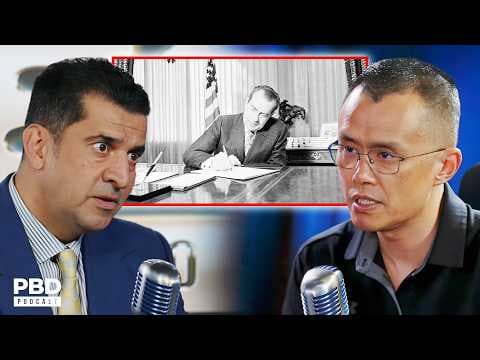
The discussion shifts to a hypothetical scenario: if the speaker could use his resources to uncover one non-public fact, what would it be? After some thought, he expresses interest in understanding the behind-the-scenes discussions and factors that led to President Nixon's decision in 1971 to move the U.S. off the gold standard. He acknowledges knowing the general background—that no one had enough gold, and governments wanted the ability to print fiat money—but wants to know the "real discussions" and conversations from that time.
He considers whether moving off the gold standard was a good, bad, or necessary move. He believes it was a bit of both, acknowledging pros and cons. While staying on the gold standard might limit economic development, and some quantitative easing and inflation can be necessary, the problem is that inflation often escalates too high, too quickly. He likens this to the initial good intentions of foundations or charities that later degrade due to human nature, greed, and poor management. He doesn't think it was a bad move at the time but notes the difficulty of maintaining such systems over time.
The conversation then touches on the limitations of gold, such as its divisibility and transportability, contrasting it with fiat money, which is backed by a promise. The speaker also mentions Nixon's dealings with China, noting that at the time, China was weak, and the U.S. was concerned about the USSR.
Asked about returning to China, the speaker reveals he hasn't been back in seven years. He explains that China explicitly banned cryptocurrency exchange businesses, and if he were to return, people would want to meet him and discuss crypto, which he doesn't want to be seen as promoting. He clarifies that he isn't necessarily afraid for his safety but doesn't want to cause problems for others or go where he might not be welcome in a professional capacity.
He confirms he has never spoken with Jack Ma, though he has met other senior Alibaba personnel. He speculates that Jack Ma has become much more low-key, likely due to past criticisms of the government, suggesting a "behind closed doors" conversation might have occurred.
Finally, the speaker addresses whether China views him as their creation because he was born there. He disagrees, stating he left at age 12 and spent his formative teenage years and most of his working life outside China. He identifies ethnically as Chinese but culturally and in his business approach, he feels more aligned with American capitalism. He also refutes the common accusation that he is part of the Chinese Communist Party, emphasizing he is a business person, not political, and his business couldn't even operate in China. He states he would be open to visiting China if officially invited, especially to help with crypto regulation, but wouldn't go unsolicited. He prioritizes spending time in pro-crypto countries, like the UAE, where he feels safe.