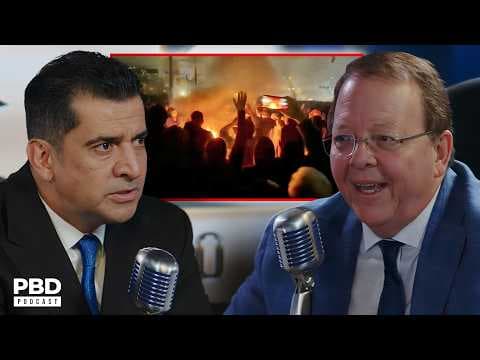
"Bombing NEVER Topple Regimes" - War Expert PREDICTS Trump's Iran Strategy Will FAIL
Audio Summary
AI Summary
The discussion begins by acknowledging America's long history of global involvement, citing the triangular diplomacy with China and the Soviet Union under Nixon as an example of the US shaping international dynamics. However, the counter-argument is made that the US has significantly benefited from these interventions, particularly after the Cold War. The end of the Cold War in 1990 created a power vacuum, especially in Eastern Europe, Africa, and Asia, which American companies capitalized on, leading to the "roaring 90s" and the spread of global capitalism. Vietnam is presented as a successful case of growth stemming from this period.
The speaker emphasizes that America has "made out like bandits" and that this is healthy for maintaining its 26% share of global GDP. The conversation then shifts to the current US strategy regarding Iran, specifically questioning the effectiveness of "maximum economic pressure." It is argued that while eliminating an enemy like the IRGC could benefit the world, the current approach lacks a clear strategy. The speaker critiques President Trump's handling of the situation, noting that after 60 days, there is no evident strategy, only negative outcomes.
The options presented to Trump—starting bombing, pulling out, or maintaining the blockade—are deemed mere military tactics, not a comprehensive strategy linked to desired outcomes. Historical examples, such as the sanctions on Iraq in 1990, are cited to demonstrate that economic pressure alone does not typically lead to regime change. Despite a 47% reduction in Iraq's GDP for 12 years, Saddam Hussein's regime did not crumble. Instead, weakened governments often redirect remaining resources to supporters, strengthening their hold. The occupation of France by Germany in WWII further illustrates how economic control can prevent popular uprisings.
The speaker asserts that economic pressure primarily serves as a precursor to military conquest, not as a standalone means to topple a regime. Historical data from World War I and II, including studies on bombing campaigns and economic sanctions, consistently show that these measures alone do not achieve regime change. While economic pressure can achieve minor goals like negotiating trade or releasing hostages, it is insufficient for major objectives such as regime overthrow, surrender of WMDs, or halting military offensives.
The speaker expresses a strong desire to see the IRGC fall, describing it as one of the most evil regimes globally, citing recent atrocities like the murder of 20-30,000 people in 72 hours. This is compared to historical events like Saddam Hussein's killing of 20,000 Kurds or the Srebrenica massacre. The speaker recalls identifying Iran's nuclear weapon as Obama's number one problem in 2008 and views the JCPOA as an imperfect but necessary deal, preferring it over a "magical hope of a full loaf." The humanitarian cost of economic sanctions, leading to malnutrition and disease, is also highlighted, emphasizing that such pressure is not inherently humanitarian. The speaker advocates for a well-defined strategy that genuinely considers the downsides, rather than dismissing them.