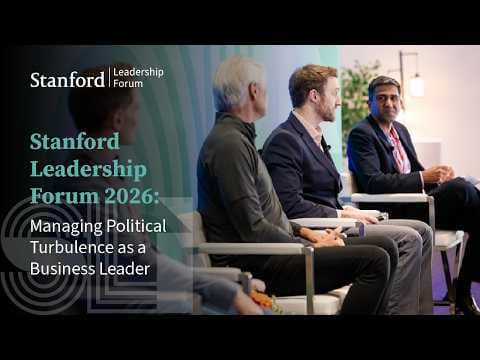
Stanford Leadership Forum 2026: Managing Political Turbulence as a Business Leader
Audio Summary
AI Summary
The breakout session, "Managing Political Turbulence as a Business Leader," explored the influence of geopolitical risk, shareholder activism, social media amplification, and declining trust in institutions on business. The panel included Nick Bloom, Professor of Economics at Stanford; John Donahoe, Chair of the Stanford Athletics Department and former CEO of Nike; and Chris George, a technology and business leader and senior advisor to the U.S. government.
Nick Bloom initiated the discussion by defining uncertainty from an academic perspective. He presented two main ways to measure uncertainty: financial market volatility (like the VIX index) and text analysis (scraping newspapers and economic reports). He noted a current divergence: financial markets, as indicated by the VIX, suggest average uncertainty, while text-based measures show incredibly high uncertainty, reflecting concerns over immigration, trade, and political instability. Bloom believes the reality lies somewhere in between. He emphasized the long-term damaging effects of sustained uncertainty, drawing parallels with Brexit, which he estimates has cut UK GDP by 6-8%, costing the average Brit thousands annually. He warned that current U.S. policy uncertainty, if prolonged, could lead to a similar "Brexit situation."
Chris George responded to the challenge of policy whiplash, where government policies, like renewable energy subsidies, frequently change with administrations. He advised business leaders to identify structural trends that will persist across administrations, such as the increasing demand for semiconductors or the impact of AI. Businesses should align with these long-term trends rather than pinning their hopes on single government grants or short-term policy initiatives. George also stressed the importance of aligning business interests with national benefits, as these are more likely to garner sustained support.
John Donahoe echoed this sentiment, drawing on his experience at eBay, ServiceNow, and Nike. He emphasized the importance of distinguishing between structural, long-term trends and temporal, short-term shifts when formulating strategy. Donahoe noted that uncertainty is a constant in business, driven by various factors, and the ability to differentiate between these types of issues is crucial for effective leadership and internal dialogue.
The conversation then shifted to the impact of the social environment on businesses, particularly the amplified power of individuals through social media. Donahoe shared his experience at Nike regarding the company's decision to back Colin Kaepernick in 2018 and his own leadership during the George Floyd events. He highlighted the critical need for leaders to separate personal views from the organization's stance, speaking up only on issues core to the company's purpose. For Nike, racial justice was deemed core due to its brand history with Black athletes and its consumer base. Donahoe explained that while such stances can lead to backlash (e.g., being labeled a "woke company"), they reinforce company culture and values among employees. He also addressed the challenge of employee activism in tight labor markets, advising leaders to clearly explain the "why" behind decisions, even if they conflict with some employees' personal views, and not to be overly swayed by "noisy tails" amplified by social media.
Chris George added Intel's perspective as a B2B company. He explained that Intel's core issues included immigration, vital for securing talent, and export/tariff policies, which directly impact their business model. He stressed that companies must be selective in the social stands they take, focusing on a few key issues to maintain clarity and impact. Taking a stand on too many issues dilutes the message and makes it harder to influence policymakers.
Nick Bloom then shared an observation from earnings calls of publicly listed companies, noting a 50% drop in political discussions under the Trump administration. He suggested this indicates a deliberate effort by firms to avoid political topics due to fear of backlash. Neil (the moderator) corroborated this with his observation of Fortune 500 shareholder proxy documents, which heavily featured DEI and ESG topics in 2021 but saw them disappear by 2023-2024. He suggested that many companies follow legitimate social trends rather than leading them, seeking legitimacy within the prevailing social norms. Donahoe agreed, stating that while some issues are genuinely important to shareholders and employees, CEOs also prioritize risk management and avoid unnecessary political fights that could create distractions.
The panel discussed the populist backlash against globalization, immigration, and trade, which conflicts with the business community's consensus on their benefits. Chris George suggested reframing these issues in terms of international competition, particularly with China. When framed as essential for national competitiveness (e.g., in AI research or defense technology), it becomes easier to gain public support for policies like immigration. Bloom reinforced this with the example of Brexit, where economists overwhelmingly opposed it due to economic concerns, but the electorate remained unconvinced, highlighting a "mass failure" of academics, media, and politicians to effectively communicate the benefits of globalization.
The discussion also touched on the broader implications of AI, which Bloom described as an all-encompassing theme in economics, dominating teaching and assessment methods. George emphasized the need for long-term policy decisions, particularly in areas like electric grid build-out, that can outlast political tenures and are robust against administrative changes. He highlighted the role of companies in building consensus and informing policymakers, suggesting that more stable, non-political roles within government agencies could help retain institutional memory and foster trust.
Donahoe then addressed his current role managing Stanford Athletics amidst the challenges of Name, Image, and Likeness (NIL) rules and legal uncertainty. He described it as a period of disruption, akin to what he experienced in tech industries. His approach is to establish a clear point of view—that a new, logical set of rules will eventually emerge, centering on the student-athlete's well-being—and then navigate the "lawless middle" with nimbleness. He emphasized not getting outraged by the current chaos but focusing on Stanford's path forward and influencing the development of sensible rules. He noted that Stanford is often looked to for principled leadership in this space.
Bloom reflected on the immense pressure on student-athletes, who are expected to excel academically at Stanford while also performing at a professional level in their sports, highlighting the difficulty of balancing these demands.
Chris George offered a framework for business leaders interacting with government officials: "Relationship matters." He stressed that living and being in community with policymakers in places like DC builds essential trust, which is crucial given the diverse and often unpredictable incentives in the political sphere. He noted that personal connections foster a deeper level of trust than purely transactional interactions, making it easier to navigate complex policy environments.
In the Q&A, Azita Armani (GSB '99) asked how to define "core to the business" in a context where corporations are expected to serve multiple stakeholders beyond shareholders. George explained that Intel tactically made a list of issues, rank-ordered them, and assigned values across different constituencies (employees, customers, etc.) to determine which issues were truly central to their business model and brand value.
Nicholas from Mexico posed a difficult question about businesses in developing countries facing autocracy: whether to speak up and risk government retaliation or comply and risk losing the rule of law. Neil cited "When Democracies Die," noting that in historical instances (like Finland vs. Nazi Germany), business elites who stood up against autocratic movements were crucial. Bloom also referenced the Foreign Corrupt Practices Act, discussing the dilemma faced by companies operating in countries where bribery is common, highlighting the tension between business success and upholding ethical standards. Donahoe added that in such situations, CEOs must consider what their employees expect and what the company stands for, beyond just business interests.
Belinda Nixon (Stanford '90) asked about the board's role in managing political turbulence. Donahoe stated that a board serves as a sounding board for the CEO, offering an external perspective and challenging assumptions, but its job is not to shape specific policy on these issues.
Kristen Jacobson (Stanford '95) inquired about the difficulty of deciding when a university president, like John Levin, should respond to issues, especially those core to the institution but potentially divisive. Donahoe, having worked with Levin, praised his intellectual honesty and objectivity. He explained that Levin considers both whether an issue is core to Stanford's mission and whether speaking up will actually advance the cause or make it worse. Sometimes, even for core issues, silence or a carefully measured response is the more effective strategy.