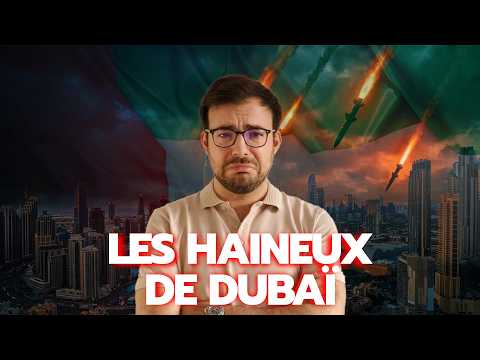
Ma réponses aux haineux de Dubaï
AI Summary
In this video, Émile OS, an international tax lawyer, addresses the growing wave of hostility directed toward French expatriates living in Dubai. This resentment has intensified following recent geopolitical tensions in the Middle East, leading many in France to mock influencers and entrepreneurs who now find themselves in a potentially volatile region. Émile argues that this "avalanche of hate" is misplaced and reflects a deep-seated frustration among the French population regarding their own domestic issues, specifically security and taxation. He contends that those criticizing expats are missing the real target: the systemic failures of the French state.
The video begins by establishing the geopolitical context. Émile recounts a series of military escalations where the United States and Israel targeted Iran, leading to Iranian retaliations against American bases across the Middle East, including those in Saudi Arabia, Bahrain, Qatar, and the United Arab Emirates. While drones and missiles have been intercepted over Dubai, causing some disruption at the airport, Émile notes that the panic among French social media users is disproportionate. He specifically calls out influencers like Tibo InShape for suggesting that the situation proves France is a better place to live. According to Émile, this sentiment is based on a fundamental misunderstanding of the reality of expatriation and the current state of France.
One of the most common criticisms leveled against expats is that they only leave for the money and will eventually return to France for its superior healthcare and security. Émile dismisses this as a myth. While acknowledging that France has highly skilled medical specialists, he argues that the overall healthcare system is no longer among the world’s best. He points out that many other countries offer excellent care through robust insurance systems without the crushing tax burden found in France.
On the subject of security, Émile is even more critical. He compares crime statistics, noting that even with the threat of regional conflict, Dubai remains significantly safer than France. He cites figures suggesting that in 2025, France saw approximately 1.5 homicides per 1,000 inhabitants, a rate he claims is at least three times higher than that of Dubai. He also highlights the staggering 3.5 million crimes and misdemeanors recorded annually in France, ranging from thefts to physical assaults. In contrast, he portrays Dubai as a place where personal property can be left unattended without fear of theft. He argues that the mockery of Dubai’s safety is a coping mechanism for French citizens who are frustrated by the deteriorating security in their own cities.
The core of Émile’s argument focuses on the "rules of the game." He asserts that the lifestyle enjoyed by expats in Dubai—characterized by low or zero taxes—is entirely legal. These conditions exist because of laws and international agreements crafted and maintained by the very leaders the French public elects. He finds it counterproductive to label expatriates as "tax evaders" or "cheats" when they are simply navigating the legal framework provided to them. If people can legally optimize their situation to save money and live in a safer environment, they will naturally do so.
Émile describes the French tax system as one of the most unjust in the world, not because of high rates alone, but because of its extreme complexity. The system is filled with "niches" and loopholes that require expensive professional advice to navigate. This creates a divide where only the wealthy can afford tax lawyers to reduce their burden, leaving average citizens to pay the full price. He argues that the public’s anger should be directed at the politicians who created this convoluted system and the administration that is often too incompetent or powerless to enforce its own rules.
This systemic failure extends to immigration and the judicial system. Émile compares the enforcement of deportation orders (OQTF) in France to the strict policies of the UAE. In Dubai, where 90% of the population is foreign, any criminal offense results in immediate expulsion and a lifetime ban. In France, however, only about 10% of deportation orders are actually carried out. He attributes this to a lack of funding for police, judges, and prisons. He criticizes the French government for behaving like a poorly managed business; rather than streamlining operations or resolving core issues, the state’s reflexive response is always to increase taxes or accumulate more debt.
Finally, Émile touches upon the risks of French interventionism in Middle Eastern conflicts. He expresses concern over statements from the French Foreign Ministry regarding the defense of regional allies. He warns against repeating the mistakes made in Syria, which he believes led to waves of refugees and domestic terrorism, such as the Bataclan attacks. He notes that there is currently no threat of "Iranian terrorism" in France and argues that the government should avoid meddling in foreign "messes" that could bring insecurity back to French soil.
In conclusion, Émile OS urges the French public to stop directing their hatred toward their neighbors or those who have chosen to leave. He emphasizes that the frustrations regarding taxes, security, and the perceived "unfairness" of expatriation are symptoms of a broken system. He encourages a shift in focus toward the decision-makers who set the rules and the administrators who fail to manage the country effectively. For Émile, the choice to move to Dubai is a rational response to the "hell" of modern French governance, and until the rules of the game change, the exodus of entrepreneurs and influencers will continue.