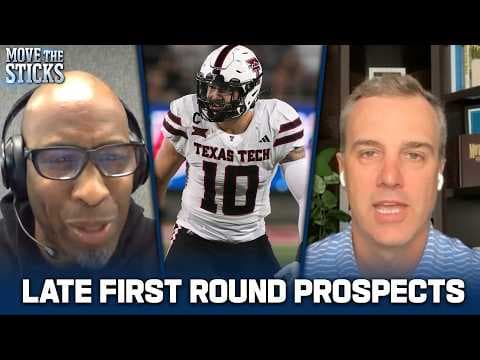
Reevaluating Talent and Late First Round NFL Draft Prospects | Move the Sticks
Audio Summary
AI Summary
As the draft approaches, the hosts discuss the challenges of refining draft boards. They emphasize the importance of sticking to initial evaluations and personal opinions, despite the "fog of confusion" that arises from external noise and differing opinions in the final weeks. They highlight that while it's natural to revisit early assessments, players rarely change their "zip codes" (general draft range), only their "houses" (specific position within that range). Often, first impressions prove to be the most accurate.
A key insight shared is the correlation between a team's success and the size of its draft board. Top-tier teams tend to have much smaller, more focused boards, prioritizing players who fit their specific culture, scheme, and environment. They are disciplined in their approach, avoiding the temptation to scout or consider players who don't align with their philosophy, even if those players are highly regarded by others. This selective approach makes decision-making clearer and more efficient, akin to choosing from a concise menu rather than an overwhelming one. Less successful teams, conversely, often maintain excessively large boards, trying to "serve too many masters," which can lead to confusion and suboptimal choices.
The conversation then shifts to potential surprise first-round picks. Keelin Rutled, an offensive lineman from Georgia Tech, is identified as a "red star" player who could sneak into the late first round. Despite typically being valued as a second-round pick, his athleticism, physicality, and bullying style of play could appeal to teams like the Patriots, who need such a player and often select based on specific fit rather than consensus. The comparison is made to Logan Mankins, who was a surprising late first-round pick for the Patriots.
Chris Johnson, a cornerback from San Diego State, is another candidate. His impressive 4.40-second 40-yard dash at the combine addressed concerns about his recovery speed, making him a more attractive prospect. While there might still be some on-tape concerns, his strong and tough play, combined with improved athletic metrics, makes him a solid number two corner prospect who could be taken in the first round by a team looking for certainty.
Jarian Price, a running back from Notre Dame, is also discussed as a potential late first-round pick. He is considered a "tier one" running back due to his big, fast, and physical play, dynamic return ability, and receiving potential. While the running back class isn't widely seen as having multiple first-round talents, Price's comprehensive skill set makes him a strong candidate for a team needing an impact player at the position.
Jacob Rodriguez, a linebacker, is mentioned as a player whose stock has risen significantly. Initially viewed as a third-round prospect, his elite makeup, strong production, and impressive workout numbers have solidified him as a second-round talent, with a chance to surprise in the first round. His instincts and awareness, which initially made him play faster than his perceived speed, were validated by his quick combine time. Anthony Hill, another linebacker, is also highlighted for his exceptional 17 career sacks, track background, and ability to hit, run, and cover, potentially challenging CJ Allen as the first linebacker taken.
Other potential late first-round surprises include Emanuel Pregnon, a guard from Oregon, and Jake Gold, who possesses size and versatility, having played multiple positions. Gold's impressive testing numbers and "classic Pittsburgh Steeler type" play style make him an intriguing prospect.
The hosts then discuss trending draft narratives. Germod McCoy is seen as trending to be the first cornerback picked. His 2024 tape is highly regarded, and his impressive workout, demonstrating full health and prototypical size, has alleviated concerns. His feisty, aggressive play and baseball background add to his appeal.
Regarding top-tier prospects, there's a belief that Caleb Williams, the quarterback, is firmly entrenched as the first pick, but Marvin Harrison Jr. is no longer a lock for the second overall selection. Bane, another top prospect, is trending to fall out of the top five, with his landing spot likely being in the 8-10 range, or even as low as 12-17, due to concerns about his measurables and the high expectations associated with a top-ten pick.
Kaden Proctor, the big tackle from Alabama, is predicted to go between picks 10 and 20. Concerns about his weight management, particularly his significant in-season weight loss, are noted. However, there's a direct correlation between his weight and on-field performance, suggesting that if he can maintain his conditioning, his talent and athleticism are undeniable.
Finally, the discussion turns to the Jets' second overall pick, specifically between Reese and Bailey. While initial leaning was towards Reese, current chatter suggests the Jets are leaning towards Bailey, the more polished pass rusher, for greater certainty. This aligns with the philosophy of coaches like Aaron Glenn, who might prefer a known quantity like Bailey over the projection of Reese, especially considering the challenges of integrating versatile players into specific positional rooms. The "fog of confusion" intensifies as the draft nears, making it crucial for evaluators to trust their own assessments amidst the influx of information and differing opinions.