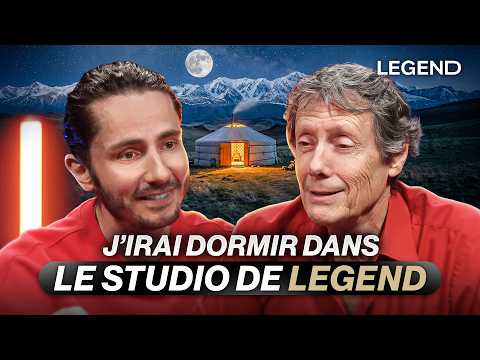
J’IRAI DORMIR CHEZ VOUS : FUSILLADE, KIDNAPPING… LES HISTOIRES LES PLUS FOLLES D’ANTOINE DE MAXIMY
AI Summary
Antoine de Maximi, creator of the popular YouTube series "Gérormir chez vous" (I'll Sleep at Your Place), shares his extraordinary experiences with Guillaume, host of the podcast "Légendes." De Maximi has filmed 75 episodes of his show, traveling to diverse and often improbable locations, filming himself alone with a unique camera setup: one on his shoulder, one facing him, and one in his hand, allowing for comprehensive coverage.
The core concept of "Gérormir chez vous" is to approach strangers randomly and ask to sleep at their home. De Maximi emphasizes that there is no prior preparation; he books flights spontaneously, sometimes at the airport, and has even changed countries mid-trip due to unforeseen circumstances like COVID-19. He recounts a memorable instance where he spontaneously flew to Greece and another time to Taiwan, only to switch to Vietnam on the first day due to pandemic restrictions.
His innovative filming technique involves a GoPro on his shoulder, a camera on a rig filming him, and a third camera in his hand. This setup, which he essentially invented, allows for dynamic shots and the crucial "shot-reverse-shot" editing technique, making his solo travel documentaries possible. Unlike typical TV productions with large crews, de Maximi operates entirely alone, carrying his own equipment, including spare cameras, batteries, and chargers, in a 20kg suitcase. He packs enough clothes for a washing machine load, ensuring he can maintain a semblance of normalcy. While he sometimes stays in hotels as a fallback, he prioritizes the human connection of sleeping at a local's home.
De Maximi explains that his shift to this format at age 44 was driven by a desire for creative freedom. Having previously produced large-scale scientific expedition documentaries, he felt constrained by the demands of multiple channels and large teams. He wanted to focus on ordinary people, not extreme adventurers, and tell their stories. His technical background as a sound engineer, cameraman, director, and presenter enabled him to conceive and execute this solo project. He conducted initial tests at a local market, initially with a friend nearby for safety, but soon realized the cameras didn't deter people, who quickly forgot about them and acted naturally.
His production company, Bonne Pioche, supported him despite initial difficulties in finding a broadcaster, with the show eventually airing on RMC Découverte. De Maximi notes that the company took a significant risk, as they weren't paid for the first year.
The show has produced several viral moments, including the now-famous clip of Daoud in Kabylie, Algeria, who, when asked what he wanted to drink, humorously replied, "A little bit of gas, a little bit of lemonade." This phrase became a widespread meme. De Maximi shares an anecdote from India where, due to limited sleeping arrangements, he ended up sharing a double bed with the husband of his host's sister, leading to a hilariously awkward situation for French viewers, though de Maximi remained unfazed due to his extensive experience in adapting to different situations.
He recounts a strange incident in Mumbai where a man he met on the street, whom he didn't perceive as dangerous, insisted on accompanying him and then asked to sleep in his hotel room. De Maximi agreed, seeing it as an opportunity for a different experience, but they were ultimately denied entry to the hotel, as the staff found the situation suspicious.
De Maximi's adventurous spirit was forged early. Born in Lyon, he grew up in Paris and had an unconventional childhood, including family trips to nudist camps, which he found awkward as a teenager. His parents were artists with limited financial means, but they fostered a rich intellectual environment, hosting diverse guests who shared food and conversation.
Before his documentary career, he served in the army's cinema unit, which led him to Beirut as a reporter in 1979. He later worked for CBS News and undertook expeditions like a 4-month trip to Peru in 1983 and an Amazonian expedition using a hand-cranked 16mm camera.
A particularly harrowing experience occurred in 1984 in Lebanon when he entered a village that had been massacred. He describes the graphic scenes of violence, which profoundly impacted him, leading him to a deeper appreciation for life and a commitment to living it fully. This experience reinforced his desire for an unconventional life, rejecting the idea of being boxed in.
He has also faced danger, including a close call during a shooting in St. Lucia in 2015. While filming in a seemingly peaceful setting, gunfire erupted nearby. His unique setup allowed him to continue filming, capturing the panic and his own surprisingly calm reaction, driven by his professional instinct.
The most intense fear he experienced was a near-kidnapping attempt in Bolivia in 2006. A woman, posing as a police officer, tried to force him into a taxi. He realized she was a scam artist when she refused to show her badge. As a crowd gathered and de Maximi continued to film, the woman and her accomplice fled. The incident led to his temporary detention at a police station, where he continued filming, even appearing live on Bolivian television. He was later exfiltrated by the French ambassador due to ongoing threats, spending a night at the embassy before flying out. He later learned the woman was imprisoned for her actions.
De Maximi also recounts his experience filming in the Democratic Republic of Congo at the Nyiragongo volcano, where he and his team camped inside the crater for days, wearing gas masks due to toxic fumes. He also detailed a deep-sea expedition in a submersible to 5,000 meters, emphasizing the inherent risks of such ventures, including the possibility of entrapment or equipment failure.
He discusses a period of depression in the 2000s, triggered by personal issues and a feeling of having reached the peak of his life. However, the launch of "Gérormir chez vous" revitalized him, allowing him to work intensely and channel his energy. He produced nine episodes a year for the first two years, sleeping in his editing room to meet deadlines.
A recent episode in Mauritius highlights his continued dedication to authentic encounters. Despite warnings about a particular neighborhood, he ventured in and met a man who had lost a leg. De Maximi offered him money for a drink, which the man initially refused as an insult, emphasizing the cultural norms of hospitality. De Maximi's generosity extended to helping individuals, and he clarifies that while he doesn't accept payment from hosts, he often leaves gifts, adapting to local customs. He also addresses criticisms of profiting from his guests, asserting that his actions are driven by genuine connection and support.
His most emotionally moving experience was in Malawi with Jeanette, a woman who, despite being disabled by polio, radiated positivity and raised five children alone. De Maximi's filming of her led to a crowdfunding campaign that provided her with financial support, enabling her to build rental rooms and escape poverty. He personally returned to Malawi to ensure the funds were used effectively and that Jeanette could improve her life.
De Maximi's early career involved more extreme adventures, including diving in ice crevasses in Greenland, working on a floating platform in the Amazon, and filming monkeys from high in the canopy. He considers these experiences more spectacular than "Gérormir chez vous," which he describes as "gnognote" (weak stuff) in comparison, although it brought him recognition. He is currently developing a surreal feature film titled "Nanoseconde," about a man's consciousness in the fraction of a second between life and death, with talking objects as main characters.
He concludes by reflecting on the changing media landscape, the increased respect for individuals' privacy, and the global reach of content today, contrasting it with the past. He emphasizes his commitment to avoiding pre-conceived notions in his interviews, allowing subjects to speak freely, a principle born from his early experiences as a war reporter where political commentary could be dangerous. He also addresses the subjective nature of perception, urging viewers to see the "glass half full."