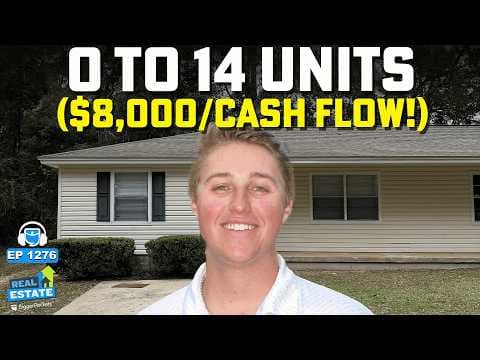
I Bought My First Rental at 18: Now I Have 14 Units ($8,000/Month Cash Flow!)
Audio Summary
AI Summary
Logan George, at just 18 years old with no credit and $15,000, defied conventional wisdom by purchasing a four-bedroom townhome in his desired neighborhood. He achieved this by mailing over 200 handwritten letters to potential sellers. He then rented out three rooms to friends, effectively living for free and generating extra income to reinvest. This initial success served as a springboard for Logan, who has since grown his rental portfolio to 14 units, generating nearly $8,000 in monthly cash flow. His approach, as highlighted by host Henry Washington, involves fundamental real estate strategies like identifying sellers, direct mail marketing, and direct communication, all while maintaining a full-time job.
Logan's real estate journey began with his family's involvement in the industry. His father owned rental properties around 2006-2008, a period Logan, then around 12 years old, recalls with his father collecting rent in cash. However, his father eventually sold these properties. When Logan left for college about six years prior to this recording, he was faced with rent costs of approximately $1,000 per month for a one-bedroom apartment. His father suggested he consider buying a property instead.
Despite being 18, working a $15/hour job at a gym, and having no credit, Logan saved diligently. His father identified three neighborhoods near Florida State University as potential areas for investment. Logan then embarked on a direct mail campaign, hand-writing over 200 letters to residents in these neighborhoods. One of these letters yielded a response from a seller interested in selling their townhouse.
Unable to secure a traditional loan due to his lack of credit, Logan negotiated an owner-financing deal. He put down $10,000 of his $15,000 savings, purchasing the four-bedroom townhouse for $110,000. The seller had a $6,000 deficit on their loan, which Logan's down payment covered, allowing the seller to receive the remaining balance as cash flow. Logan paid the seller a mere $500 per month for the property. He rented out the other three bedrooms to his friends for $335 per room, plus splitting the electricity bill. This arrangement allowed Logan to live for free and cover his expenses, with some money left over. He notes that the property required no immediate repairs. The owner financing had a favorable interest rate of 3.15%, and his total monthly payment, including taxes and insurance, was around $750. This strategy allowed him to eliminate his largest living expense at a young age, enabling significant savings.
Logan lived in the townhouse for four years. After two years, he observed that the property's value had appreciated to $160,000. This realization motivated him to consider how many times he could replicate this strategy to achieve financial independence. The property now rents for $2,000 per month, providing substantial cash flow on his initial investment.
Following his first deal, Logan began selling cars during college, earning a good income and saving aggressively as he lived frugally. Approximately three years after his first purchase, in 2023, another townhouse in the same community became available. This three-bedroom, three-bathroom unit was listed for $160,000 and was in immaculate condition. Logan, having saved money and seeing the potential to rent it for $1,700 per month, decided to purchase it. This property was listed on the MLS. Despite being second in line for a full-price offer, the initial buyer backed out, and Logan secured the property with an FHA loan. He moved into this townhouse, renting out his first property. He lived there for about a year before purchasing two more duplexes later that same year.
Seeking to exit the demanding car sales industry and leverage his saved cash, Logan shifted his focus to acquiring small multi-family properties. Inspired by the Bigger Pockets podcast, he decided to target properties with two to four units, aiming for "ugly duckling" properties needing some work. He initiated another direct marketing effort, making around 250 phone calls. One call connected him with an elderly woman who owned a duplex, with her son occupying the adjacent unit without paying rent. The woman expressed a desire to move and mentioned the property needed repairs she couldn't afford. Logan, realizing the property was only 15 minutes away, immediately asked if he could view it, which he did that same day.
During the visit, Logan and the seller developed a rapport. He offered to figure out a fair price and meet again on Monday. Over the weekend, he researched comparable sales. When they met, the seller tentatively valued the property between $180,000 and $200,000. Logan offered $170,000, but the seller wanted to consult her son. Logan then increased his offer to $180,000, contingent on signing the contract immediately, which she accepted. He secured a conventional loan for this duplex, requiring a 20% down payment. After the son moved out, Logan invested an additional $20,000 in repairs. The property, rented to existing tenants, now generates $2,300 per month in rent.
Logan detailed his cold-calling script: "Hey Henry, real quick, my name's Logan. Is this you over here off of uh, you know, Capstone Drive with that duplex? Is that you? You know, they'd say, yeah, yeah, that's me. I own it. Well, awesome. Hey, I'm a young guy in the area, you know, getting into investing. And uh, one thing that I do kind of put out there, I'm I'm not a realtor, and some realtors get their business. Uh, I got a little more traction by adding in there, you know, hey, I'm not a realtor. I don't want to sell your property. I'm actually interested personally. Have you ever thought about selling it if the money was right?" He emphasized that persistence is key, as one "yes" after many "no"s can be incredibly rewarding.
Henry highlighted that cold calling is an underutilized but effective strategy due to its low competition. He also pointed out the value of combining direct mail with cold calling. Logan’s strategy of immediate follow-up, or "speed to lead," was praised. Logan would often visit properties within 15 minutes of a call, advising sellers not to clean or prepare, thereby reducing their stress and expediting the process. He also emphasized the importance of being personable and building rapport, sharing an anecdote about connecting with a seller over their shared interest in painting.
Logan further demonstrated his problem-solving approach by offering to pay for the elderly seller’s move, solidifying their relationship and making the transaction smoother. He purchased the duplex with a conventional loan, putting 20% down and investing $20,000 in cosmetic repairs. The duplex now rents for $2,300 per month, with his mortgage payment around $1,300.
Logan then acquired another duplex from a seasoned investor named Curtis, whom he met through the previous deal. Curtis, tired of managing his portfolio, had owned the duplex since 1999. Logan visited the property 20 minutes after their initial phone call. Curtis, impressed by Logan's approach and offer, agreed to owner-finance the deal. The purchase price was $230,000 for a duplex with a large vacant garage. One unit was rented at $900 per month, and the other unit was vacant. Logan rented the vacant unit for $1,200 and, after the initial tenant moved out, increased the rent in the other unit to $1,250. He also rented the garage for an additional $250 per month for storage, bringing the total monthly rent to $2,650. Logan put down approximately 25% ($57,500) and secured an owner-finance rate of 6.75% from Curtis, which was favorable compared to market rates of 7-7.5% at the time.
Henry underscored the effectiveness of targeting owners of small multi-family properties, particularly those owning in their personal name or trust, who have significant equity and have owned for an extended period. This demographic often represents "mom and pop" owners looking to exit the market, making them ideal candidates for owner financing and mentorship opportunities. Logan's relationship with Curtis exemplifies this, as Curtis became a friend and mentor, even offering private financing for Logan's subsequent townhouse purchase.
This townhouse, bought for $100,000, required a $7,000 roof replacement and a $5,000 kitchen renovation. Logan put down 20% and Curtis provided a private note for the remainder. Logan moved into this townhouse, subsequently selling his second MLS-acquired townhouse for a $40,000 profit, leveraging the equity and cash flow to reinvest.
Utilizing a 1031 exchange from the townhouse sale, Logan aimed to acquire more properties. After three months without finding a suitable replacement, a listing for a duplex at $225,000 appeared on the MLS in a familiar area. Upon further investigation, he learned the seller owned four adjacent duplexes on the same street and was experiencing management issues from their California residence. Logan inquired about purchasing all four properties, and the realtor relayed an offer from the seller: $185,000 per duplex if purchased as a package. This brought the total for eight units to $750,000. Logan proposed owner financing to the seller, who agreed to finance $500,000 of the purchase price at a 6% interest-only rate.
On day one, the total rent from these eight units was $4,100, though two tenants were not paying, and one unit was vacant. Logan evicted the non-paying tenants and began renovating the units, focusing on cosmetic upgrades like paint, new appliances, and countertops. He retained three existing tenants who maintained their properties, slightly increasing their rent. He has since rented out the fifth remodeled unit, achieving 100% occupancy. The total monthly rent now stands at $8,700, resulting in a monthly cash flow of $4,600 from these eight units.
Logan's current portfolio comprises 14 units, generating $17,000 in monthly rent, with $7,900 in cash flow after expenses. Henry commended Logan's determination, consistency, and willingness to employ strategies that many find daunting. He emphasized that Logan’s success demonstrates that off-market deal finding is accessible without needing to operate like a large wholesaling company or invest heavily in lead generation. Simple, consistent efforts like making phone calls or sending direct mail remain effective.
Logan has transitioned from his car sales job and now runs his own insurance agency, working 40+ hours a week. He values maintaining this income stream, as he believes it accelerates his real estate growth. He acknowledged that while he might not be working a traditional W2 job indefinitely, his real estate portfolio would need to be significantly larger before he considers stopping work entirely. He highlighted that having a consistent income stream, even from a job, makes it easier to scale real estate investments by providing financial stability and improving bankability. This security allows for more strategic, less emotionally driven investment decisions, as opposed to needing immediate income to support a family.
Logan also stressed the importance of mentorship, naming Curtis and another mentor, Bill, whom he met at Home Depot. He values their advice on deals, as they have no vested interest in his decisions. He encourages younger investors to find mentors who can provide objective guidance. Henry concluded by congratulating Logan on his achievements at a young age, emphasizing that real estate is a "get-rich for sure" business, provided one remains persistent. He also urged Logan to use his acquired wealth to improve the lives of others, viewing wealth as a responsibility.