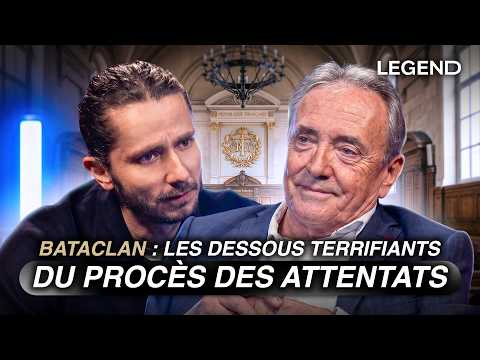
JUGE DU PROCÈS DU BATACLAN : LES DESSOUS TERRIFIANTS DU PROCÈS DES ATTENTATS (ABDESLAM, MENACE…)
AI Summary
Jean-Louis Perriè, the presiding judge of the November 13th attacks trial, shared unprecedented insights into his career and the monumental trial. With a long and distinguished career, Perriè presided over the trial of Salah Abdeslam and other accused individuals, a process that lasted over ten months and involved 2,500 civil parties.
Perriè, a Marseillais by birth, began his judicial career as an investigating judge in Marseille. He recounted the immense scale of the November 13th trial, which began on September 8, 2021, and concluded on June 29, 2022. The case file alone consisted of 500 volumes, equivalent to stacking documents up to the 17th floor of the new courthouse. Over 300 civil party lawyers and 40 defense lawyers were involved, with thousands of police officers securing the palace during the trial.
The invitation to preside over such a high-stakes trial came in late 2019, shortly before Perriè's planned retirement. He was not a candidate for the role, as several significant trials were on the horizon, including those for the Charlie Hebdo and Montrouge attacks, the November 13th attacks, and the 2016 Nice attack. Presiding over these cases was a daunting prospect due to the immense media and public pressure. Despite initial hesitation and concerns about his ability to maintain impartiality, Perriè accepted, viewing it as an honor and a responsibility to shed light on France's most severe attack since World War II.
Perriè explained the different roles of judges in the French legal system. An investigating judge leads an investigation, with powers such as wiretapping and surveillance. This role is preparatory, gathering all necessary evidence for trial. Correctional judges handle misdemeanors, while Assize Courts, presided over by a Court of Appeal magistrate, deal with serious crimes like murder, rape, armed robbery, large-scale drug trafficking, and terrorism.
In Assize Courts, citizens serve as jurors, a practice dating back to the French Revolution. Jurors are selected from electoral lists, must be over 23, and have no criminal record. Their participation is a civic obligation, and employers are legally bound to allow their employees to serve. However, for the most serious cases, such as terrorism or highly organized crime, jurors are not used to protect them from threats, as had occurred in the 1980s. The November 13th trial, therefore, was presided over solely by professional magistrates.
Perriè emphasized the human aspect of judging, noting that while the accused are charged with terrible acts, they are still human beings. He admitted to using occasional lighthearted remarks to ease the heavy atmosphere of the courtroom, especially during a ten-month trial where human interactions become more pronounced. Judges, he noted, are trained to confront difficult realities, including attending autopsies and visiting crime scenes. While the initial exposure to such horrors can be shocking, judges develop a certain resilience over time.
He also touched upon the psychological toll of such work, introducing the concept of "vicarious trauma," a form of trauma experienced by those who are repeatedly exposed to the suffering of others, such as first responders, lawyers, and judges. Perriè himself experienced this after hearing over 400 victim testimonies during the November 13th trial, leading to symptoms like sleep problems and hypervigilance. He even recalled a vivid dream where he was present in the Bataclan during the attack, which prompted him to seek support from a psychologist friend.
Perriè shared a particularly poignant case from his time as a prosecutor in Versailles. A drunk driver killed two 17-year-old girls, who were tragically received at the hospital by the father of one of the victims, an emergency doctor. The dignity of the victims' families, who were deeply religious and spoke of forgiveness, left a lasting impression on him.
Another memorable case involved four young men, including three brothers, accused of rape, torture, and barbarity against a teenage girl. The most violent of the group, a 16-year-old, was tried in a juvenile Assize Court and sentenced to 30 years, the maximum possible for a minor at the time. Perriè noted that the law allows for the "excuse of minority," which halves the potential sentence, but it can be set aside in particularly grave cases, as it was in this instance due to the extreme dangerousness of the accused.
He also recounted a complex drug trafficking case involving a well-organized network transporting tons of cocaine from Colombia to Europe via sailboat and helicopter. Perriè found humor in recognizing a specific, remote location where the drugs were offloaded, a detail known only to him due to his family's origins in the area.
Regarding the November 13th trial, Perriè explained that he was approached in late 2019, initially as the second presiding judge, but later became the lead due to unforeseen circumstances with the first choice. He had about 18 months to prepare the massive case file, a period extended by the COVID-19 pandemic and associated construction delays for the specially built courtroom.
The trial began with a technical glitch, causing a 45-minute delay due to network overload from the numerous journalists and public attending. The proceedings were historically filmed for archives and simultaneously broadcast to 15 other courtrooms to accommodate the public and press.
On the first day, Salah Abdeslam, who had previously refused to speak, made a chilling declaration during the identity verification process. When asked about his profession, Abdeslam stated, "I have ceased all activity since I became a fighter for the Islamic State." This created a "glacial chill" in the courtroom. Perriè, however, calmly responded by noting he had "interim worker" in his notes, effectively rebuffing Abdeslam's attempt to assert control and setting a firm tone for the trial.
Perriè described Abdeslam as an individual with a strong personality who maintained eye contact and showed no inclination to defer to the judge. Over the course of the trial, Abdeslam evolved from a provocative stance, claiming victims were treated like "dogs" in detention, to attempting to portray himself as a peripheral figure in the attacks. He asserted he had renounced his explosive belt, but the court concluded, based on evidence, that the belt had malfunctioned, not that he had chosen not to detonate it.
Abdeslam was involved in transporting the terrorists to the Stade de France but did not directly participate in the shootings. He claimed the attacks were justified by France's involvement in the coalition against the Islamic State, an argument Perriè refuted by pointing out that the decision to carry out the attacks predated France's military intervention in Syria and Iraq.
Perriè's own security was heightened during the trial following a death threat published on social media by an ISIS-affiliated media outlet. Despite the constant police protection, which included discreet but highly effective officers, Perriè maintained a relatively normal life, attending restaurants and cultural events, albeit with security measures in place.
The trial saw 2,500 civil parties, many of whom initially doubted the justice system but eventually found comfort and solidarity in the courtroom, which some affectionately called "the village." Perriè highlighted powerful testimonies, including that of Aurélie Silvestre, a widow of a Bataclan victim, and David Fritz, a hostage who later became friends with former President François Hollande. Hollande himself testified, a rare event for a former head of state, and Perriè meticulously adhered to protocol to maintain impartiality.
Perriè spoke of the profound impact of viewing the crime scene photos, particularly those of young victims, which evoked feelings of anger and incomprehension. He recalled the heartbreaking image of two young women found embracing behind the Bataclan bar, shot by a terrorist.
Despite the gravity, there were moments of unexpected lightness, often initiated by victims. He recounted an exchange with a law student victim who playfully corrected his outdated legal knowledge, eliciting laughter from the courtroom. Another survivor, a railway worker, brought levity with his humorous account of surviving the Bataclan attack.
The verdict was delivered on June 29, 2022. Perriè described the immense relief of reaching the end of the trial, which many doubted would conclude. He announced the sentences, including life imprisonment without parole for Salah Abdeslam, meaning he cannot seek parole for the first 30 years. No appeals were filed, a rare outcome that brought satisfaction to Perriè and the judicial team.
Today, Perriè dedicates his time to training new magistrates, lecturing on terrorism and the trial, and writing. He expressed pride in having fulfilled his duty, viewing his profession as a vocation to restore a sense of justice in the face of profound injustice. He stressed the importance of the human element in judging, advocating against systems like plea bargaining for serious crimes, as it risks overlooking the complex human motivations behind such acts.