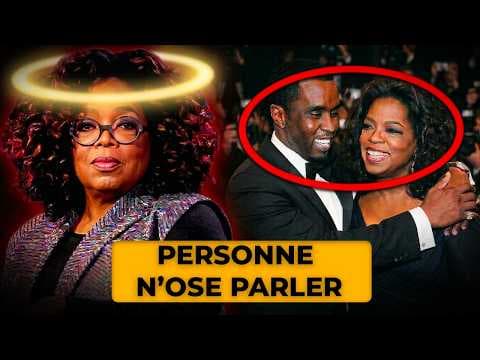
Pourquoi aucune polémique ne peut détruire Oprah Winfrey
AI Summary
On April 20, 2020, a tweet threatened to derail the career of a powerful television host, Hélène DGRS, who, after years of adoration, was accused of being privately hateful and fostering a toxic work environment. Her image collapsed within months, leading to the cancellation of her show a year later. James Corden faced a similar trajectory in 2022 when a viral accusation of inappropriate behavior in a restaurant damaged his reputation, resulting in his show's cancellation the following year.
In contrast to these vulnerable television figures, Oprah Winfrey, the "queen of the small screen," has maintained an seemingly untouchable status despite numerous controversies. Some criticisms stem from her interview style, such as her insistence on personal questions with a visibly uncomfortable Michael Jackson. More significant criticisms revolve around the school she built in South Africa, where allegations of abuse emerged, coupled with testimonies describing a strict atmosphere deemed disconnected from the real needs of the children and their families. Her associations with powerful Hollywood figures like Weinstein and Diddy have also drawn scrutiny. Yet, Oprah Winfrey remains one of the most powerful women in the world. This raises the question of how she constructed such a solid image that appears impervious to attack, and how this long-standing invulnerability might be changing.
Oprah Winfrey is notable as the first Black female billionaire in history. This wealth, often presented as cash in bank accounts, actually represents her total assets, frequently including stocks. The discussion then transitions to investment, mentioning Freedom 24, a brokerage offering the Freedom Academy, an educational platform for investment basics. The speaker uses Freedom 24 for their own investment strategy, which includes classic ETFs and individual stocks like Apple through a CTO (securities account). Freedom 24 offers thousands of stocks and ETFs and has a promotion for new clients: 0% commission on stocks and ETFs until August 31, 2026, for account openings and initial deposits. The company's parent is listed on NASDAQ, and Freedom 24 has offices worldwide, including Paris. As a regulated broker, it is supervised by CySEC and adheres to European regulations like MiFID II, with client funds protected by European law. To open an account, an ID card is required, and the process is quick, with French-speaking customer service available within 15 minutes. It's noted that the CTO is considered an overseas account and must be declared for tax purposes.
To understand Oprah's indestructible image, one must examine its foundations, starting with her origins and how she first broke into the media landscape by defying existing norms. In 1986, Oprah Winfrey debuted her national talk show. Her presence as a Black woman on national television was groundbreaking for the era, but other factors also set her apart. Early in her career, she gained control of her production means, acquiring the rights to "The Oprah Winfrey Show" with her production company in 1998, two years after its national launch. This ownership proved crucial for managing her image.
Before that, Oprah established a unique relationship with her audience. Her talk show, while not revolutionary in concept—initially inviting ordinary people with interesting personal stories to share—differed significantly from competitors like Phil due to her empathy. Unlike other hosts who could be distant or even sarcastic, Oprah genuinely listened and sought to understand her interviewees, making "Oprah understands you" a central selling point for her show.
However, understanding wasn't enough. Oprah soon began to share her own deeply personal and difficult past. She grew up in extreme poverty with her grandmother, experienced sexual abuse from family members starting at age nine, and became pregnant at fourteen, giving birth prematurely to a child who died weeks later. By revealing these personal wounds publicly, show after show, she became relatable and accessible to her audience. This vulnerability became her media capital; she was seen as a friend to millions of viewers who felt understood and close to her. She pioneered a new category of star, one whose life was the product, effectively becoming the first influencer. This image, initially solid, would soon face a series of challenges that, surprisingly, only strengthened it.
In early 2007, Oprah celebrated the opening of her school in South Africa, designed to educate adolescent girls aged 13 to 18. The $40 million cost sparked debate, with some criticizing the luxurious nature of the school and suggesting simpler facilities could have served more students. Oprah defended her choice by emphasizing "exposure to ambition," aiming to create a selective space offering real opportunities for students to realize their potential.
Unfortunately, months after its opening, the school was marred by a sexual violence scandal. A dormitory supervisor was accused of physical and sexual violence against the girls. Although she pleaded not guilty and was acquitted two years later due with the judge citing inconsistent student testimonies, the incident could have been devastating for a humanitarian project, especially one involving children—a highly sensitive subject Oprah understood well. While not personally at fault, her image was fully engaged. Oprah took moral responsibility, firing the accused and the school director (who later sued her for defamation). She traveled to the school to apologize to parents, reminding them of her own history as a victim of abuse and offering students a direct line to her. In this crisis, Oprah shifted from being part of the problem to becoming the solution, turning a potential scandal into a consolidation of her image.
However, some controversies touched Oprah more directly. In 1988, she famously brought 67 pounds of animal fat onto her show to illustrate the weight she had lost, a central theme throughout her career. By the late 1990s and early 2000s, she began featuring weight loss experts like Dr. Oz, who became a frequent guest. Dr. Oz eventually launched his own show, produced by Oprah's company. This became problematic when Dr. Oz was accused by the scientific community and later sued for false advertising, specifically for exaggerating the benefits of weight-loss supplements. He presented two products as "miracle cures" and "revolutionary fat burners" without scientific proof, leading to a $5.25 million settlement in a class-action lawsuit.
While Oprah was not directly the source of these troubles, the accusations extended beyond Dr. Oz. Throughout her career, she promoted other controversial scientific figures, such as Dr. Phil (another weight-loss expert deemed scientifically questionable) and John of God, a "psychic surgeon" who claimed to heal serious illnesses through spiritual interventions. In 2018, a "Stat" article, a health-focused media outlet, stated that the scientific community disliked Oprah Winfrey.
Oprah's reaction to such accusations is noteworthy. She rarely confronts controversies directly, often choosing silence. What truly protects her is her particular stance: she doesn't claim to disseminate or possess the truth. In her words, she is merely there to "ask questions people want answers to." She never promised to be right; rather, she promised to share experiences. From this position, it becomes difficult to fault someone for being wrong when they never claimed to be right. Oprah is not an expert and acknowledges this, aiming instead to present avenues and give everyone a voice. This approach creates a debate without absolute truth.
The information we receive about Oprah comes from two channels: Oprah herself (via her show, magazine, interviews, social media, and website) and the media. Her relationship with the media is unique. A 2010 "Guardian" article, "The Secret World of Oprah Winfrey," revealed that for two decades, publishing houses were hesitant to publish any nuanced or negative biographies about her, treating it as a forbidden subject. Even renowned biographer Kitty Kelley's book on Oprah contained nothing truly controversial. Television hosts like David Letterman refused to host Kelley due to their personal ties with Oprah. This silence stemmed from a climate Oprah fostered. One-third of the people Kelley tried to interview refused to speak, because Oprah required all close and distant collaborators to sign NDAs (non-disclosure agreements). While legal and common in media, Oprah used these clauses as a powerful tool.
From the beginning, Oprah's success has been rooted in control. She controls the platforms she uses: owning her show, her television channel, her magazine, and her book club. More importantly, she controls the narrative—what media, biographers, and curious individuals can say about her. She demonstrated this with Apple in 2024 when she approved a documentary about her career. After the film was completed, Oprah deemed the final cut disappointing, bought it, and never released it, without further explanation. This anecdote highlights her ultimate control over her story, preventing any controversy from ruining her image by dictating how it is framed and told.
However, as mentioned earlier, an element is now changing the game, and this time, Oprah does not have control. At the 2018 Golden Globes, amidst the #MeToo movement and the Weinstein scandal, Oprah delivered a speech that, while seemingly aligned with the anti-sexual violence climate, failed to convince everyone. Singer Seal publicly criticized her on Instagram for hypocrisy, suggesting she had been "part of the problem for decades" but was now perceived as the solution, despite having heard rumors about Weinstein's serial abuse of young actresses. Indeed, Oprah's associations, particularly within Hollywood, are now causing problems, even as she denies any knowledge or involvement.
Beyond Hollywood, John of God, the psychic surgeon she promoted, was convicted of rape against four women and accused of sexually assaulting hundreds. While these are not Oprah's direct actions, they represent three public relationships, all with figures convicted of sexual abuse. This raises the question of why this is affecting Oprah's image now, after she navigated the 1990s, 2000s, and much of the 2010s without significant issues. The key change is the context. Since 2017, an anti-elite sentiment and increasing public distrust of political and media elites have intensified, working against her.
A notable example of this shift occurred in 2023 when devastating fires ravaged Maui, Hawaii, where Oprah owns a home. Following the fires, Oprah and Dwayne Johnson announced a fund to aid those affected. However, this initiative was poorly received by the public. On social media, it was perceived as billionaires asking the middle class to fund something they could easily pay for themselves. In reality, Dwayne and Oprah had personally contributed $10 million to the fund before any public appeal, but this did little to quell online anger. Theories quickly emerged: Oprah allegedly hired firefighters to protect her home (denied by all, as her properties were miles from the most affected areas) and blocked a private road to prevent evacuees from using her property (also false). In these situations, factual information failed to sway an enraged internet.
This situation is new in Oprah's career, indicating a loss of some of her precious control over her image. The current climate no longer allows her to achieve the same level of unanimous public approval. Nevertheless, it's essential to maintain nuance. With the internet, everything has fragmented, including public images. While she may be more divisive today and her reputation less pristine, she remains a powerful figure due to her career achievements. Oprah still commands immense influence and, crucially, has not wavered from her stance of "giving everyone a voice, sharing experiences, not the truth." This was recently evident in her interview with an HR professional caught with the CEO at a Coldplay concert, where Oprah again faced strong criticism but fully owned her position.
At 72, despite all that could have destroyed her and the inevitable weakening of her image in recent years, the queen of media is still far from relinquishing her crown.