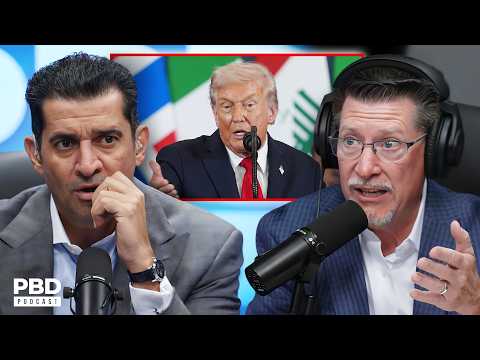
“Trump’s Wall Of Worry” - Iran BLINKS As Ceasefire Reopens Strait of Hormuz
Audio Summary
AI Summary
The discussion revolves around a series of controversial tweets from the president, particularly concerning Iran, and the subsequent reactions and geopolitical implications. The first tweet, posted on Easter, declared "Tuesday will be power plant day, bridge day, all wrapped up in one in Iran. There will be nothing like it. Open the effing straight, you crazy bastards, or you'll be living in hell. Just watch." It concluded with "Praise to Allah. Donald J. Trump."
This tweet sparked widespread reaction, including a viral video from Tucker Carlson. Carlson criticized the president for using profanity on Easter morning and mocking another religion, stating that "no decent person mocks other people's religions." He argued that mocking faith itself undermines the acknowledgment that humans are not in charge of the universe. This led to a debate on social media platforms, with some supporting Carlson and others criticizing him, recalling past instances where he had criticized Islam.
The following day, the president posted another tweet, which many found equally alarming. It stated, "A whole civilization will die tonight. never to be brought back again. I don't want that to happen, but it probably will. However, now that we have complete and total regime change, where different, smarter, and less radicalized minds prevail. Maybe something revolutionally wonderful can happen. Who knows? We will find out tonight one of the most important moments in the long and complex history of the world. 47 years of extortion, corruption, and death will finally end. God bless the great people of Iran." This tweet led to speculation about which civilization the president was referring to.
Subsequently, a ceasefire was announced, based on a conversation between Prime Minister Shabbas Sharif and Federal Marshal Aim Munir of Pakistan. The president's tweet regarding the ceasefire stated that he agreed to suspend bombing and attacks on Iran for two weeks, contingent on the Islamic Republic of Iran agreeing to the "complete immediate and safe opening of the Straight of Hormus." He explained that this "double-sided ceasefire" was possible because all military objectives had been met and exceeded, and a definitive agreement for long-term peace with Iran and in the Middle East was progressing. He mentioned receiving a "10-point proposal from Iran" which he believed was a "workable basis on which to negotiate." He concluded by expressing honor at the impending resolution of this long-term problem.
Minutes after this ceasefire tweet, there were reports of attacks, with Iran allegedly bombing Israel, and Israel retaliating. Jesse Waters retweeted a clip showing sirens wailing over Tel Aviv, indicating an incoming missile and an interceptor in pursuit. This raised questions about the effectiveness of the ceasefire.
Tom offered his perspective, suggesting that the president's actions over Easter weekend were a "Kaiser Sosa moment," a negotiation tactic where one side makes the other believe they are "1% crazier than they are" to make them nervous. He drew a parallel to how the Iranian government reacted to Ronald Reagan's election, believing him to be "bonkers" and willing to use nukes, which helped resolve the hostage crisis. Tom believes the president adopted a hard negotiating position, causing Iran to "blink" and agree to discussions. He also suggested China's involvement, noting their current crude oil deficit and potential role in facilitating the agreement. Tom highlighted the president's contrasting messages – "f you on one hand" and "God bless the people of Iran" – suggesting he wanted Iranian citizens to see the latter message.
Colin agreed, comparing the tactic to the president's "tariff playbook," where he takes extreme, seemingly irrational positions to force the other side to compromise. While acknowledging it might not be the most diplomatic approach, Colin viewed the outcome as positive, considering the initial fear of escalation and "boots on the ground." He noted that the markets seemed to have bottomed out and oil prices peaked a week prior, indicating a broader trend. Crude oil was down $20 (18%), Dow Jones futures were up 2.7%, S&P futures up 2.67%, NASDAQ futures up 3.5%, Gold up 3% ($4,800), Silver up 7.73%, and Bitcoin up to $71,000.
Brandon, however, presented an opposing opinion. While supporting the president, he believed the situation highlighted the US's unpreparedness for a prolonged conflict due to a "hollowed out" manufacturing base and shortages of defense missiles. He agreed with the "Kaiser Sosa" interpretation of the president's actions but felt the outcome was not optimal. Brandon argued that Iran had gained leverage by realizing they could threaten to shut down the Straight of Hormuz, simply by threatening drone strikes on ships, not by physically blockading it. He questioned whether ships would have the courage to pass through, even with a ceasefire.
A poll was sent to the audience asking who won the ceasefire: Iran, the US, or if it was too early to tell. Brandon believed Iran was in a better position due to increased leverage. Tom disagreed, stating that Iran agreeing to a ceasefire meant avoiding further destruction, not a win. He emphasized that the US was asking Iran if *they* had had enough, not the other way around.
Brandon reiterated his point, arguing that Iran had discovered a new leverage point – the ability to threaten global shipping in the Straight of Hormuz – which they didn't have before and which the US couldn't stop by "brute force."
In response, statistics were cited: 92% of Iran's largest vessels destroyed (over 140), Iran's missile drone attack rate down 90% from week one, and a significant death toll for Iran (10,000 killed, including 1,000 civilians and 6-7,000 military personnel in the first 34 days, now 39 days). Additionally, 4 million people were displaced (3.2 million in Iran, 1.2 million in Lebanon).
The question was posed if the two-week ceasefire was just a "timeout" for Iran to strategize with Russia and China. It was mentioned that Pakistan brokered the deal and China made a phone call to encourage Iran to accept. Colin suggested that China was the real winner, as they appeared to be the "adult in the room," strengthening their negotiating position, especially concerning Taiwan. He expressed concern about the long-term geopolitical risk of China moving into Taiwan, which could cause a major global disruption. He concluded by stating that such geopolitical risks usually don't last long politically, especially with upcoming midterms, and that the markets look ahead of these worries.