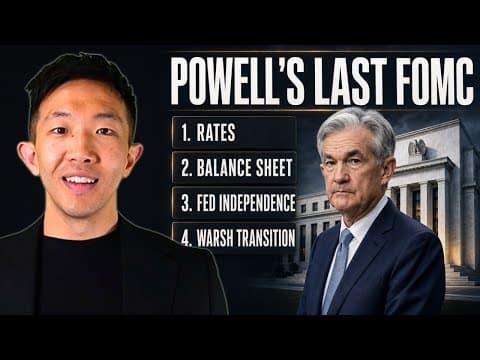
Powell's Last FOMC Summary. 4 Key Takeaways for Investors.
Audio Summary
AI Summary
Jerome Powell delivered his final address as Federal Reserve FOMC chair, summarizing key points from today's FOMC event.
The FOMC decided to keep the policy rate unchanged at 3.75%. This stance is deemed appropriate for achieving maximum employment and 2% inflation goals. Developments in the Middle East introduce significant uncertainty, and the Fed remains attentive to risks to its dual mandate. Market pricing for rate cuts in 2026 remains similar to pre-meeting expectations, with no immediate cuts anticipated.
Powell reiterated that holding rates is necessary due to uncertainties surrounding the Strait of Hormuz closure and potential oil price impacts on core PCE, which is forecasted to rise to 3.2% from 3.0% year-over-year. While inflation is expected to eventually decline, it's too early to cut rates, and hiking is also not immediately considered. Powell emphasized data-driven decisions, avoiding influence on his successor, Kevin Warsh. The probability of a rate hike by year-end slightly increased to 16-17%, but this is not a significant change.
There was no mention of the Fed's balance sheet, quantitative easing (QE), or quantitative tightening (QT), leaving uncertainty about future actions in this area.
A significant portion of Powell's address focused on Fed independence. He stressed that the Fed's independence is sustained by law and custom, establishing clear boundaries between the Fed and political entities like the administration and Treasury. He highlighted the importance of not using monetary tools for goals outside the Fed's mandate, resisting political pressures to repurpose them.
Powell announced he would remain a governor after his term as chair ends on May 15, planning to maintain a low profile but vigilantly overseeing Fed independence. He expressed concern about political pressure, specifically referencing investigations reportedly linked to his resistance to Trump's demands. Powell stated he would speak out if Warsh appeared to yield to political pressure and act as "Trump's puppet," despite Warsh's previous testimonies affirming his independence. Powell's commitment to protecting Fed independence is a hard line, potentially complicating Warsh's ability to cut rates if such decisions are perceived as politically motivated rather than data-driven.
Powell also touched on communication tools, noting that Warsh might consider changes. Warsh is known for preferring a less forward-looking interpretation of inflation and potentially discontinuing the Q&A press conferences, opting for only an initial speech. Powell expressed openness to these changes, provided they align with data-driven decision-making and maintain Fed independence. He confirmed he had not been in close contact with Warsh since January, but congratulated him, indicating a clear path for Warsh to lead as he sees fit, as long as Fed independence is upheld.
Market reactions included high oil prices and inflation. The S&P showed no volatility, while the 10-year Treasury was stable. The two-year Treasury saw a slight increase, suggesting market expectations of fewer rate cuts and a more hawkish outlook, aligning with a neutral, rather than dovish, interpretation of Powell's speech.