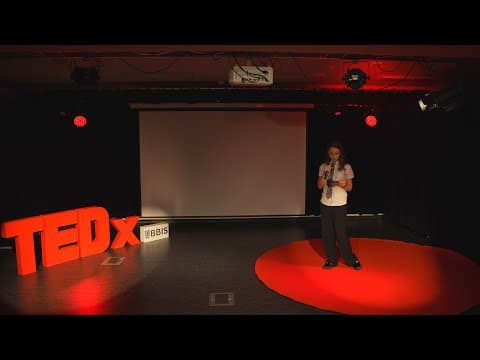
My Problem with Faith | Szonja Rakosi | TEDxBBIS Youth
Audio Summary
AI Summary
The speaker, Sonia, recounts her journey of faith and questioning, beginning with her mother’s simple assertion that God loved her like she did. Growing up in Dubai, surrounded by a predominantly Muslim community, Sonia, though Christian, observed the kindness and warmth of those around her. She questioned why she couldn't belong to their faith, not out of a desire for specific rules, but for the feeling of belonging and warmth.
Upon moving to Germany, Sonia developed a more personal belief in a higher power, though not tied to any specific religion. She actively sought proof, interpreting natural occurrences like shifts in the wind or a sudden sight as divine signs, driven by a deep desire for this belief to be real. However, this faith was marked by uncertainty, as she was not truly comforted by these perceived signs, merely convincing herself of their divine origin.
The narrative then shifts to Budapest, where Sonia experienced intense bullying from fifth to eighth grade. She describes the cruelty as consistent and targeted, impacting her self-esteem regarding her appearance, intelligence, and language skills. In response, she turned to the Christian God, praying and making desperate bargains for the bullying to stop, but saw no change.
This led her to consider Islam, a decision her open-hearted mother supported, even providing her with religious clothing. Sonia saw an opportunity to explore this during a school costume day, intending not to mock but to satisfy her curiosity and longing. However, her attempt was met with hostility; she was called a terrorist, told to go home, and reprimanded by teachers for her costume, while witnessing other students engage in more offensive behavior without consequence.
This experience led Sonia to abandon religion entirely. She candidly admits that this didn't immediately bring peace or freedom, and the bullying persisted. Reflecting on her experiences, Sonia acknowledges that belief in God can indeed provide peace, love, and comfort, and she values the warmth she witnessed in Dubai from people living their faith. However, she strongly asserts that one does not need religion to be a good person. She notes that some of the cruelest experiences came from religious individuals, while some of the kindest came from those who never mentioned God.
Sonia expresses a reluctance to pass on religious belief to children in the same way she received it. While understanding it stems from love, she identifies the "promise" as the problematic element. As a child, she understood the message as "believe hard enough, and it will work." When this didn't happen, she concluded either she hadn't believed enough or wasn't worthy of an answer. This burden, she feels, is too heavy for a child.
She contemplates the possibility that some higher power may not operate on a child's timeline of prayers. While she can accept this possibility, she can no longer accept the certainty and promises that came with her fervent belief. She still wishes her belief had been rewarded, her mother had been right, and her imagined best friend had been real and responsive. This longing persists, but she distinguishes between wishing something is true and knowing it is true, believing children deserve to understand this difference.
Ultimately, Sonia concludes that the most important aspects of life, regardless of religious context, remain consistent: kindness, caring for each other, and trying to do good. These simple principles, she believes, are what truly matter.