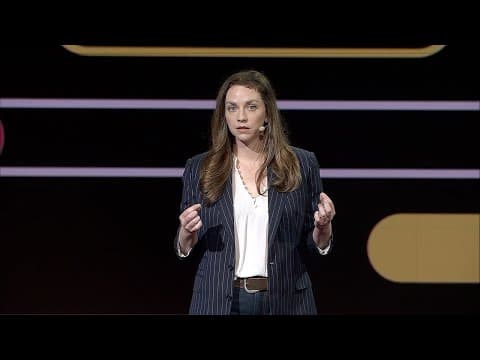
How to talk to the worst parts of yourself | Karen Faith | TEDxKC
Audio Summary
AI Summary
The speaker challenges the common notion that one must love themselves before being able to love others, asserting that she loved everyone else before she learned to love herself. She explains that love is unconditional and welcomes everyone, much like focus group moderators do. This experience with focus groups, where diverse individuals with varying personalities and motivations come together, taught her how to welcome all the "strange and difficult parts" of herself.
She likens her morning meditation to her work as a focus group moderator, starting with the same welcoming phrases: "Thanks, everyone, for being here. Your input is valued. I’m going to hear from each of you. I’ll give you all the chance to speak. Just do your best to be completely present, honest, and try to make any requests reasonable." This highlights her approach to managing internal dialogues, which she describes as having "plenty of quirks" and a "really noisy one."
The speaker identifies with the experience of having conflicting thoughts and feelings, noting that she argues with herself and has multiple "me's" within her – a sentimental one, an intellectual one, one who loves being on stage, and another who is fearful. She acknowledges that it's common to have conflicting emotions simultaneously, such as being excited about a new job while dreading returning to work, or loving someone who has betrayed you. However, she distinguishes these manageable conflicts from more difficult thoughts like feeling worthless, unforgivable, or responsible for bad events. These negative thoughts, she explains, have led many people, including herself, to seek solace in therapy, yoga, or alcohol.
She details her extensive efforts to silence these negative internal voices, trying various forms of therapy, energy healing, body work, hypnotherapy, soul retrieval, tapping, light therapy, and multiple types of yoga, even participating in shamanic rituals. Despite these attempts, she found herself still yelling "Shut up!" at her own mind.
Her career as a people researcher, which began when a supervisor noticed her exceptional ability to capture not just conversations but also body language, micro-expressions, and tonal shifts, was later understood to be a symptom of complex post-traumatic stress stemming from an "appalling upbringing." She shares this not to be exceptional but to create a sense of shared experience, acknowledging that everyone has navigated difficulties to be where they are, and all paths taken are honorable.
Her upbringing, while leaving her with shame and a fragmented sense of self, also gifted her with "super antennas" for the emotions of others, making her a hypervigilant but exceptionally observant person. This led her to spend 20 years shadowing people in various aspects of their lives, asking them to be honest and vulnerable. To achieve this, she developed a practice she calls "unconditional welcome," which goes beyond researcher neutrality.
She recounts an instance where she had to interview an "unpleasant woman" who was feeding an infant french fries and espousing anti-vaccination views while smoking. Despite her initial judgment and dislike, the speaker realized she needed to connect with the woman for her research. Using visualization, she imagined inflating a "shiny soap bubble filled with unconditional welcome" that could contain both of them. This allowed her to see beyond the woman's behavior to her underlying fear and anger, and to understand her strength in building a family. By welcoming the woman unconditionally, the speaker saw her more clearly and felt an instant love for her.
This experience was a turning point, teaching her that love isn't about determining who deserves it, but simply welcoming someone exactly as they are. It took two more years to apply this to all parts of herself. She describes a particularly difficult period where a part of her, afraid, angry, whiny, and relentless, constantly told her they would never get better and wanted to die. Instead of fighting back, she took a deep breath and, acting as her own moderator, said, "Thank you for sharing. I’m going to remind you of our agreement to be honest and reasonable." The voice responded, explaining her pain and her desire to die. The speaker promised to take care of her but required her cooperation. The voice agreed, and they began a dialogue.
As she continued this internal dialogue, she encountered more "voices" with different perspectives, transforming her mind into a focus group-like setting with a moderator maintaining order through honesty, boundaries, kindness, and gratitude. She expresses gratitude to all her "selves," viewing her fragmented self not as broken but as a prism, full-spectrum.
Today, she welcomes every voice in her head, recognizing that even the "whiny, shamey voice" is trying to help. When asked to be clear and kind, these parts reveal their needs and what she can learn, but only when accepted unconditionally.
Her closing remarks to herself differ from her focus group closings. While in focus groups she would handle practical matters like parking validation, with her internal selves, she says, "I love you. Thank you for helping me see what you see." This practice of unconditional welcome, applied to oneself and others, is crucial. She reiterates that love isn't about self-love first; it's about opening the door to welcome anyone, exactly as they are. She encourages the audience to practice this welcome with the person next to them, regardless of their background or flaws. By welcoming others, we may discover parts of ourselves to love. She concludes by stating, "You are welcome."