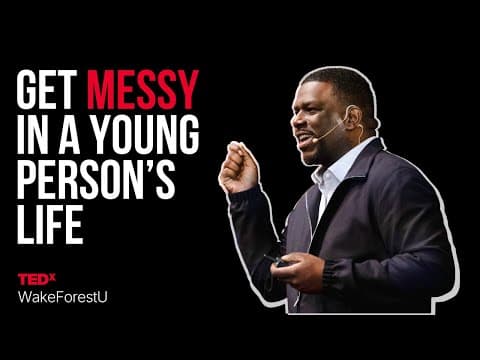
What is Mentorship? Mentorship is Messy | Artis Stevens | TEDxWakeForestU
Audio Summary
AI Summary
The speaker begins by reflecting on the messiness of childhood, recalling how as children, despite our big smiles and energy, we were often "big slobs"—eating messily, leaving things everywhere, falling and getting bruised, and playing in dirt and mud. The constant mission of childhood often seemed to be avoiding the command to "clean your room." However, the speaker posits that this very messiness was formative. Each dropped bite of food led to exploring tastes and building connections. Every bruise taught resilience and grit. Moments in the mud fostered exploration and discovery. Unclean rooms helped shape personal space, identity, and connection to the world.
Crucially, the speaker emphasizes that throughout this messy childhood, we were never alone. There was always someone—a parent, caregiver, or later, a teacher, coach, or friend—who supported, challenged, and protected us. These individuals embody the powerful concept of a "mentor." Mentorship, since the beginning of time, has helped people become more compassionate, capable, and connected, recognizing that being human is inherently a messy experience where we learn not just from successes but from mistakes, imperfections, and vulnerabilities. Therefore, mentorship itself is a messy process, but one that has the power to change lives and the world.
The speaker shares personal experiences to illustrate this. Growing up in a large family in Brunswick, Georgia, without much material wealth, the speaker's parents instilled the value of being "rich in relationships." His mother anchored their community with an "Auntie Network," a system where "your child is my child," fostering a collective approach to raising children. His father, a preacher, responded to the seven-year-old speaker's question about following in his footsteps by saying, "Son, everyone has their ministry in this world. You have to find yours." These words liberated the speaker from generational expectations and empowered him to forge his own path.
This path, however, was not straight or clear; it was messy, filled with bumps and bruises, yet he was never alone. When a football injury derailed his college dreams, leading to depression, his middle school teacher, Mr. Harrington, mentored him, showing him that the skills applied to football could be applied to academics, propelling him to be the first in his family to attend college. In college, despite changing his major multiple times due to indecision, his professor, Dr. Moshi, mentored him, emphasizing that the necessary change was in his heart, belief, and confidence in belonging, leading him to graduate from the University of Georgia.
After graduation, contemplating law school, the speaker took a summer job interview in public housing, initially viewing it as mere practice. There, he met Don McGlamory, who became a lifelong mentor. McGlamory, sensing the speaker's lack of seriousness, took him to a public housing playground, which the speaker recognized from his childhood. McGlamory revealed that the community had become a "mess" and needed someone to change it, stating, "I believe you are that somebody." He urged the speaker to seize the moment to change his community, emphasizing that law school could wait. In that moment, the speaker found his purpose, embarking on a 30-year journey of empowering young people to change the world, a journey consistently supported by mentors.
Now, as the CEO of the largest youth mentoring organization in the country, the speaker sees the immense power of young people—their ambitions, innovation, and energy—but also the messiness, isolation, and division they navigate. His hope lies in the daily mission of connecting thousands of young people with volunteers in "bigs and littles" relationships. These relationships, though sometimes starting awkwardly, evolve through shared interests and active listening, leading to mutual exploration, learning, and empowerment, ultimately forming family-like bonds that last for decades and create generational change.
The "secret sauce" of this century-old magic is simple yet powerful: mentors don't need to be perfect; they just need to be present. Consistent presence in a young person's life leads to them being twice as likely to be healthy, happy, and confident, 20% more likely to attend college, and earning 15% more across their careers, effectively closing economic gaps.
The speaker envisions a future where mentorship is deeply integrated into society: mentors in every school, workplace mentoring programs in every company, and mentorship as a primary solution in mental health, foster care, and juvenile justice systems. He imagines investing in mentorship as a relationship infrastructure across the country, much like roads and bridges, to connect people to opportunities.
In conclusion, the speaker reiterates that life's success often begins with its messiness. Everyone has a "ministry" fueled by mistakes, imperfections, and vulnerabilities, and crucially, by connections to empowering people. He encourages everyone to embrace the "messiness" of mentorship by being present, showing vulnerabilities, rediscovering childhood joy, and "cleaning their rooms" of negativity to inspire young people to do the same, ultimately leading to positive change in their surroundings, communities, country, and the world. He urges listeners to "be a mentor and get messy in a young person's life."