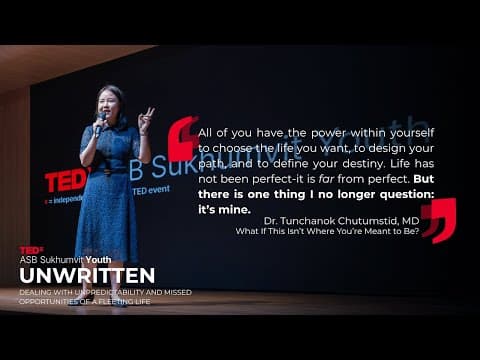
What If This Isn't Where You're Meant to Be? | Dr. Tunchanok Chutumstid MD | TEDxASB Sukhumvit Youth
Audio Summary
AI Summary
The speaker shares her journey from a seemingly successful academic and medical career to pursuing her own business. For a significant part of her life, she believed she was on a path to success, marked by scholarships, good grades, and a clear trajectory toward becoming a medical professor. This path, she admits, was not solely her dream but also a fulfillment of her parents' and society's expectations for a prestigious and stable career.
However, despite achieving these milestones, she felt a profound sense of unhappiness and emptiness. She likens this feeling to the temporary elation of achieving a goal, like completing a marathon, which quickly fades, leaving one to question "what's next?" This internal dissatisfaction stemmed from a long-held desire to build something of her own, to have a business or practice where she could exercise more freedom and grow at her own pace. She felt constrained by the limitations of a large, conservative organization, even though she enjoyed aspects of her work as a faculty member at a public hospital, which involved patient care, research, and teaching. Despite the external markers of success, she felt trapped.
The turning point came during a running event where she reconnected with senior physicians who shared similar aspirations. This encounter ignited a spark, leading to the idea of starting small clinics together. This moment, she describes, was the first time her heart and eyes truly sparkled, giving her goosebumps and a profound sense of purpose.
The process of establishing their business was arduous. They brainstormed, researched, and pitched their ideas to numerous friends, potential partners, and investors, but faced widespread rejection. Eventually, they found their current partner and began the practical steps of setting up a clinic. This involved crucial early decisions, such as naming the company. For this, she turned to ChatGPT, providing prompts for a name that was memorable, not too trendy or old-fashioned, and unique. After generating fifty names, they narrowed it down and used a website that scored names based on feng shui principles, ultimately selecting "Agile Clinic."
Next, they tackled the corporate identity (CI). The speaker admits her initial understanding was limited to colors, favoring green. This led to a humorous situation where she, along with her female partners, spent hours choosing from numerous shades of green, while her male partners struggled to differentiate them. Beyond colors, she was deeply involved in the minutiae of the clinic's aesthetic, handpicking towels, glasses from IKEA, sinks, taps, and even stones, an experience she found simultaneously overwhelming and rewarding for a small business.
The journey continued with negotiations and interviews. Lacking prior experience in negotiation, she found herself in unfamiliar territory, moving beyond the relatively minor negotiations with patients about exercise regimens. With her lawyer, a high school best friend, by her side, she engaged in debates that felt like a real business endeavor, a stark contrast to their high school debate team days. Interviewing staff was also a significant learning experience. As a small business owner, she had to project an image of a tough boss, while internally, she was eager to hire anyone who seemed suitable. This process taught her a great deal about leadership and hiring.
To make their new clinic known, they established a social media presence. The speaker describes the challenge of creating personal branding content, particularly the fear of judgment. Her first video took numerous attempts and days to produce, and she initially posted it with trepidation, later taking it down and reposting it. She realized that the real hurdle wasn't the technical aspect of video creation but overcoming the fear of online judgment. After a year, their social media account had garnered 11.5 thousand followers, and she had learned to accept and move past criticism.
Throughout this entrepreneurial pursuit, she maintained her full-time role as a university hospital faculty member, a demanding schedule that left her feeling drained. She recognized that she couldn't give 100% to both endeavors, leading to internal conflict and unhappiness. She grappled with the decision to leave her prestigious job, fearing the repercussions of business failure, parental disappointment, and the perception of having made a bad choice.
A pivotal conversation with her mentor helped her reframe her perspective. Her mentor pointed out that she was exaggerating the potential glories of her academic career while focusing on the worst-case scenarios for her business. He urged her to consider what *she* truly wanted, not what others expected or what looked good on paper. This led her to a profound question: if she were to die tomorrow, would she regret not pursuing her dreams? The answer was a resounding yes.
This realization empowered her to resign from her job, stepping out of her comfort zone daily. She acknowledged the fear but understood it shouldn't be a deterrent. She relied on her gut feeling, estimating a 60-70% chance of success, coupled with positive business trends. She also realized the importance of calculating her risks and acknowledging her support system, noting that many people underestimate their support, which prevents them from pursuing interesting ventures. She humorously mentions that her ultimate safety net was the thought of returning to her parents' home for a simple meal and a warm bed.
Life in the business has been a "roller coaster," filled with challenges she now calls "challenging challenges," lessons not taught in medical school. She recounts incidents like a flooded clinic floor due to a broken tap and locked doors with equipment inside, forcing her to break in. These adversities, however, have fueled her drive to persevere, improve, and grow with her team.
She concludes by reflecting that life isn't perfect, but she no longer questions its value because it is hers. She then poses a question to the audience, asking if they've ever felt stuck or chosen a path based on external validation. She emphasizes that everyone possesses the power to design their own life, define their destiny, and that often, all it takes is the courage to ask, "What if this isn't my life?"