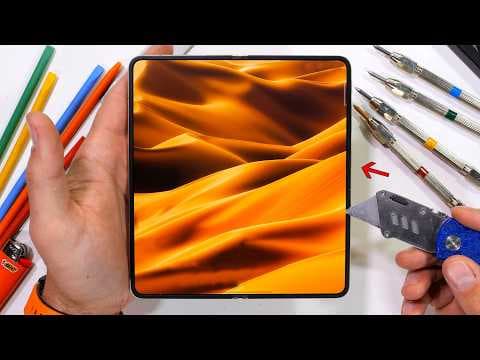
They said it was Glass...
Audio Summary
AI Summary
The Oppo Find N6 folding phone is presented as a pinnacle of design, featuring a nearly non-existent center crease. The device comes with an 80W charger, a SIM card tool, and a protective case. Surprisingly thin, the Find N6, even with its 6.6-inch front screen and large 8.1-inch inner screen, has a smaller footprint than a cased Galaxy S26 Ultra.
Oppo achieved the minimal crease by incorporating a thicker "auto smoothing flex glass" for the center screen. Despite the name, this screen still scratches at level two, similar to other flexible screens, with deeper grooves at a fingernail level. This highlights that while marketing terms can change, the inherent softness of flexible screens due to physics remains. The front 6.6-inch nano-crystal glass screen has a removable plastic covering, revealing actual glass underneath that scratches at level six, with deeper grooves at level seven. The exterior 20-megapixel front-facing camera is protected by this glass, situated below a thin earpiece slit. The interior 20-megapixel selfie camera, however, has a plastic overlay. When folded, the soft inner screen is protected.
The phone's sides are aluminum, housing the power button, volume rocker, and a dedicated AI button. The top features a loudspeaker and double microphones. The spine of the Find N6 is crafted from grade 5 titanium, which is about twice as strong as aluminum, a difference that can be audibly distinguished when tapping the two metals. The bottom includes a lower stereo loudspeaker, an 80W USB-C 3.1 port, and a SIM card tray with a red rubber ring, contributing to its IP56, IP58, and IP59 water and dust resistance ratings.
The back panel, in "blossom orange," is made of plastic rather than glass, a choice that allows for a thinner, more durable panel that still supports wireless charging. The large camera module features a 50-megapixel periscope telephoto lens, a 50-megapixel ultrawide lens, and a 200-megapixel main camera, alongside a color calibration sensor. A significant drawback mentioned is that the Find N6 is not available for sale in the USA or Europe, only in other regions.
Regarding durability, the Find N6 has an IP5 dust resistance rating, meaning minor dust ingress can occur without causing malfunctions. During a bend test from the closed position, the phone exhibits a surprising amount of flex, with the back plastic panel lifting slightly without catastrophic damage. Bending it backward when open causes the soft screen to wrinkle under pressure, but the device remains intact, demonstrating the impressive durability attributed to the titanium spine and Oppo's design.
Upon disassembly, the watertight plastic border around the flexible screen was carefully removed. An accidental poke to the screen's edge with a knife caused immediate damage, highlighting the fragility of the flexible display. The flexible screen itself is supported by a metal plate and can only be bent in one direction at a time to prevent cracking. Oppo's "auto smoothing flex glass," similar to Samsung's ultra-thin glass, is present underneath the top plastic layer. This glass layer is stated to be 50% thicker than Samsung's, contributing to the reduced crease visibility. The glass exhibits remarkable stress tolerance and bend radius before failing. Oppo rates the phone for a million regular folding motions. Replacing the screen requires opening the back panel to access the internal connection.
The "Zero Field Titanium Flexion hinge" is a key innovation. Removing a strip over the hinge gears reveals a blue photopolymer 3D-printed layer. This 3D printing enhances hinge flatness by 75%, reducing surface height variations to just 0.005 mm, approximately the width of a human hair. The resin is even cured into screw holes to further flatten surfaces. The hinge design features a high point in the middle, and the blue resin raises the sides to match this midpoint, effectively flattening the crease.
The "Blossom Orange" back panel, confirmed to be plastic despite common misconceptions, is secured with significant watertight adhesive. Similarly, the front screen is heavily adhered, making folding phones like this challenging to repair.
Internal components include two silicon carbon batteries: a larger 3,225 mAh unit and a smaller 2,775 mAh unit, totaling 6,000 mAh. The 50W wireless charger has oddly shaped coils. The upper and lower stereo speakers, despite their thinness, contain internal components referred to as "balls." The 80W USB-C 3.1 charging port, featuring a red rubber ring, uses the aluminum frame as its housing to reduce thickness. The motherboard houses the cameras: a 50-megapixel ultrawide without OIS, a 50-megapixel 3x telephoto with internal optical image stabilization, and a 200-megapixel main camera also with OIS.