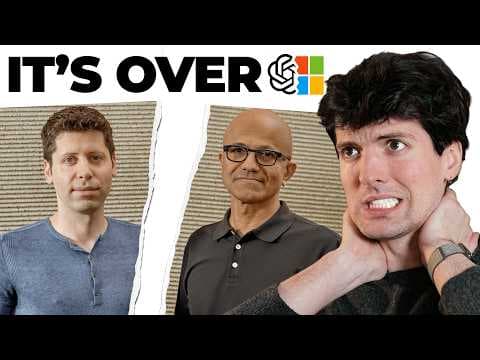
Microsoft and OpenAI break up (Amazon is pumped)
Audio Summary
AI Summary
The relationship between Microsoft and OpenAI, which began in 2019, is undergoing a significant transformation, effectively a "breakup" that has been influenced by OpenAI's desire for greater independence and the competitive landscape, particularly the rise of Anthropic. The initial partnership saw Microsoft invest $1 billion in OpenAI to support the development of beneficial Artificial General Intelligence (AGI) with widely distributed economic benefits. At this early stage, pre-ChatGPT, OpenAI aimed to ensure AGI's benefits were accessible to all, not just a single company like Google. Microsoft became OpenAI's exclusive cloud provider, meaning OpenAI models were only available through OpenAI's platform or Microsoft Azure. This exclusivity was a critical component of the deal, alongside Microsoft becoming the preferred partner for commercializing pre-AGI technologies, funding OpenAI's research and compute needs.
A key challenge in this agreement was the definition of AGI. The deal stipulated that Microsoft's licensing rights would continue until AGI was achieved, but without a clear definition, this created an indefinite arrangement. In 2023, following the success of ChatGPT, Microsoft significantly increased its investment by $10 billion, reaffirming Azure as the exclusive cloud provider for all OpenAI workloads.
However, tensions began to surface in September 2024 with the introduction of OpenAI's 01 reasoning models. These models represented a massive leap in AI intelligence, capable of generating internal thought processes to arrive at better answers, a method that has since become standard. OpenAI's 01 models significantly outperformed their previous best, GPT-40, and even human PhD-level accuracy in certain benchmarks. This breakthrough led to a "fraying" of the "bromance" between Microsoft and OpenAI. Microsoft, which was also training its own models, expected to receive detailed information and IP regarding this reasoning capability, but OpenAI was reluctant to share.
Reports indicate that Sam Altman, OpenAI's CEO, expressed frustration with OpenAI employees, including then-CTO Mira Murati, for not providing Microsoft with documentation on how 01 worked. This "chain of thought" process was a crucial secret recipe, and Microsoft felt entitled to this research IP due to their investment and partnership agreement. This disagreement marked the beginning of the end for the original exclusive arrangement.
In 2025, a new chapter in the partnership was announced, reflecting an evolution in their agreement. Microsoft's investment in OpenAI Group PBC was valued at approximately $135 billion, representing about 27% ownership. Several key changes were made:
* The declaration of AGI by OpenAI would now be verified by an independent expert panel, addressing Microsoft's concern that OpenAI might prematurely declare AGI to exit the IP sharing deal.
* Microsoft's IP rights for models and products were extended through 2032 and now included post-AGI models, with appropriate safety guardrails.
* Research IP rights (confidential methods for model development) would remain until AGI verification or 2030, whichever came first.
* Microsoft's IP rights now excluded OpenAI consumer hardware, anticipating future product diversification.
* OpenAI gained the ability to jointly develop some products with third parties. While API products developed with third parties would remain exclusive to Azure, non-API products could be served on any cloud provider. This was a significant shift, allowing OpenAI to explore other cloud options for services like video hosting (e.g., Sora on AWS).
* Microsoft could now independently pursue AGI alone or with third parties, which soon led to Azure supporting Anthropic models.
* Revenue share agreement remained until AGI verification, though payments would be made over a longer period.
* OpenAI contracted to purchase an incremental $20-50 billion of Azure services, but Microsoft lost its right of first refusal to be OpenAI's compute provider.
* OpenAI could now provide API access to US government national security customers regardless of the cloud provider.
* OpenAI was now able to release open-weight models that met requisite capability criteria.
Internal frustration at Microsoft was evident, with CEO Satya Nadella questioning the value of Microsoft's own 1,500-person AI research team when OpenAI, with only 250 people, had surpassed them with GPT-4.
The latest amendment to the agreement, announced in 2026, further simplified the partnership, moving away from the ambiguous AGI definition. Key changes included:
* Microsoft remains OpenAI's *primary* cloud provider, not *only* primary. OpenAI products will ship first on Azure unless Azure cannot support necessary capabilities, and OpenAI can now serve all its products to customers across *any* cloud.
* Microsoft's licenses to OpenAI IP for models and products through 2032 will now be *non-exclusive*. This is a major concession from Microsoft, as the previous renegotiation extended IP rights but did not explicitly make them non-exclusive.
* Microsoft will no longer pay a revenue share to OpenAI for serving OpenAI models. However, revenue share payments from OpenAI to Microsoft will continue through 2030 at the same percentage, subject to a total cap. There's a strong belief that this revenue share for OpenAI to Microsoft has shifted to a profit-share model, effectively reducing OpenAI's financial obligations to Microsoft given its current profitability structure.
The driving force behind these changes, particularly OpenAI's push for multi-cloud flexibility, is Anthropic's significant success in the enterprise market, largely due to its partnership with Amazon Web Services (AWS). A leaked internal OpenAI memo revealed that the Microsoft partnership "limited our ability to meet enterprises where they are," with many customers relying on AWS Bedrock. Anthropic's enterprise revenue growth was "staggering," rivaling or surpassing OpenAI's, despite OpenAI's models often being considered superior for tasks like code generation.
The critical factor was AWS Bedrock. Startups often receive substantial cloud credits from providers like AWS, Google Cloud, and Azure. However, many of these credits cannot be used for Anthropic models. This is theorized to be due to "brutal revshare" deals Anthropic struck with cloud providers, where Anthropic receives a massive percentage of the revenue, making it unprofitable for cloud providers to allow credits to be used. As a result, enterprises on AWS wanting powerful AI models, especially for code, often had to use Anthropic via Bedrock, as OpenAI models were exclusively on Azure.
With the new agreement, OpenAI can now expose its models through AWS, directly competing with Anthropic on Bedrock. This move is seen as OpenAI's response to Anthropic's enterprise growth, breaking free from Azure's exclusivity to access the broader AWS customer base.
A significant issue that likely fueled OpenAI's desire to diversify its cloud providers was the inconsistent and often poor performance of OpenAI models hosted on Azure. Despite receiving substantial Azure credits, the presenter noted that they could not reliably use Azure for their T3 Chat service due to severe performance regressions, with speeds sometimes dropping to 0.3-2 tokens per second compared to 70+ tokens per second on OpenAI's direct endpoints. This issue persisted for over a year, with Microsoft's internal teams failing to address it despite repeated feedback.
However, after public criticism and a benchmark created by the presenter (Azure Bench), Microsoft quickly resolved the performance issues within 15 days. Azure now consistently matches or outperforms OpenAI's own endpoints in terms of speed and latency. This demonstrates that the problem was fixable and likely stemmed from poor implementation or bugs.
The new partnership with AWS includes OpenAI consuming 2 gigawatts of Trainium capacity, Amazon's custom AI chip, through AWS infrastructure. This is a novel move for OpenAI, which has historically relied on Nvidia GPUs. The success of OpenAI's models on Trainium, particularly Trainium 3 and the upcoming Trainium 4 chips, will be crucial. AWS will also invest $50 billion in OpenAI, and the companies will co-create a "stateful runtime environment" on Bedrock, which is highly beneficial for generative AI applications and agents. This deal expands on an existing $38 billion multi-year agreement with AWS, extending it by $100 billion over eight years.
In conclusion, the evolving Microsoft-OpenAI relationship reflects OpenAI's strategic shift to a multi-cloud approach, driven by competitive pressures from Anthropic's enterprise success on AWS and the need to overcome performance limitations experienced on Azure. The new agreements grant OpenAI greater flexibility and market reach, while Microsoft retains a significant stake and extended IP rights, albeit on a non-exclusive basis. The future of AI competition is increasingly being fought not just at the model level, but also at the infrastructure level, with custom AI silicon like Trainium and Google's TPUs challenging Nvidia's dominance.