AI Is Destroying Every Moat Except Bitcoin | Jordi Visser
AI Summary
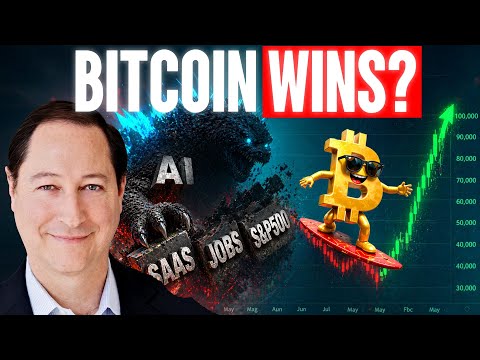
Jordy Vir, a market analyst, holds a bullish outlook on Bitcoin, believing it has already bottomed and that the "crypto winter" will be mild. His central thesis revolves around inflation and Artificial Intelligence (AI) driving investors towards a "scarcity portfolio," which he is actively front-running. He argues that the next time Bitcoin breaks higher, its ascent will be sustained, unlike previous cycles.
Vir posits that current secular market trends, particularly the disruptive force of AI, inevitably lead to a greater appreciation for Bitcoin and other scarce assets. He highlights the merging of the digital economy with traditional finance and the industrial economy, a process that has been ongoing since the Manhattan Project. While the fiat system's market cap is approximately $750 trillion, Bitcoin's is still under $2 trillion, suggesting significant potential for re-weighting. He points out that current economic growth is driven by semiconductors, AI, and robotics, areas that are less labor-intensive than traditional industries. This shift exacerbates a wealth distribution problem that has been developing since the advent of the personal computer.
AI, in Vir's view, accelerates this process by disrupting the human brain's advantage over technology, and eventually, human physical labor with the rise of humanoids. This labor-versus-capital issue, which he believes contributed to the initial concept of decentralized digital currency, is why AI makes Bitcoin's rise an "inevitability," not just a forecast. He likens Bitcoin's established moat to that of gold and religion, chosen by people as enduring stores of value.
He elaborates on the "AI trade" and its connection to Bitcoin, arguing that AI will disrupt every traditional store of value. From artwork authenticity to the value of jobs, AI's rapid progress will blur the lines between real and fake, and erode the value of anything that isn't truly scarce. He emphasizes that the world is changing so fast that people don't fully grasp the speed of AI's advancement. This disruption, he believes, will lead people to question the value of their possessions and seek true scarcity. Unlike those who solely champion gold, Vir sees a broader range of store-of-value assets, including real estate and the S&P 500, but believes these will ultimately be eroded by AI.
Vir contends that AI is leading to the "destruction of abundance," particularly for anything created on code in the digital economy. Software-as-a-Service (SaaS) companies, once thought to have strong moats, are seeing their profits rapidly eroded as AI can quickly replicate and even surpass their offerings. He views this "SaaS apocalypse" as a destruction of terminal value, where the future discounted cash flows of these companies are severely impacted by the speed of AI development. This, he argues, is analogous to the "quantum risk" often cited against Bitcoin; both make people question the future value of an asset. The disruption to SaaS also impacts the private credit world, which has significant exposure to these companies, demonstrating how AI is a disruptive force to the entire fiat system.
Addressing the skepticism about such a radical market shift, Vir acknowledges the uncertainty but points to the undeniable and rapid advancements in AI since ChatGPT's launch three and a half years ago. He emphasizes the need to focus on data and observable trends, rather than speculative arguments. He also believes that the fear of "quantum" computing has had a larger, though often unacknowledged, impact on Bitcoin's price than understood by the crypto community. This fear acts as an overhang, preventing traditional money from fully embracing Bitcoin, as they have other seemingly safe and high-return investments like semiconductor stocks and the "Mag 7." However, he believes this will change as AI consumes everything, forcing a shift. He contrasts this with "mythos" (a new hacking tool), which he describes as a massive, real disruption to the traditional fiat system, yet generates less panic than theoretical quantum threats to Bitcoin.
Vir paints a future where AI leads to widespread deflation, as technology inherently drives down costs. He envisions a world in 15 years where many goods and services are "somewhat free," even in the physical world with humanoids. This deflationary pressure, however, coexists with inflationary pressures from underinvestment in physical infrastructure needed for AI. He describes AI as the "new QE" (Quantitative Easing) because it allows companies to achieve growth by replacing human labor with bots, effectively cutting costs. This, he argues, will prevent large companies from increasing their employee counts, and instead lead to reductions.
The current challenge, he notes, is a compute shortage, where the adoption of AI is outstripping the supply of data centers and computing power. This could temporarily pressure corporate margins if AI costs rise or earnings growth slows. Vir explains that while AI is deflationary for labor and software, there are inflationary forces from government spending, energy prices, and the need for physical components like copper and silver to build AI infrastructure. He believes that in the short run, the underinvestment in physical capacity will lead to higher inflation, potentially exceeding 4% year-over-year soon. Ultimately, deflation will win, but not before a period of inflation driven by the demand for physical resources.
Regarding stocks, Vir believes the market is already discounting AI's disruption. While the S&P 500's performance this year has been driven by semiconductors, many other sectors, including financials and software, have struggled. He predicts that in 10 years, the S&P 500 might be at similar levels, even as the economy doubles. This excess value creation, he argues, will flow not to traditional corporations but to "super entrepreneurs" and small businesses leveraging AI in a decentralized world. He believes public companies, with their rigid cost structures and resistance to rapid change, are ill-suited for a deflationary environment.
He dismisses the term "bubble" for AI, drawing a parallel to Bitcoin's multiple "bubbles" followed by new all-time highs, suggesting these are periods of "rolling speculation" or "episodic moves." He sees a future with more volatile, sharp upswings and downswings across various assets, requiring investors to recognize this as the new market dynamic.
Vir also discusses the "Bitcoin IPO" concept, referring to the recent period where early Bitcoin holders (OGs) distributed their holdings, similar to employees selling shares after a company's IPO. This distribution, he argues, makes sense for those who have seen massive gains and have other investment opportunities or want to diversify against quantum risk. He sees this as a necessary step to reduce Bitcoin's concentration among early holders.
He highlights a key difference in the most recent Bitcoin cycle: unlike previous cycles, altcoins did not reach new highs. This, he believes, indicates a more mature market, akin to the post-dot-com bubble era where truly resilient companies emerged. He notes a shift in the crypto community, with fewer individuals driven by "get rich quick" schemes and more long-term commitment. He also sees a coming "regulatory tailwind" for the industry.
Vir believes Bitcoin's volatility has decreased, making it more attractive to institutional investors and wealth managers who can now incorporate it into their diversified portfolios. He anticipates that as traditional assets underperform, wealth managers will increase their Bitcoin allocations. He also emphasizes Bitcoin's global role, citing countries like Iran accepting it for oil, and its potential as a safe haven during global inflationary pressures and currency instability in emerging markets.
His current portfolio is heavily weighted towards "scarcity assets" related to AI infrastructure: memory stocks (Micron, Pure Storage, Marvell), lithium (ALB, LAC), silver miners, and companies involved in chip design (Nvidia, Cadence, Synopsys). He advocates for investing in anything that supports the power and computing needs of the "agentic world" driven by AI. He encourages listeners to analyze Nvidia CEO Jensen Huang's transcripts for investment insights. He firmly believes in divesting from "abundant" assets (like software built on code) and investing in "scarce" assets.
Regarding the debate between Jensen Huang and Dwarakesh on selling advanced chips to China, Vir aligns with Huang, advocating for a position of strength and global competition rather than fear-driven export controls. He believes China will inevitably catch up in AI capabilities, making it crucial for the US to maintain its lead through innovation and widespread adoption of its technology.
Finally, Vir shares his personal AI stack, which includes OpenClaw, Claude, Perplexity, Gemini, ChatGPT, and Grok, all used daily for research, content creation, and quality control, demonstrating the immense productivity gains possible with AI assistance.